




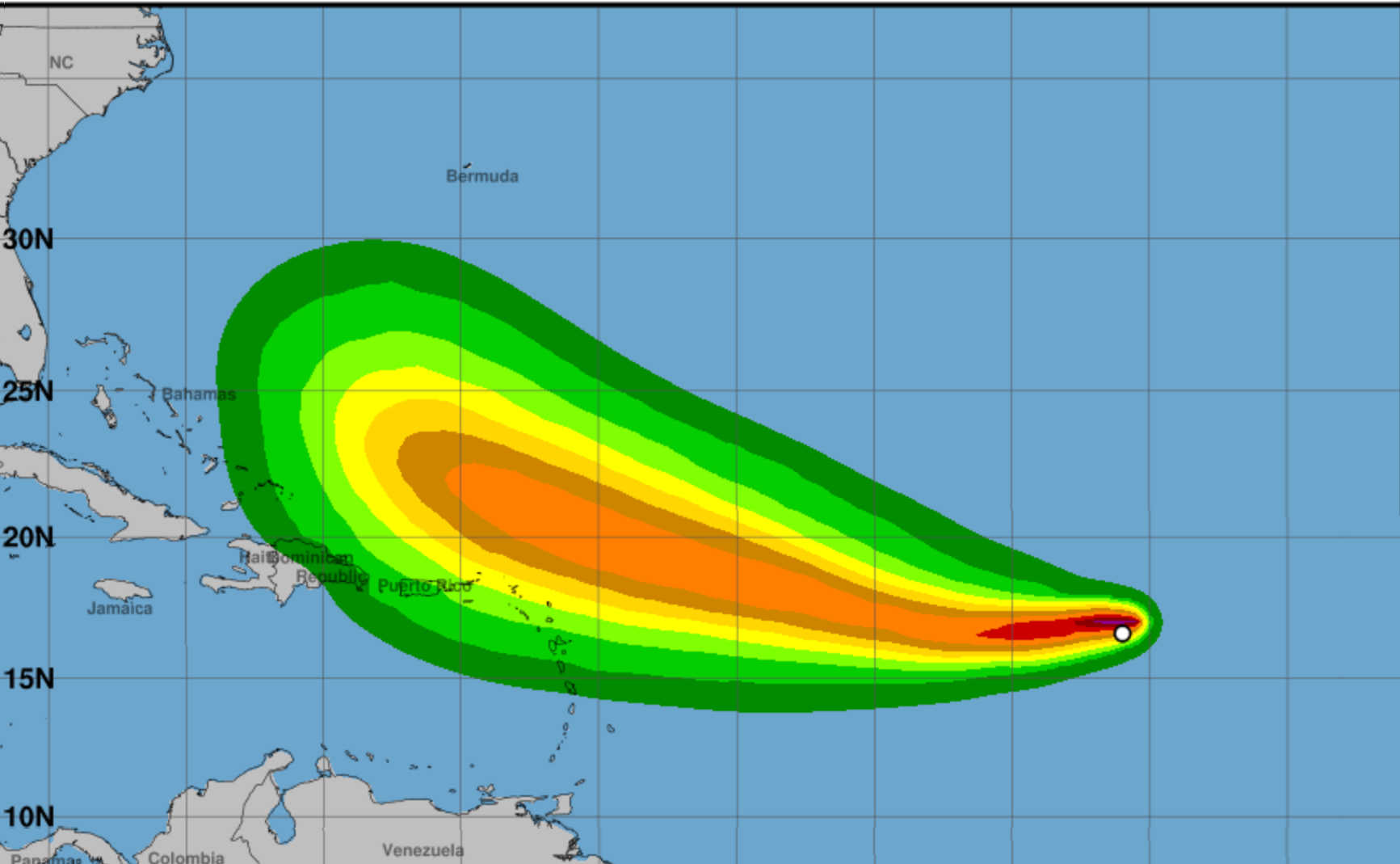
The National Hurricane Center (NHC) continued to monitor Tropical Storm Erin on Wednesday morning. At 5:00 AM the storm’s center was located near 16.5°N 41.9°W, about 1400 miles (2255 km) east of the northern Leeward Islands. Maximum sustained winds were 45 mph (75 km/h) and the system was moving west at 20 mph (31 km/h). Minimum central pressure was 1004 mb. Weather Underground’s hurricane tracker listed identical values for location, movement, wind speed and pressure in its 9 AM UTC update.

Key messages from the NHC
-
No watches or warnings yet, but interests in the northern Leeward Islands, U.S. Virgin Islands and Puerto Rico should monitor the storm. Erin is expected to continue west today and begin a turn toward the west‑northwest by Thursday night. On this track, the storm’s center is likely to move near or just north of the northern Leeward Islands over the weekend. Tropical‑storm‑force winds currently extend about 60 miles (95 km) from the center.
-
Strengthening into a hurricane is forecast within 48 hours. Erin has struggled to organize due to marginal sea‑surface temperatures and dry air, but forecasters expect the environment to become more conducive as the storm moves into warmer waters. The official intensity forecast calls for Erin to become a hurricane by late Thursday or early Friday.
-
Track guidance shows a west‑northwest turn near 65°W. The storm is currently moving west under a strong ridge. A weakness in the ridge near 65°W should cause Erin to turn west‑northwest and slow down later this week. The NHC notes that track models are in fairly good agreement and its forecast lies on the southern side of the model suite, but future adjustments are possible.
-
Potential impacts to the northern Leeward Islands, U.S. Virgin Islands and Puerto Rico remain uncertain. Erin could move close enough to produce some impacts, yet the magnitude of those impacts is not yet known. As the storm passes north of the islands, swells are expected to begin affecting the northern Leeward Islands, Virgin Islands and Puerto Rico by this weekend, creating life‑threatening surf and rip currents.
Forecast positions and intensities
The NHC’s official forecast projects steady strengthening over the next five days:

-
Today (Wednesday): Erin continues west with winds around 45 mph.
-
12 hours (13/18 UTC): center near 16.4°N 44.1°W, winds 50 mph.
-
24 hours (14/06 UTC): 16.5°N 47.1°W, winds 60 mph.
-
36 hours (14/18 UTC): 17.0°N 50.0°W, winds 65 mph.
-
48 hours (15/06 UTC): 17.8°N 52.9°W, winds 75 mph (Category 1 hurricane).
-
60 hours (15/18 UTC): 18.6°N 55.8°W, winds 85 mph.
-
72 hours (16/06 UTC): 19.5°N 58.7°W, winds 100 mph (Category 2 hurricane).
-
96 hours (17/06 UTC): 21.3°N 63.5°W, winds 115 mph (Category 3 hurricane).
-
120 hours (18/06 UTC): 23.4°N 66.8°W, winds 115 mph. By this time the storm is expected to be north of the Leeward Islands, moving into open Atlantic waters.
European model perspective
While the NHC’s forecast is the official track, global models help forecasters gauge uncertainty. The NHC notes that track guidance is in fairly good agreement with a west‑northwest turn later this week. European model ensembles (ECMWF) generally support a northward recurvature, keeping the storm north of the Caribbean islands. However, intensity plays a role – a stronger storm is more likely to turn north, whereas a weaker storm could track farther west before recurving. As of Wednesday, model consensus leans toward the northward solution, but residents should continue to monitor official forecasts given the typical 4–5‑day track errors.
Impacts and outlook for the U.S. Virgin Islands and Puerto Rico
Weather today and tomorrow (13–14 Aug)
The local weather across the U.S. Virgin Islands and Puerto Rico remains dominated by strong easterly trade winds and Saharan dust haze, with only isolated showers. National Weather Service forecasts for St. Thomas and St. John call for highs around the lower 90s °F (32–34 °C) with east winds 10–15 mph (gusts to 20 mph) and a 50 % chance of scattered showers. St. Croix will be similar, with highs near 94 °F and east winds 15–20 mph, but only a slight (10–20 %) chance of rain. Marine forecasts warn of seas 4–6 ft and frequent trade‑wind gusts, so small craft should exercise caution. The Saharan dust keeps the UV index extreme; residents should use sun protection.
Weekend impacts
As Erin draws nearer, swells generated by the strengthening storm will increase surf heights and rip‑current risk along north‑ and east‑facing beaches in the Virgin Islands and Puerto Rico. The NHC warns that these swells will begin by this weekend and may be life‑threatening. Depending on Erin’s exact track, outer rain bands and gusty squalls could brush the northern Leeward Islands late Saturday into Sunday. If the storm passes to the north as forecast, the islands would mainly experience dangerous surf and rip currents; a track farther south could bring tropical‑storm‑force winds and heavy rain. Residents should review hurricane preparedness plans and stay informed.

3‑day and 7‑day outlook
-
Through Friday (3‑day) – Erin strengthens and turns west‑northwest while still well east of the Caribbean. Local conditions remain breezy and hazy with isolated showers. Expect increasing sea swells late Friday and Saturday.
-
Saturday to Monday (3–5 days) – The storm’s center passes near or north of the northern Leeward Islands. Impacts in the U.S. Virgin Islands and Puerto Rico will depend on the storm’s distance: most likely high surf, rip currents, and occasional outer rain bands. If the storm tracks closer, tropical‑storm‑force winds and heavier rain could affect the islands.
-
Next week (5–7 days) – Current forecasts take Erin northwest into the open Atlantic between Bermuda and the Bahamas. For the Virgin Islands and Puerto Rico, the main concerns should subside after Monday, though residual swell may persist. It is too early to determine impacts for the U.S. East Coast or Bermuda.