



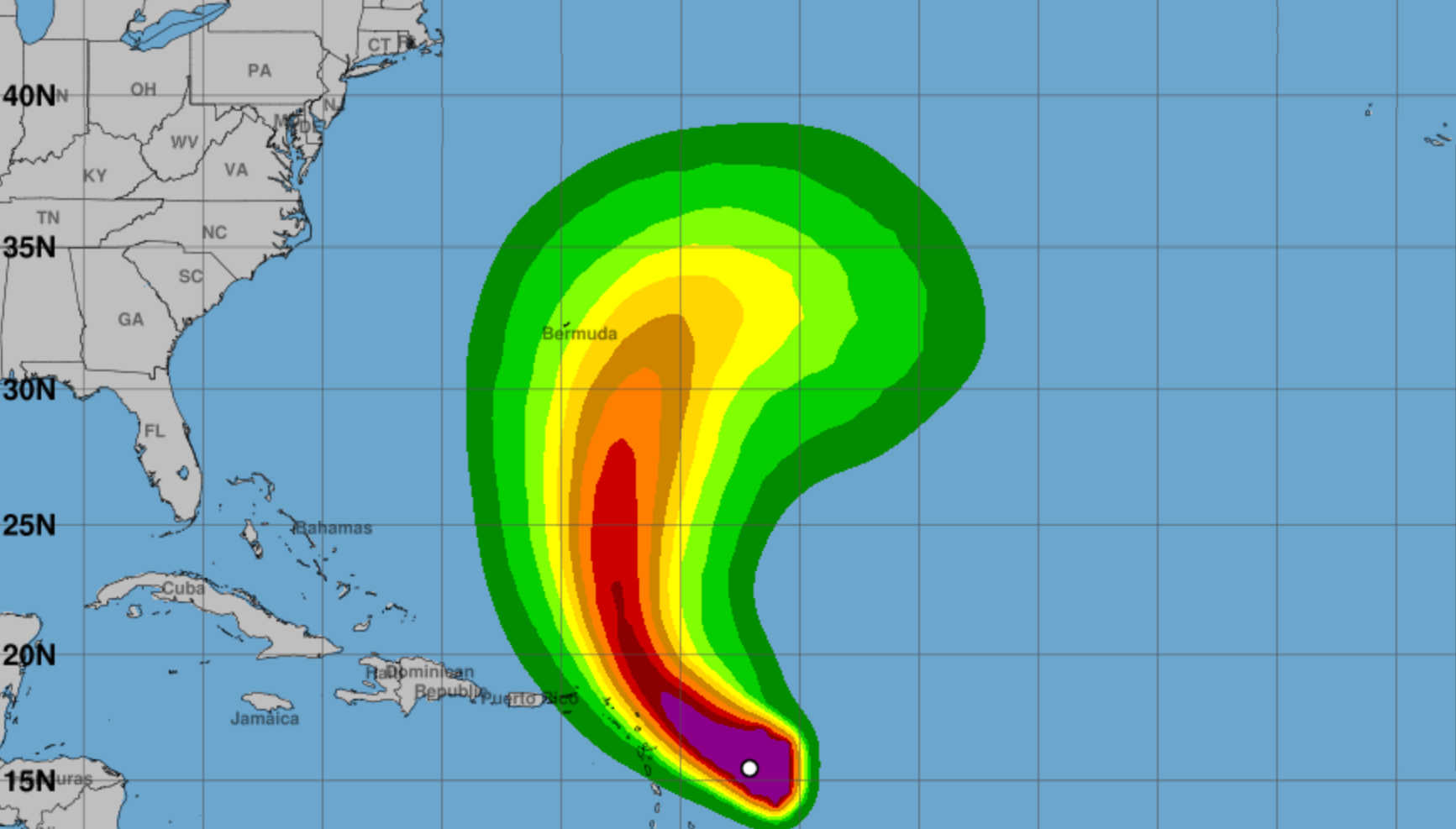
Tropical Storm Jerry has gained strength in the Atlantic and is now tracking west-northwest toward the northern Leeward Islands, bringing with it the potential for heavy rain, gusty winds, and hazardous marine conditions across the northeastern Caribbean.

According to the National Hurricane Center’s (NHC) 5 a.m. advisory, the storm’s center was located near latitude 15.7° N and longitude 57.7° W, approximately 470 miles southeast of St. Croix, with maximum sustained winds of 65 mph and a minimum central pressure of 999 mb. Jerry is moving west-northwest at 20 mph.
Structure and Current Conditions
Forecasters describe Jerry as a sheared tropical storm, with its low-level center displaced on the northwestern edge of its main thunderstorm activity. Deep convection remains concentrated on the storm’s eastern and southeastern sides, where the strongest winds are occurring. Winds to the west of the center are significantly weaker, reflecting the storm’s uneven structure.

The NHC notes that this asymmetry will influence impacts on nearby islands, limiting the spread of sustained tropical-storm-force winds. The strongest winds are expected to remain east of the center, largely over open waters.
Forecast Track and Intensity
Jerry is expected to begin turning northwest later today as it curves around the southwestern edge of a subtropical high-pressure ridge. Forecast models bring the storm’s center just northeast of the northern Leeward Islands later today and tonight. While the track has shifted slightly closer to land, forecasters maintain that the risk of sustained tropical-storm-force winds over the islands remains low.
By Friday night, a developing trough over the western Atlantic is expected to steer Jerry northward, moving the system away from the Caribbean and keeping it well southeast of Bermuda by Sunday.
Despite moderate wind shear currently limiting development, Jerry is forecast to reach hurricane strength by Friday or Saturday as environmental conditions become more favorable. The official NHC forecast projects gradual intensification to near 85 mph winds over the weekend before weakening early next week as the system encounters cooler waters.
Model consensus remains split: the HAFS hurricane models predict major hurricane development, while the GFS and Google DeepMind models suggest only modest strengthening. The NHC’s forecast takes a middle ground.
Advisories and Key Messages
Tropical storm watches remain in effect for parts of the northern Leeward Islands.
Heavy rainfall is expected across the Leeward Islands, the British Virgin Islands, and the U.S. Virgin Islands through Friday, raising the risk of flash flooding in urban and mountainous areas.
Swells generated by Jerry will create dangerous surf and rip currents along northern and eastern beaches of Puerto Rico, Culebra, Vieques, and the U.S. Virgin Islands.
Local Weather and Marine Impacts
The National Weather Service (NWS) San Juan Office reported that scattered showers and thunderstorms will develop across Puerto Rico’s interior, northern, and western areas this afternoon, while isolated convection may occur across the Virgin Islands.
A Heat Advisory remains in effect from 10 a.m. to 4 p.m. AST for coastal and urban areas of Puerto Rico, Vieques, Culebra, and the U.S. Virgin Islands, with heat indices reaching dangerous levels. Residents are advised to limit outdoor activities and stay hydrated.
Jerry’s proximity will begin influencing local seas by tonight. Swells are forecast to reach the region’s waters, building seas to 8–9 feet and creating a high risk of rip currents through the weekend. A Small Craft Advisory is in effect for offshore Atlantic waters and the Anegada Passage.
Friday and Weekend Outlook
Conditions are expected to deteriorate late Thursday night into Friday as outer rainbands move across the northeastern Caribbean. Gusty winds, rough seas, and locally heavy rainfall are likely in the U.S. Virgin Islands, with a moderate to high potential for flash flooding in saturated or low-lying areas.
Forecasters expect trailing moisture from Jerry to maintain unsettled weather into early next week. Precipitable water values above two inches suggest that showers and thunderstorms could persist across Puerto Rico and the Virgin Islands even after the storm moves north.
Swells will remain elevated, generating breaking waves of six to seven feet along exposed coasts. Marine and beach conditions are expected to gradually improve by early next week as high pressure rebuilds behind Jerry.
Preparedness and Safety Guidance
Emergency officials urge residents to stay informed through official updates from the NHC and NWS, as Jerry’s track and strength could change in the coming hours.
Flood safety: Clear drains, avoid flooded roads, and move to higher ground if flood warnings are issued.
Heat precautions: Stay hydrated, avoid strenuous outdoor activity, and check on vulnerable individuals.

Marine hazards: Mariners should secure vessels and avoid travel in rough seas. Beachgoers are advised to stay out of the water at high-risk beaches and follow lifeguard instructions.