

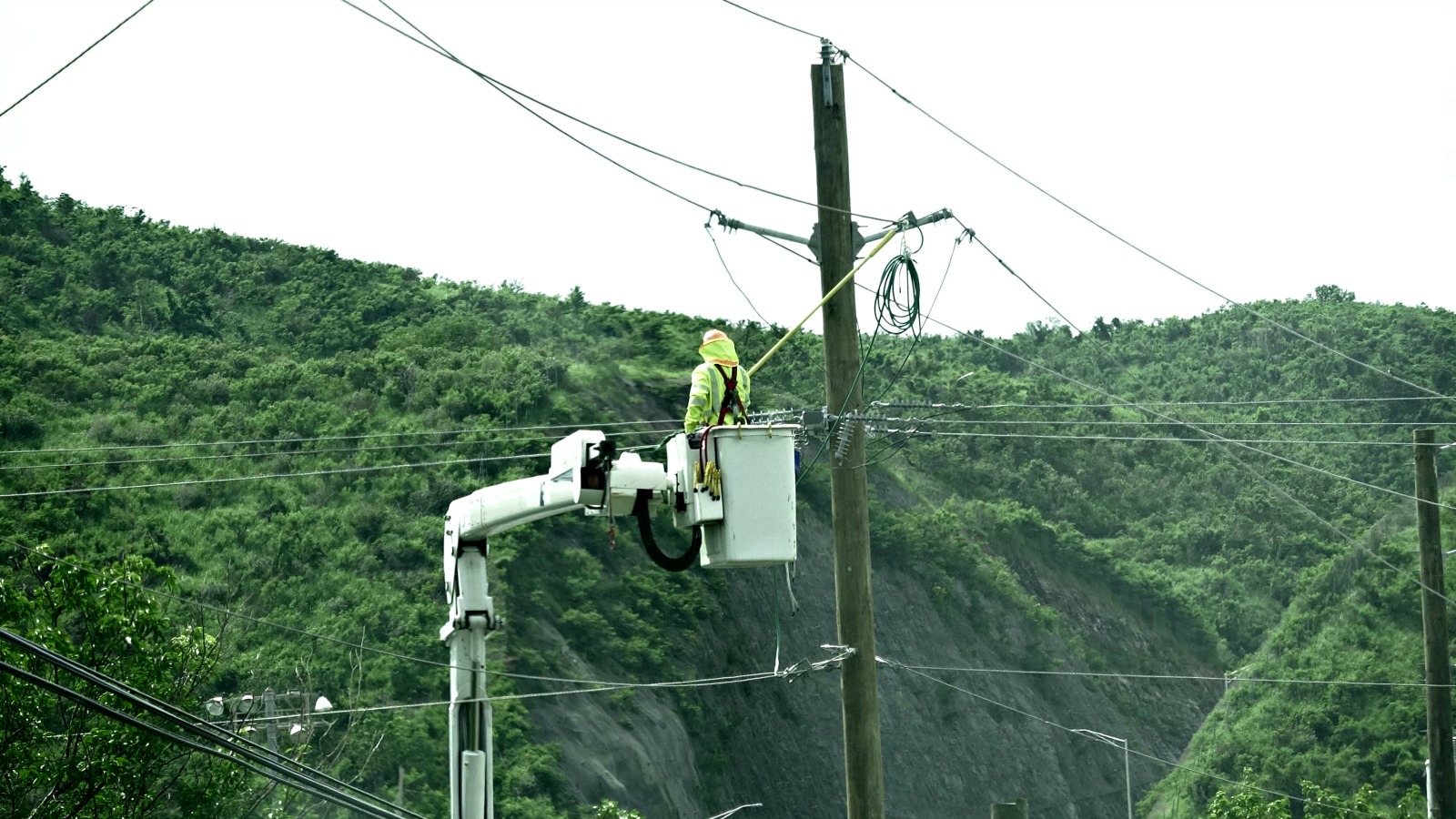
The Federal Emergency Management Agency has obligated over $4.5 billion for the Water and Power Authority's recovery and resilience work across the territory. However, as generous as that allocation may seem, WAPA's Director of Grants Management Joe'lle Webster told lawmakers on Thursday that it represents less than half of the total damage sustained by WAPA infrastructure following the hurricanes of 2017.

In fact, as Ms. Webster testified before the Committee of Disaster Recovery, Infrastructure, and Planning, there was an “estimated $11 billion in total damages across the territory” in the aftermath of Hurricanes Irma and Maria.
The yawning gap between funds obligated and value of damage sustained concerned Senator Novelle Francis, who wondered whether WAPA was at a “disadvantage in being able to satisfy hardening of our infrastructure grid.” Ms. Webster hesitated to confirm a disadvantage, but instead stated the obvious: “It shows that we got more damages than we got money to replace it.”
Sen. Francis remained occupied with how WAPA would “reconcile being able to fully harden the energy grid for the territory.” It’s not a question that Ms. Webster was able to answer, a response that Mr. Francis deemed understandable.

However, with the $4.57 billion from FEMA obligated and thus secured, WAPA is pressing ahead with several projects across both districts. That includes the installation of composite poles across the territory, a project which is 94% completed on St. Thomas and 96% completed on St. Croix, according to Ms. Webster’s testimony. She also told lawmakers that “multiple undergrounding projects are in active construction.”
Approximately $892 million of the obligated amount has already been spent thus far. Senator Francis urged WAPA to spend the rest of the funds as quickly as possible. “Whatever remains is always under the threat of being clawed back,” he warned.
WAPA does have new projects in the pipeline, Ms. Webster said. The utility is designing microgrids on St. Thomas and St. Croix. They will “combine solar generation and battery storage systems to create local power zones capable of independent operation,” she told lawmakers. The microgrids will be located in densely populated areas, like Bovoni on St. Thomas. Currently in the design phase, once completed, the microgrids are expected to “enhance grid flexibility, reduce the scale of outages, and ensure communities retain power during emergencies.”
The authority is also managing the prudent replacement of much of the territory’s two power plants. According to Ms. Webster, the infrastructure at the Randolph Harley Power Plant is decades old and replacement is “not only justified but necessary.”
WAPA has been awarded $206,260,560 for the Harley Power Plant project. Similarly, $674,782,181 has been awarded for the Richmond Power Plant.
Meanwhile on St. John, WAPA is interested in expanding capacity. There is no power generation on St. John, which instead “relies entirely on power transmitted via submarine cables.”
Ms. Webster informed the committee that “the current focus is on combining battery storage and emergency generation to strengthen grid reliability and support critical loads during outages.” Battery Energy Storage Systems (BESS) will be installed in Cruz Bay, Frank Bay, and Coral Bay, said Ms. Webster.
Ms. Webster described the plans as a “comprehensive effort” that “represents a critical step toward establishing energy resilience on St. John.”
WAPA’s testimony, however, left at-large Senator Angel Bolques Jr. wanting more. He considered the testimony a “watered-down version” that omitted “critical information," including specific project deadlines. “You've shared dollar figures, no start dates, no end dates, no concrete milestones of completion. There's no budget breakdowns in here,” Sen. Bolques stated.
He complained about the lack of “performance data” from WAPA, including “outage reduction statistics,” and “ reliability metrics or customer impact data.” Senator Bolques also noted that there was “no clear plan for St. John” with no completion dates for the design phase or “fallback plan if FEMA delays come about.”
Ms. Webster acknowledged that “the people of the Virgin Islands want to see actual construction” as opposed to receiving updates on the design phases of various projects. However, when Bolques inquired about the power plant replacements, Vernon Alexander, special project director, told him that WAPA just does not have those details “at this juncture.” Responses to the request for proposals came in less than a month ago, he noted, and preparations are currently being made to evaluate the three bids that came in.
Unfortunately for lawmakers and the listening public, several other questions also went unanswered. These included an attempt by committee chair Senator Marise James to ascertain the savings from WAPA’s solar infrastructure projects thus far. Mr. Alexander replied that the team “didn't come prepared to give you exact numbers on that.”

The Water and Power Authority is scheduled to appear again before lawmakers during a Committee of the Whole meeting on October 29th to address public complaints, among other issues. Lawmakers have urged WAPA’s leadership to be prepared to respond to the questions that went unanswered during Thursday’s meeting.