

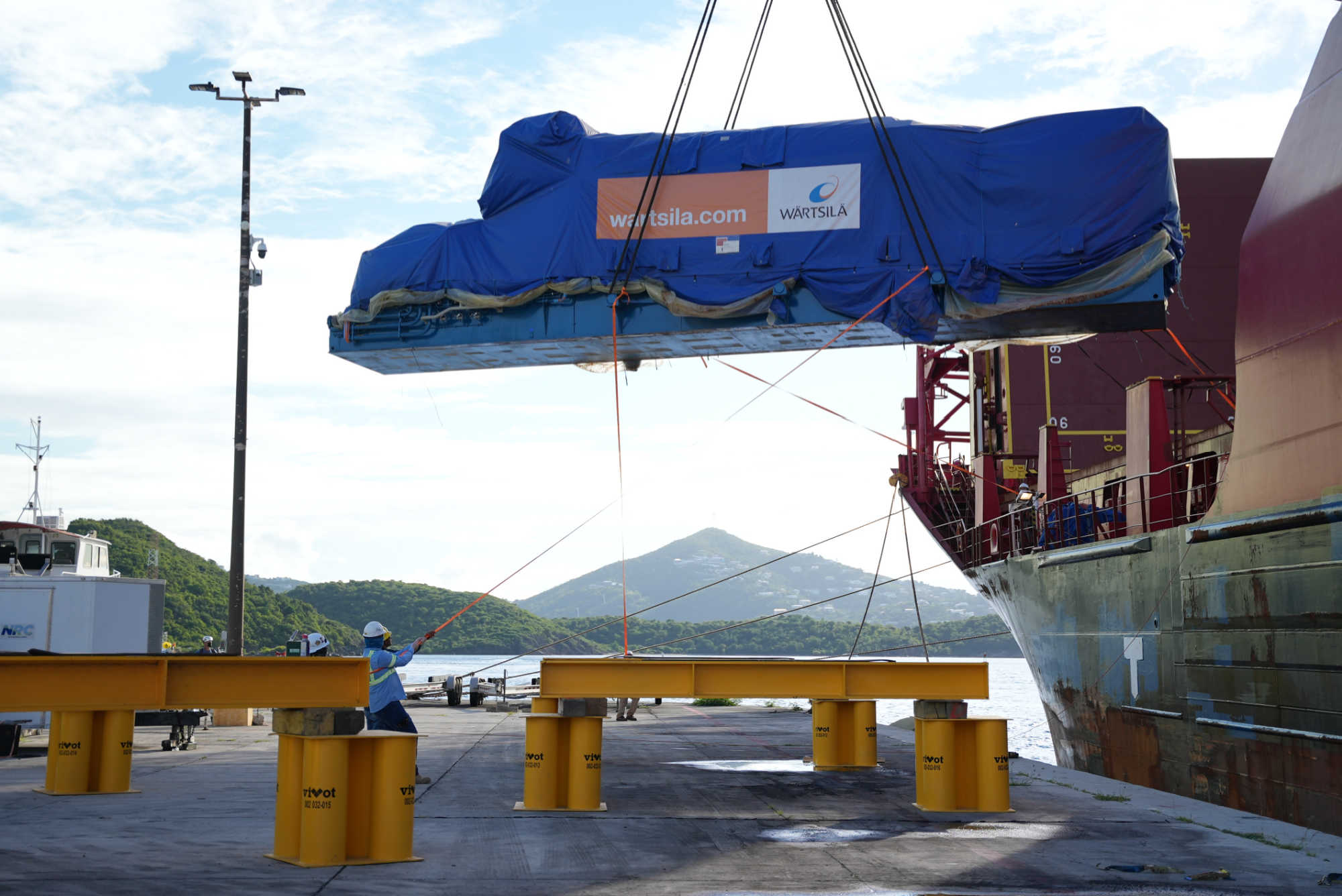
Energy utility consultants for the Public Services Commission have labeled the Water and Power Authority’s Phase 2 Wärtsilä generators an “experimental” and an “ill-advised” gamble that has locked the territory into a costly operational trap. During the PSC’s June meeting on Wednesday, part of the discussion focused on the four units which have struggled to operate as initially expected.

The four generators, purchased in 2020 and installed at the Randolph Harley power plant on St. Thomas five years later, were meant to be operated on either diesel or liquified petroleum gas. “And we can switch that on a dime,” said WAPA CEO Karl Knight during a ribbon-cutting ceremony in January 2025. At the time the contract was inked in July 2020, then-Executive Director Lawrence J. Kupfer noted that the generators purchased by WAPA were “the first engine/hybrid power plant undertaking” by Wärtsilä, and “the first installation of that company’s LG engines which are capable of burning the two fuel types.”
What that designation of “first” really meant is that the units were entirely unproven. PSC Chair David Hughes noted that “they were somewhat experiments, and they’re clearly not working out very well.” Consultant Julius Wright agreed, noting that while Wärtsilä has had experience with dual fuel diesel and LNG engines, these were the first ones to utilize LPG — or propane — as their second fuel type. Courtney Mark, a veteran electrical engineer with almost 40 years of experience at the Trinidad & Tobago Electricity Commission, explained that burning liquid propane introduces entirely different engineering hurdles than burning gaseous methane. “In the case of the Virgin Islands, burning a liquid propane is very, very difficult,” he stated. “The term dual fuel is very familiar to Wärtsilä, but the combination of fuels that are being burnt is very rare.”
So rare, according to Mr. Hughes, that Wärtsilä has “not sold another engine of this type to anybody since.” The PSC chair concluded that “they were probably ill-advised as a purchase by WAPA.” The claims of dual fuel operation made by WAPA officials also do not stand up to scrutiny, Mr. Hughes said. “They are not true traditional dual fuel in the sense that they give us the flexibility to use either of our fuels. They actually lock us into the opposite position, which is we have to have both fuels to run them efficiently.”

To ameliorate the challenges currently being faced, Mr. Wright proposed that WAPA segregate one of the new Wärtsilä units to continue attempting the LPG conversion, while running the others on diesel. “We think WAPA needs to tell the Commission within 20 days…how much it would cost” to do that, Mr. Wright suggested. “It is much cheaper to burn the new Wärtsilä units running diesel fuel than to continue to try to run on LPG and in its place run Unit 15, because Unit 15 is so inefficient compared to the new Wärtsilä units,” he explained. This configuration – with Unit 15 offline and one of the four Phase 2 Wärtsilä’s being tested on LPG use – would be cheaper for WAPA, up to a diesel cost of $5 or even more per gallon, Mr. Wright said. He assured commissioners that WAPA has sufficient generation capacity across the seven remaining Wärtsiläs to accomplish this goal.
Mr. Wright suggested that there be further investigation into WAPA’s acquisition of the Phase 2 Wärtsilä generators. “Whether they were misspecified, whether they were promised something that couldn’t be done, that remains to be seen,” he noted. Of particular interest is the contract between WAPA and Wärtsilä, which Mr. Wright said needs to be closely scrutinized.
“That is one of the strategic issues we identified that needs to be further investigated,” he declared. “It’s a puzzlement to me that the citizens of the Virgin Islands don’t have a system that operates better, and that those units are not operating better.” Mr. Mark added that any such contract should have had provisions for liquidated damages for delays in meeting completion milestones, and Mr. Wright wondered “why there aren’t some financial responsibilities of Wärtsilä on all these issues.”

While Commissioner Clement Magras pushed to have the consultants examine the Wärtsilä contract, Mr. Hughes reminded commissioners that financial constraints precluded the PSC from tasking the consultants with that investigation right away. “It’s going to have to wait until we can afford those additional billings,” he cautioned.