

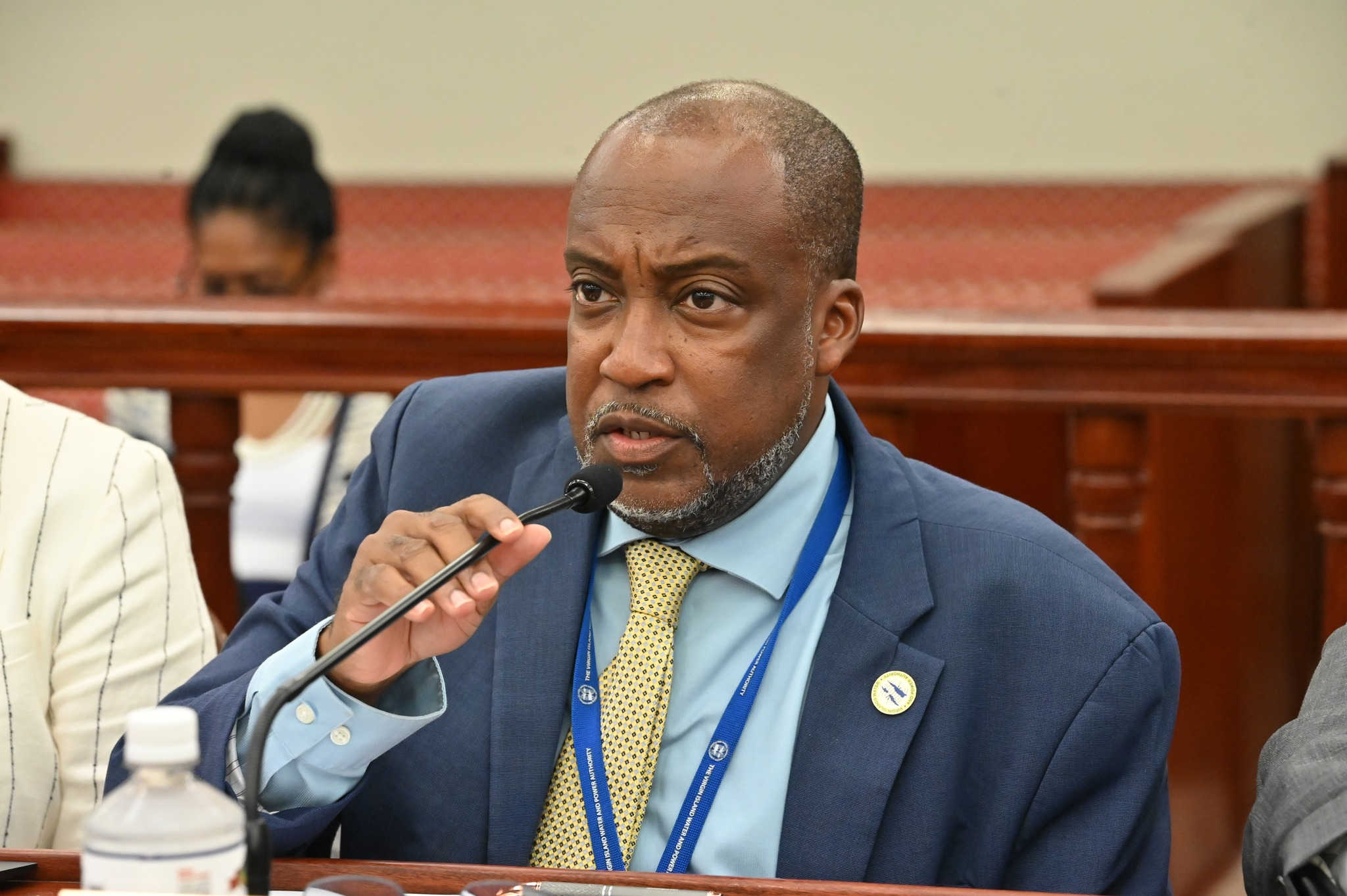
Failure to adequately maintain critical infrastructure is largely to blame for a series of power outages that have affected the entire territory, particularly the St. Thomas/St. John district, the V.I. Water and Power Authority contends. According to WAPA CEO Karl Knight, the challenges that have led to the recent string of outages were a sobering reminder that “matters left unresolved for too long will eventually return to haunt us.”

Power cuts and rolling blackouts, now commonplace in the territory, have been raising the ire of ratepayers for years. A need for public accountability is why WAPA was requested to testify before the Committee of the Whole on Wednesday. As instructed, Mr. Knight provided a comprehensive account of the factors that caused several power generation units at the Randolph Harley power plant to fail between September and October 2025.
In summary, a series of unfortunate effects was triggered by a “false alarm at the propane terminal, an apparent incident of operational error, storm-related outages, and mechanical failure of a valve that conspired to create one of the most disruptive periods of power generation we have experienced in the past year,” Mr. Knight disclosed.
The underlying commonality, he confirmed, is the “lack of preventative and routine maintenance that has left the authority vulnerable to equipment failures.” It’s the same message he delivered to board members in September following a string of power outages on St. Thomas.

It comes as no surprise that the only way to improve reliability at the power plant is to invest in its maintenance. Doing so, said Mr. Knight, is “directly tied to the financial health of the community.” WAPA has been struggling to stay above water, anticipating a shortfall of $9.6 million that will force the authority to prioritize outstanding payments and needs.
Kevin Smalls, director of Plant Production, informed Senator Ray Fonseca that total deferred maintenance for St. Thomas currently stands at approximately $20 million, while St. Croix requires another $10 million. The FY2026 budget only includes $6 million for “plant maintenance” and another $20 million “that is spread amongst the rest of the operation” for “minor and routine maintenance,” added Mr. Knight.
Solutions are necessary – and urgent. According to Mr. Knight’s testimony, increasing the current residential kilowatt-hour rate from 43 cents to 45 cents “would yield at least $12 million in additional annual revenue and close the projected budget shortfall facing the authority.”
He made it clear, however, that WAPA is not going to pursue a rate increase as that move would carry “significant risks,” Mr. Knight said. These include hastening “grid defection” which he argued would “ultimately erode our sales revenue.” Instead, WAPA has chosen what Mr. Knight calls “the more difficult path.” This strategy involves right-sizing operations to “fit within current rates by reducing our operating expenditures.” Now, the authority’s leadership must strike the right balance between staffing levels, materials, and maintenance budgets.
WAPA has already begun to take small steps to remedy persistent challenges. That includes interviewing individuals for in-house tree trimming services and securing the services of a contractor to supplement internal crews. According to Mr. Knight, the “most frequent cause of outages at the distribution feeder level is trees coming into contact with the power lines.”
The authority is working on building the necessary infrastructure to replace Feeder 13 on St. Thomas, a 20-year-old installation that is the “main transmission feeder” on that island. WAPA is also looking forward to the phased completion of the Estate Fortuna and Estate Bovoni solar farms. Once online, they will “significantly increase the daytime generating capacity of the Authority in the St. Thomas/St. John district,” said Mr. Knight.
WAPA is also “pursuing temporary generation for the Randolph Harley Plant as an interim measure until a permanent generation project can be completed.” The Office of Disaster Recovery has included it as part of the power generation bundle. So too is the installation of a battery energy storage system (BESS). It will “allow for increased energy storage capacity at the Harley Plant and insulate customers from shorter duration outages due to capacity shortfalls.”
Funding, however, is always the main concern, with the availability of finances not always a sure thing. Per Mr. Knight’s testimony, the territory has been awarded $67.6 million from the HUD Community Development Block Grant — Disaster Recovery Program to enhance or improve the electrical power system. Initially $53 million of that sum was earmarked for WAPA, but the Housing Finance Authority has since “subjected WAPA to significant bureaucratic obstacles in order to access the funds,” Mr. Knight told lawmakers. The allocation for the utility was recently cut by $18 million, Mr. Knight reported. Now, WAPA can only expect to receive $35 million.
When Senator Hubert Frederick sought an update, Mr. Knight explained that “there’s no status. It’s just me complaining out loud.” A rationale for reallocating the funds is “a question for the Housing Finance Authority,” he said.
Nonetheless, WAPA has submitted applications to use the funds to install a battery energy storage system to “backup the East End Substation” and replace transformers in the distribution system. The authority also wants to use some of the money to install “distribution automation devices” and rebuild transmission Feeders 11 and 12.
Mr. Knight lamented that “we could invest even more in this area of critical need if the $18 million that has been mysteriously reallocated were restored to the authority.”
He is hopeful that these projects will supplement several legislative requests presented before the Committee on Budget, Appropriations and Finance on August 11th. They include full payment for street lighting now totaling $6.8 million in arrears, and “adjusting the legislatively mandated 30-day meter reading cycle to 35 days.” Other recommendations include permitting a customer charge for the water system and “allowing increased disconnection fees in cases of theft or criminal activity.” WAPA also wants the Legislature to appropriate “past due PSC annual assessments so that the Authority can return to good standing with its regulator.”
Mr. Knight’s latest testimony, presented on Wednesday, also included new requests, including “appropriate funding from the Tourism Revolving Fund to cover the costs of WAPA’s support of the St. Thomas Carnival, Crucian Christmas Festival, and St. John Celebration.”
It’s something that Senator Marise James considers amenable. “I think it’s only fair,” she said, noting that provisions are made for other entities like the Waste Management Authority.
There was some positive news for WAPA, as Senator Kurt Vialet shared that “we did look at the proposals that you sent to the Legislature.” Lawmakers apparently discussed the requests during the budget markup process and developed a bill “in the amount of $4 million in reference to street lighting.” Of that amount, $1 million is to be used for “back bills” where that is concerned.
Wednesday’s discussion was dominated by conversations about planning for both the long and short term. Strategic plan documents have been developed and revised by subject leaders, all aimed at transforming WAPA and ensuring its long-term sustainability.

Vialet was curt in his assessment of the situation. “The people of the Virgin Islands really don’t care about what plan that you have. All the people want is a cheaper rate.” It’s not something that the authority seems to be considering at this time. With no plans to increase the rate either, WAPA must now carefully manage its limited resources to offer a quality service to the people of the Virgin Islands.