




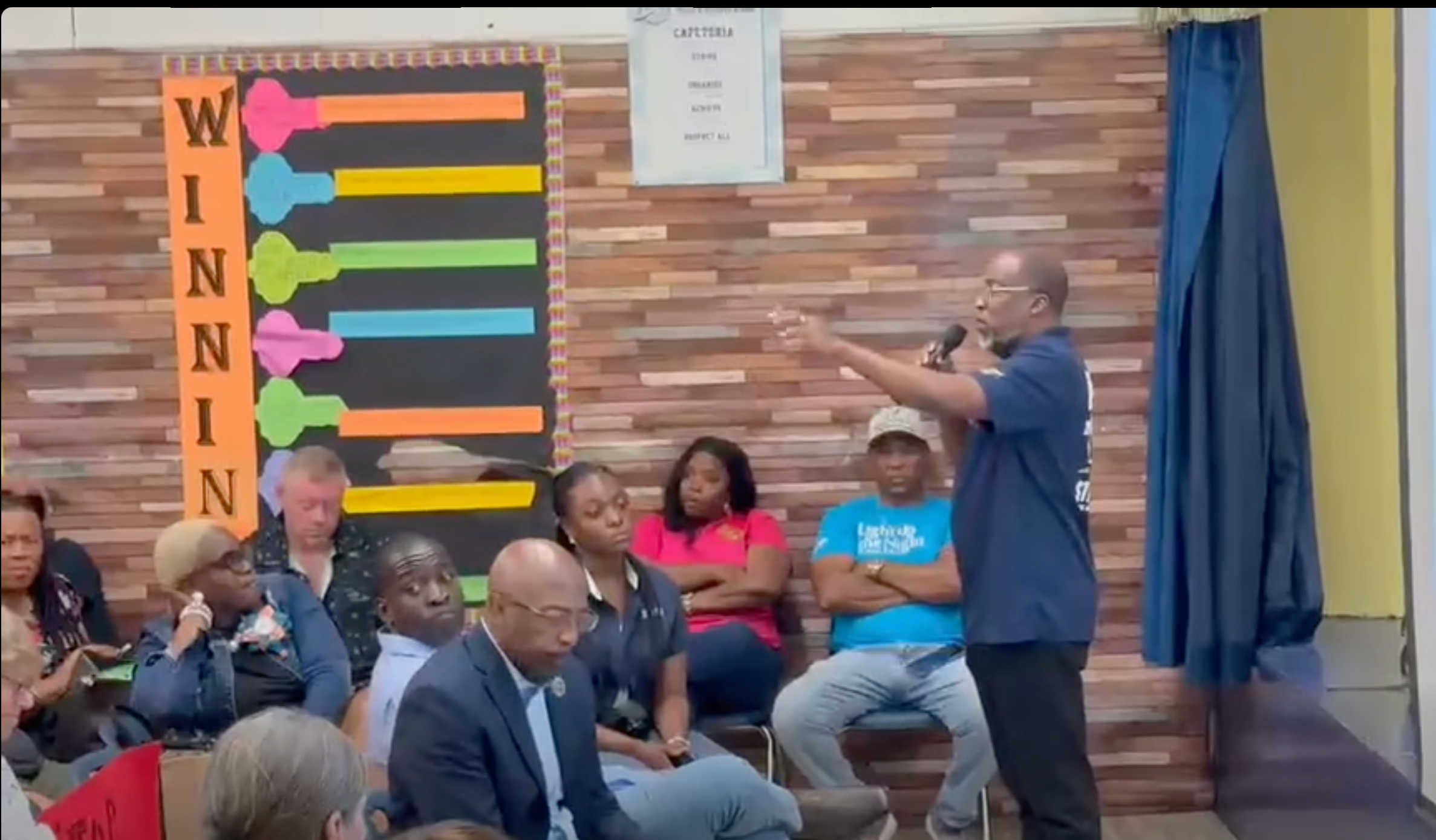
ST. JOHN — Frustration that has been building for years poured out Tuesday evening as St. John residents confronted officials of the V.I. Water and Power Authority over repeated outages, weak communication, spoiled food and medicine, poor customer service, prolonged estimated billing, and what many described as an enduring pattern of neglect.

The public town hall, called to address the recent power failures on St. John, quickly became a forum for residents to voice disgust with an agency they said has failed them for too long. Though WAPA Chief Executive Officer Karl Knight led the meeting and offered explanations for the latest outages, much of the evening was driven by residents who pressed him on exposed infrastructure, delayed projects, financial hardship, and a lack of visible progress despite years of discussion.
Among the strongest complaints was WAPA’s handling of communication during the latest outage. Residents said the authority did not provide prompt enough updates while the island remained without service for an extended period. Mr. Knight tried to explain the delayed response by pointing to WAPA’s human-powered notification system, but the explanation did little to calm the audience.
Attendees also raised broader, more systemic complaints that extended beyond the most recent blackout. They criticized WAPA’s customer service, objected to prolonged estimated billing at elevated rates, and reacted negatively when Mr. Knight said the authority was not in a position to reimburse customers who lost appliances, food, and medicine during the multi-day outage.

“We lose money on every single barrel of oil that we purchase,” Mr. Knight explained. While “this year has been a much better year for us, fiscally we are still under the water,” he said. He added that WAPA does not currently have the financial ability to make immediate purchases of spare parts or install new transmission lines without waiting for grant funding. “I’m trying to build the company back to the point where we have that capacity,” Mr. Knight said.
“Find the money,” one resident shot back, as others pointed out that many families had lost hundreds of dollars in spoiled food and ruined medicine.
Another woman in the audience said the territory no longer has the inter-agency “synergy and collaborativeness” that once existed on St. John. “The system is broken,” she said.
Resident Kurt Marsh told Mr. Knight the discussion itself was “stressful,” and said the people in the room had been in positions of power for years without producing meaningful change for St. John. He pointed out that before becoming WAPA’s CEO, Mr. Knight had served as Governor Albert Bryan Jr.’s chief of staff. He also noted that Senator Avery Lewis, who was present, had served as administrator of St. Thomas and Water Island, and that at-large Senator Angel Bolques Jr. is from St. John.
“We ain’t see no bill come forward, or no activity come forward, to do nothing about” WAPA’s problems on St. John, Marsh said.
He stressed that several decision-makers present that evening had served in the administration for years, but “we cannot get much from you.”
“You’re been in spaces where we could have made a difference years ago,” he argued. “We deserve better.”
“What we’re doing is wild that none of these real projects that have existed for years and years have come to realization, and you start giving people a whole bunch of excuses as to why.”
About two hours and 20 minutes into the three-hour meeting, Mr. Knight apologized directly to residents.
“I sincerely want to apologize to you that I can’t keep a more reliable service,” he said. “When your power goes off, we have let you down, and we’ve let ourselves down.”
But many in the room remained unconvinced that words alone would change the situation. “Unacceptable,” one woman said of WAPA and its efforts, drawing applause and approval from the audience.
In explaining the most recent outage, Mr. Knight said the earlier February 6 outage stemmed from “an equipment malfunction in the substation.”
The more recent island-wide outage, he said, began two weekends ago when “a fault on the submarine cable” triggered the failure. Showing an image of a taped-up cable that appeared to bear cut marks, Mr. Knight repeated his belief that the damage was intentional. He said the kind of damage involved would likely have injured the person responsible, and that the police had been asked to check emergency rooms in case someone appeared with a burn injury. No such person has been identified.
“I asked them to bring in the federal FBI, federal investigators to help us find who ultimately damaged the line,” he told the audience. He said he believed the motive was not sabotage but “common theft.”
According to Mr. Knight, the damage occurred near the Red Hook end of the cable, “between the substation and the point where the line goes underwater.” That disclosure prompted immediate concern from residents when he acknowledged that “you don’t have cameras” in that location.
One resident demanded to know how a cable supplying electricity to roughly 5,000 people could be left so accessible. “How is a cable that provides electricity to about 5000 people accessible in that manner,” she asked.
“Maybe there was a certain level of comfort that people would respect high voltage cables,” Mr. Knight responded. “I can’t answer that question – that was done many years ago.”
He said transmission line security is certainly something “that ultimately we have to get done as a company,” but admitted that during his year and eight months as CEO, it “was not at the top of the list.”
“Doesn’t mean it’s not important,” he said.
Mr. Knight said that after the damage was identified, WAPA energized a second line and initially restored power to St. John. But after that, a junction box fire in Red Hook knocked the island back offline. He said WAPA crews worked through the period, identifying problems, sourcing materials, and making repairs, but that the cascade of failures is what caused the extended outage.
He also used the meeting to outline what WAPA says it is trying to do next.
One of the three transmission lines currently serving St. John is scheduled for repair as part of the territory’s hurricane recovery effort. “That is the only line that received federal dollars to repair,” Mr. Knight said, noting that work is expected to begin in 2027. He added that a local contractor is expected to repair the second damaged line, which he hopes can be completed “within probably the next 30 days.”
WAPA is also trying to strengthen the system with more redundancy.
“We’re building more layers of redundancies,” Mr. Knight said. “We’re trying to restore layers of redundancy that apparently we had once upon a time. We’re trying to get that back.”
A third transmission line, he said, will be central to that effort and is currently being developed in conjunction with viNGN.
Mr. Knight also addressed why St. John continues to receive power through undersea cables from St. Thomas rather than through generation located on the island itself. He said a previous generator project for St. John was ultimately abandoned after significant scoping work because “technical consultants…raised questions about the ability to put those particular generators into Coral Bay. They felt that that was going to be a technical challenge, a logistical challenge.” He identified space constraints at Frank Bay as a major issue.
Although there had been discussion about “how do we salvage this project,” he said the plan ultimately died. “I can’t speak to how those conversations played out with prior leadership, but I can tell you tonight …that we are going back to the original plan,” he promised.
Under that approach, St. John would receive two generation locations, one at Frank Bay and one at Coral Bay. Each site, he said, would provide up to five megawatts of standby generation.
“It’ll only run when necessary, and so we don’t expect that many emissions issues,” Mr. Knight said. He added that the project is expected to go out to bid “in the next few months.”

Even with those assurances, Tuesday night made clear that for many St. John residents, the central issue is no longer just what WAPA plans to do next, but why so many promised solutions have still not materialized.