




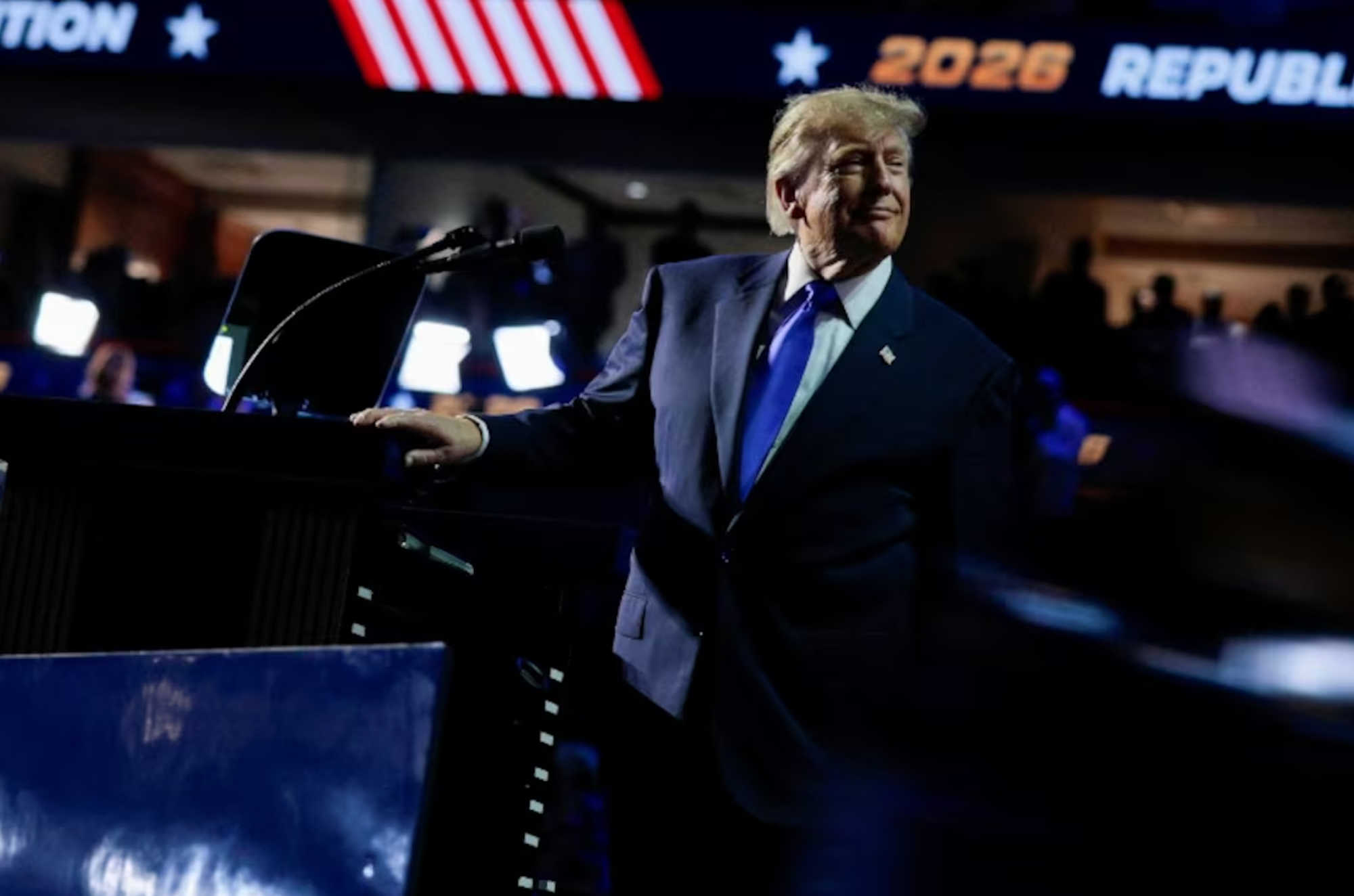
President Donald Trump has promised a $5,000 payment to every adult U.S. citizen if Republicans retain control of both the House of Representatives and Senate in November, tying the massive proposed payout directly to the outcome of the midterm elections.

Speaking Wednesday at the Republican Party's first midterm convention in Dallas, Mr. Trump described the proposed payment as a dividend stemming from what he called the country's economic success.
“Because of our tremendous economic success…I will issue a dividend to every adult citizen in the United States of America for $5,000, very much like a successful company will do a cash distribution to its shareholders,” Mr. Trump told the cheering crowd.
The president explicitly conditioned the proposal on Republicans maintaining both congressional majorities. He also said recipients would have to spend the money within the United States. Reuters reported that Mr. Trump provided no immediate details explaining how the program would operate.

The proposal would not, however, automatically become reality simply because Republicans win the elections. Congress would have to authorize or otherwise provide for the enormous expenditure. Marc Goldwein, senior policy director at the Committee for a Responsible Federal Budget, told the Associated Press that the president does not have authority to distribute the money without congressional approval.
Republican support for the proposal emerged quickly. Sen. Bernie Moreno of Ohio said he would begin preparing legislation so the “Trump Dividend” could be approved after the election if Republicans retain Congress, writing, “I will get a bill ready so that we can get the Trump Dividend passed immediately after the November 3rd election.” Vice President JD Vance, meanwhile, did not reject the proposed payments but moved directly to how they might be structured, saying wealthy Americans would not receive the dividend and suggesting tariff revenue as a possible funding source.
A nationwide $5,000 payout would carry an extraordinary price tag. Reuters estimated the cost at approximately $1.35 trillion using the roughly 270 million adults living in the United States and its territories, while other estimates that account more specifically for citizenship and possible income restrictions are lower. Either way, the proposal would require well over $1 trillion if implemented broadly.
The pledge has also prompted questions about election law because Mr. Trump expressly linked the payment to a Republican victory.
Federal law, under 18 U.S.C. §597, prohibits making or offering an expenditure to a person in exchange for voting, withholding a vote, or voting for or against a candidate. However, that does not necessarily mean Mr. Trump's proposal violates the statute.
Attorney John Day told the Associated Press that because the proposed payment would go to eligible Americans regardless of whether they personally voted Republican — or voted at all — it could legally be treated as a campaign promise rather than payment to an individual in exchange for that person's vote.
Among those critics is financial commentator Peter Schiff, who accused Mr. Trump of trying to “buy the midterms by offering all voters a $5,000 bribe in exchange for their votes.” He also warned that financing such a large payment could worsen inflation.
Echoes of the Pandemic Checks
The proposal recalls the direct payments Americans received during the Covid-19 pandemic during Mr. Trump's first term.
Under legislation approved by Congress in 2020, eligible individuals received first-round economic impact payments of up to $1,200, followed by second-round payments of up to $600. Those payments were subject to eligibility and income rules rather than being distributed universally to every citizen.
Mr. Trump has also floated large direct payments since returning to office without those proposals ultimately producing widespread checks.
In February 2025, he said his administration was considering returning 20 percent of savings attributed to the Department of Government Efficiency to Americans, after a proposal emerged for so-called “DOGE dividend” checks. The envisioned payments never materialized.
Later in 2025, Mr. Trump proposed tariff-funded dividends of at least $2,000 for lower- and middle-income Americans. Those payments also were not enacted, with Treasury officials acknowledging that congressional action would be required.
The new $5,000 proposal is substantially larger and, unlike those earlier ideas, has been explicitly tied by the president to his party's performance at the ballot box.

Republicans enter the final two months of the campaign facing a difficult national environment. The RealClearPolitics average of generic congressional ballot polling currently has Democrats ahead 48 percent to 42.3 percent, a 5.7-point advantage, although individual congressional races — rather than the national popular vote — will ultimately decide control of the House and Senate.