
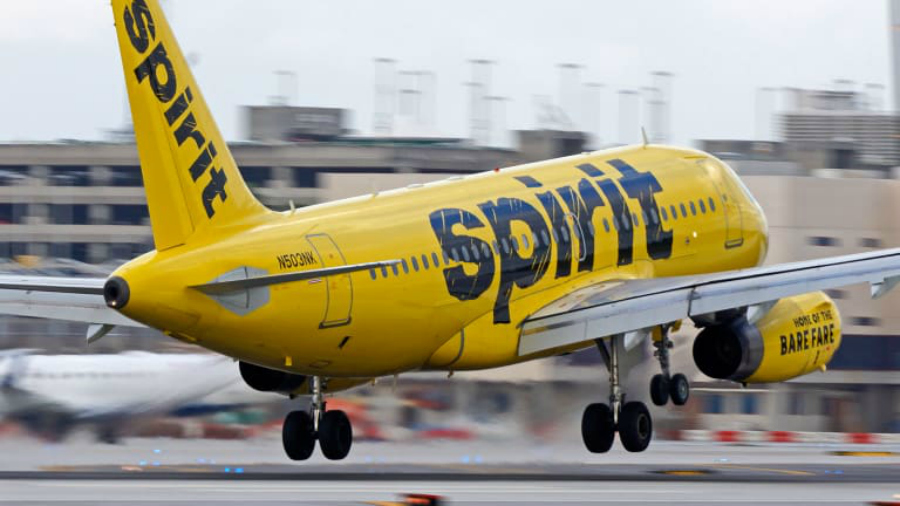
The federal government is nearing a deal to support Spirit Airlines, a development that carries direct relevance for the U.S. Virgin Islands because Spirit still lists active service tied to both St. Thomas and St. Croix.
The package under discussion has not been finalized, but the broad outline is now clearer. The Wall Street Journal reported that the administration is working on a rescue plan that could provide up to $500 million in loans in exchange for warrants that could give the government a significant stake in the airline. Reuters, citing sources, reported that Spirit and the federal government are in advanced discussions over a financing package and hope to finalize terms imminently.
Spirit’s need for help has sharpened as its bankruptcy exit has come under new pressure. The airline filed for bankruptcy protection for the second time in less than a year and had been aiming to exit in late spring or early summer after reaching a preliminary deal with lenders. The carrier’s turnaround plan was built on fuel costs averaging about $2.24 a gallon in 2026 and $2.14 in 2027, but by mid-April jet fuel was around $4.24 a gallon, roughly double what Spirit had assumed.
That mismatch has deepened an already serious financial problem. Spirit has lost more than $2.5 billion since the start of 2020, and the airline plans to shrink its fleet to roughly 76 to 80 aircraft by the third quarter of 2026, about one-third of its pre-bankruptcy size. Spirit’s latest troubles come after the collapse of attempted merger and acquisition efforts with JetBlue and Frontier.

The debate in Washington now appears to be less about whether Spirit is in distress and more about whether saving it makes sense. President Donald Trump raised the possibility of government help and also said he would welcome a buyer for the carrier, citing the roughly 14,000 jobs at stake. Transportation Secretary Sean Duffy has questioned whether a bailout would amount to putting “good money after bad,” even as he said he wants a competitive market that still includes low-cost carriers. The Biden administration had opposed JetBlue’s effort to acquire Spirit in 2024 on the grounds that eliminating Spirit would reduce fare competition.
For the U.S. Virgin Islands, Spirit’s future matters for practical reasons. On its current booking pages, the airline lists service to St. Thomas from cities including Orlando, Fort Lauderdale and Atlanta, and lists service from St. Croix to Fort Lauderdale, Atlanta and Orlando. Spirit also continues to market flights to the U.S. Virgin Islands through its destination pages.

That means any major retrenchment by Spirit would not be a distant mainland airline story for the territory. As a low-cost or ultra-low-cost carrier built around affordable fares, Spirit's continued presence in the Virgin Islands helps preserve a budget-oriented option for residents and visitors alike. In a market where air access shapes both daily mobility and tourism flow, the loss of a carrier like Spirit could tighten choices and put added pressure on fares.