




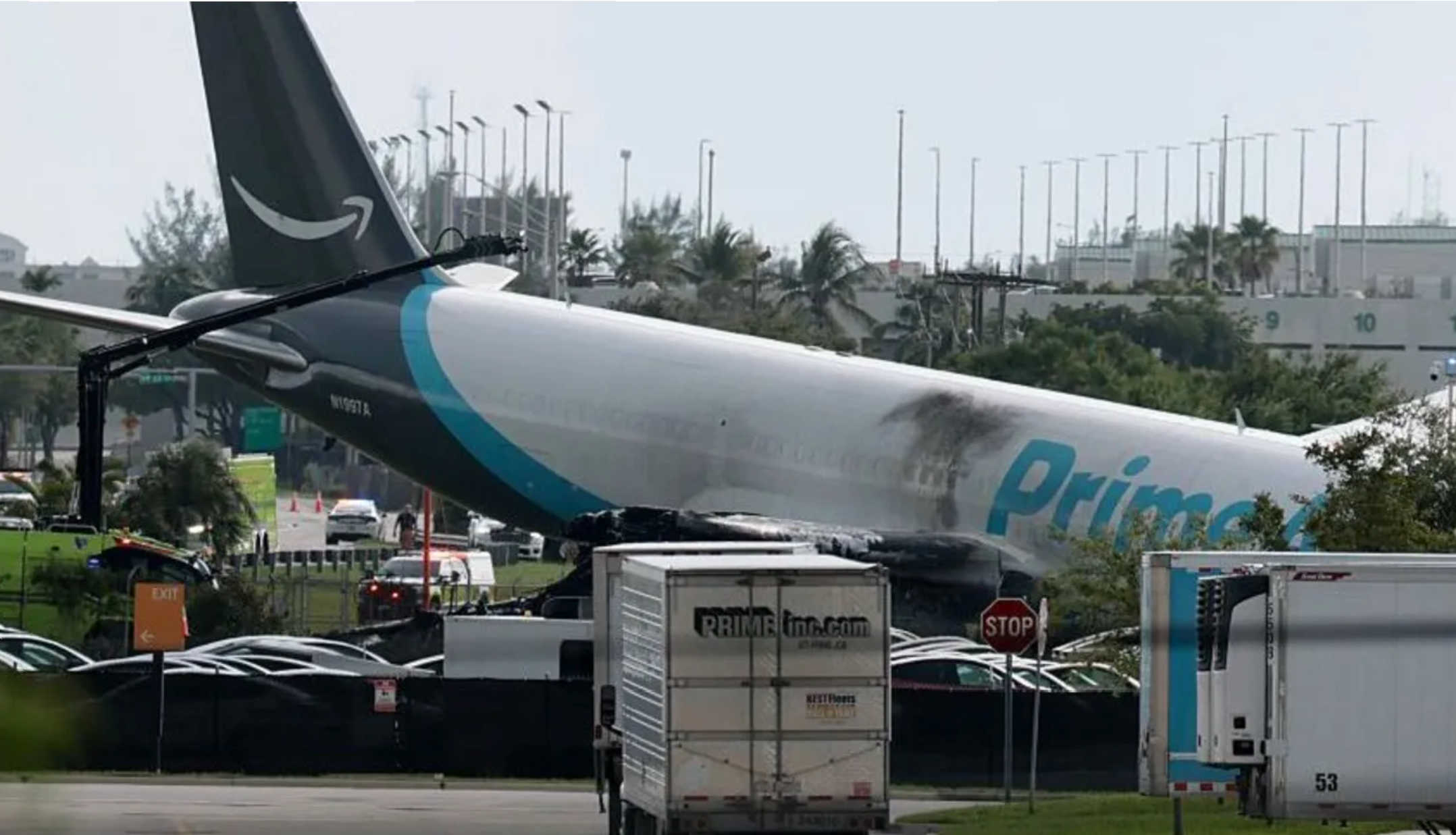
At least five people are dead and five others injured after an Amazon Prime Air cargo jet arriving from San Juan overran a runway at Miami International Airport, crossed beyond the airport grounds and struck multiple vehicles Sunday afternoon, according to authorities. Three of the injured remained in critical condition as federal investigators prepared Monday to begin examining what caused the deadly overrun.

The crash involved Prime Air Flight 7598, a Boeing 767-300 cargo aircraft operated by North Carolina-based 21 Air for Amazon. The jet had departed Luis Muñoz Marín International Airport in Puerto Rico and overran Runway 30 at Miami International at approximately 2 p.m. Sunday. The Federal Aviation Administration said it will investigate, while the National Transportation Safety Board has dispatched a team to Miami.
The Consortium first reported the crash Sunday afternoon, when authorities had confirmed that the aircraft had left the airport’s diagonal runway, struck vehicles and caught fire but had not yet released a death toll.
By Sunday evening, Miami-Dade officials confirmed five fatalities and five people hospitalized. Three were taken to trauma centers in critical condition, while two others suffered less severe injuries. As of early Monday, authorities had not publicly identified those killed or established whether the fatalities occurred aboard the aircraft, in vehicles struck by the plane, or both.

Pilots and Motorists Had to Be Rescued
Miami-Dade Fire Rescue Chief Ray Jadallah described an unusually complex rescue scene involving people trapped both inside the aircraft and in vehicles hit after the jet left the runway.
The pilot and copilot became trapped in the cockpit, while several people were trapped in vehicles along the plane’s path. Firefighters also had to extricate one person who was pinned beneath a vehicle. Nearly 200 emergency personnel responded, including more than 60 Miami-Dade Fire Rescue units.
Responders encountered heavy flames and smoke from what officials described as a complex engine-compartment fire. Specialized airport firefighting units used foam to suppress the blaze, and crews continued dealing with a fuel leak for hours after the initial fire was brought under control.
The aircraft itself remained largely intact despite the fire, images from the scene showed, but vehicles surrounding the crash site suffered extensive damage.
NTSB Investigation Begins Monday
The National Transportation Safety Board sent an investigative team to Miami led by Chair Jennifer Homendy, who is expected to provide an update Monday on the federal investigation. Boeing and 21 Air have also pledged cooperation.
No cause has been established.
Among the questions likely to receive scrutiny is exactly where along Runway 30 the 767 touched down and why it was unable to stop before reaching the end. Aviation experts interviewed by the Associated Press have raised the possibility that the aircraft remained airborne too far down the runway before touchdown, but those assessments are preliminary observations and not findings by federal investigators.
Flight-tracking data provide another striking piece of information investigators will have to place into context. Flightradar24 data cited by Reuters showed the aircraft still traveling at approximately 112 knots, or 129 mph, when it left the usable portion of the runway. The data alone do not establish why the aircraft remained at that speed or what caused the overrun.
Weather conditions are also expected to be examined. Thunderstorms were present around Miami International at the time, with wind gusts reaching approximately 30 mph. Officials have not said that weather caused or contributed to the crash.
Airport Slowly Returned to Operation
The crash initially forced Miami International to close all runways and taxiways and triggered a complete FAA ground stop.
Two runways were reopened later Sunday, and the ground stop was lifted after approximately three hours, according to Miami-Dade Aviation officials. The disruption nevertheless produced major delays during the Labor Day travel period, with more than 160 flights canceled and nearly 325 delayed by late Sunday. Some flights were diverted to Orlando International Airport.
The effects continued into Monday morning. An FAA traffic-management advisory warned arriving aircraft of delays and possible airborne holding of up to 30 minutes because of the accident, with the advisory extending through 8 a.m.
Travelers were being urged to check directly with airlines before heading to the airport.
32-Year-Old Jet Had Been Converted to Cargo Use
The Boeing 767 involved in the crash is approximately 32 years old. It began operating as a passenger aircraft in the 1990s and was converted for cargo use in 2015 before eventually entering service with 21 Air.
The age of the aircraft does not by itself indicate a safety problem. Commercial aircraft can remain in service for decades when maintained and operated in accordance with federal requirements, and investigators have not identified aircraft age as a factor in Sunday’s crash.

Amazon said it was heartbroken by the loss of life and would cooperate fully with investigators. The company uses contracted carriers, including 21 Air, to operate portions of its Prime Air cargo network.