



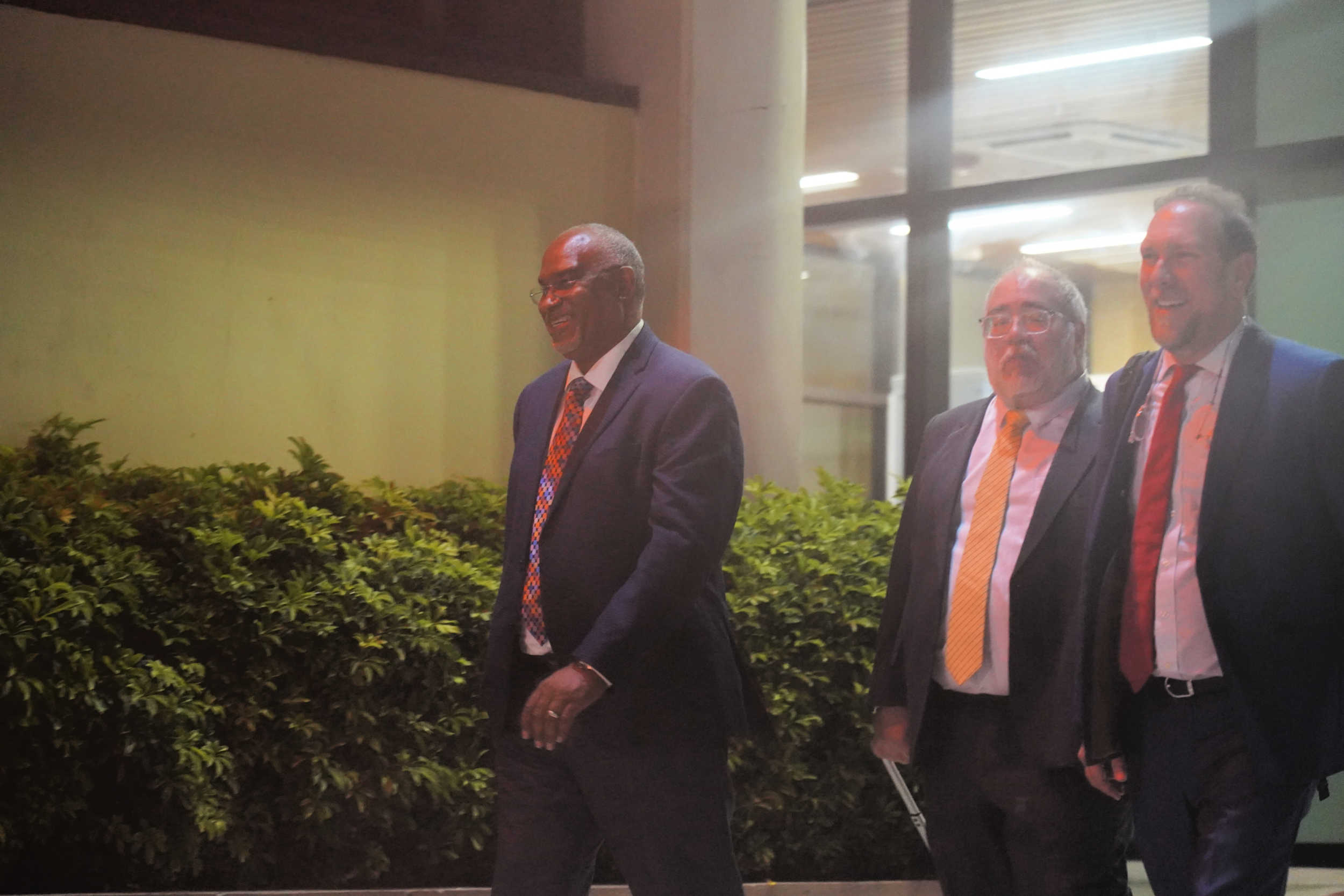
Closing arguments in the federal corruption trial of former Police Commissioner Ray Martinez and former Office of Management and Budget Director Jenifer O’Neal began at about 1:15 p.m. Wednesday in the District Court of the Virgin Islands on St. Thomas, with a modest but attentive audience looking on. By about 3:38 p.m., all three attorneys had finished, the case had officially rested, and jurors were told they will begin deliberating at 8:30 a.m. Thursday — with a verdict possible as early as that day if the panel moves quickly, though it could also come later depending on how long they deliberate.

What came before that moment was roughly two hours of sharply diverging narratives — three final attempts to shape how jurors will remember the evidence, the recordings, the documents, and the defendants themselves. One prosecutor described two powerful public officials who “walked into” corruption “willfully.” One defense attorney demanded to know, “Where is the invoice?” And another asked the jury why anyone should be convicted based on the word of a man who lives by, “Lie, steal, repeat.”
It was the most dramatic day of the case so far.
Prosecutor: “Calculated and corrupt… they used their power to line their pockets.”

Assistant U.S. Attorney Cherrisse Amaro stepped into her closing argument with a framing she returned to again and again: Ray Martinez and Jenifer O’Neal were not minor actors in the Virgin Islands government. They were “two of the most powerful people in the U.S. Virgin Islands,” she said — one directing the police force, the other controlling the flow of federal and local money into every agency.
“They walked into it willfully,” she told the jury. “Calculated, deliberate, and corrupt.”
According to Amaro, Martinez accepted nearly $100,000 in benefits from David Whitaker — the cooperating witness whose recordings and testimony have dominated the case. Those included first-class flights to Boston, nights in luxury hotel suites, expensive steak dinners, gambling money, home rent payments totaling $11,500, and tuition payments of $4,100 for the couple’s children. In return, she said, Martinez “pushed through” a $1.48 million contract for Whitaker’s company, Mon Ethos.
O’Neal’s role, Amaro argued, was more surgical: she approved the $216,000 Mon Ethos invoice that prosecutors say was inflated by $70,000, securing the very funds Whitaker later used to pay the $17,730 lease deposit for O’Neal’s Java Grande coffee shop at Yacht Haven Grande.
And Amaro did not miss the text message that has become one of the prosecution’s sharpest points. When Whitaker told O’Neal that Martinez “asked him to include $70,000 in there for his restaurant,” O’Neal responded with a single word:
“Lol.”
“She laughed,” Amaro told the jury. And then she pushed the invoice forward.
In Amaro’s telling, this was not a moment of confusion or ignorance — it was evidence of intent, knowledge, and participation. “Nothing about Jenifer O’Neal’s actions was accidental,” she said.
Amaro reminded jurors of the audio recordings where O’Neal expressed concerns about how the $17,730 lease payment would be delivered. Amaro told jurors that O’Neal wanted to avoid anything that could be traced, which is why she didn’t want the lease payment sent by wire. In the end, it was Whitaker — not O’Neal — who wired the $17,730 directly to Yacht Haven Grande.
If she believed the funds were legitimate, Amaro asked, why worry about how it was being sent?
Turning to Martinez, Amaro showed the text message where he told Whitaker to “Burn the phone then,” after the FBI raided multiple officials’ properties in June 2024. She reminded jurors that Martinez attempted to backfill the payments with a promissory note the government called “fake.”
“Martinez knew who was knocking on his door,” she said. “And he knew the kind of trouble he was in.”
She ended with a simple line: “The law requires accountability when public officials betray the people they serve.”
Oppenheimer: “This is not a case about stealing government money… where is the invoice?”
Martinez’s attorney, Miguel Oppenheimer, opened with the words prosecutors have used repeatedly: “Corruption” and “bribe.” They are “big words,” he told the jury, and should not be misapplied.
“This is not a case about stealing government money,” he said. “No one is charged for stealing or theft. It comes down to bribery.”
And if bribery is the question, he argued, then the government’s evidence must be examined piece by piece — including records it never produced.
“Where is the invoice?” he asked about the $216,000 payment. Where is the invoice for the $70,000? Where is the invoice for the KLR Services purchases?
The government, he argued, wants jurors to accept the charges without producing the very documents that could confirm—or disprove—the alleged inflation.
Oppenheimer devoted considerable time to the “Steak Out” agreement, the April 1, 2023 memorandum signed by Martinez and Whitaker outlining a proposed video series filmed at Don Felito’s Cookshop — part cooking show, part cold-case discussion. He said the government has dismissed it as a sham, but the memo was drafted with the support of Whitaker’s longtime attorney.
“A rooster doesn’t sing any better than this,” he said, invoking a Puerto Rican proverb. The agreement was real, he told the jury — a legitimate business venture.
Oppenheimer also pushed back on the prosecution’s portrayal of the Boston trips, saying the government “doesn’t understand that you can have brain surgery and follow-up appointments.” Martinez’s medical history was no secret, and Whitaker traveled with him during the first trip for that surgery. The photograph prosecutors showed — of Martinez in a high-rise suite overlooking the city — was not evidence of corruption, he said, but evidence of survival.
He then turned to Whitaker: a man who pleaded guilty in Rhode Island to a multimillion-dollar fraud, who admitted to PPP loan fraud in the Virgin Islands, who planted listening devices in government offices, and who — according to Oppenheimer — built a life of extravagance funded by schemes.
“Whatever Whitaker would receive in a month, he would spend,” he said.
And yet, Oppenheimer argued, this was the man the federal government chose as its witness.
“You are not asked to leave at the door your common sense,” he told the jury.
Smith: “Lie, steal, repeat… I am really afraid for Ms. O’Neal.”
Jenifer O’Neal’s attorney, Dale Lionel Smith, delivered the most emotional of the three closings. He did not argue accounting mechanisms or procurement pathways. He argued the meaning of conspiracy — and whether O’Neal ever knowingly joined one.
He offered a simple example: you pick up a friend from the bank, thinking nothing of it, only to discover the friend was involved in a robbery. You were never told of any criminal plan, he said, adding that someone cannot ‘accidentally’ join a conspiracy.
Smith said Whitaker dragged O’Neal into a world she had no part in constructing. He cited the moment after the listening devices press conference, when O’Neal learned her name had been mentioned. She was furious, he reminded the jury. “If she was upset about that, why would she then join a conspiracy?”
Smith revisited Whitaker’s history: “Lie, steal, repeat,” he said, echoing the phrase used in his opening statement. “That’s who David Whitaker is.”
The government, he argued, relied on Whitaker not because he was reliable but because they believed he might deliver them “big fish.” Smith said plainly: “They’re hunting big fish. Big game. They’re interested in the governor.” He suggested prosecutors believed O’Neal could provide information.
Smith repeated that the FBI is a premier agency, but in this case, “they didn’t conduct the investigation against O’Neal — David Whitaker did.”
He lowered his voice near the end:
“I am really afraid for Ms. O’Neal,” he said. “These are very serious charges.”
Government Rebuttal: “The criminals pick each other.”
U.S. Department of Justice Trial Attorney Alexandre Dempsey handled the rebuttal, beginning with a nod to local hospitality. “Thank you for welcoming me to your home,” he told the jury.
Then he addressed Smith’s suggestion that the FBI was targeting Governor Albert Bryan Jr.
“There was no testimony from the prosecution that the governor is corrupt,” he said. “Do not get distracted by that.”
On the “Steak Out” argument, Dempsey said corruption “had already commenced months before that document was signed.”
On the evidence Oppenheimer claimed was missing, Dempsey reminded jurors: “Wire transfers are not public,” and were obtained by Grand Jury subpoena, not because anyone intended them to be visible.
“The government does not pick the criminal co-conspirators,” he said. “The criminals pick each other.”
He ended by urging jurors not to rely on Whitaker’s word alone: “Look at the pieces of evidence.”

With closing arguments completed and the case formally at rest, jurors will receive the case Thursday at 8:30 a.m.