

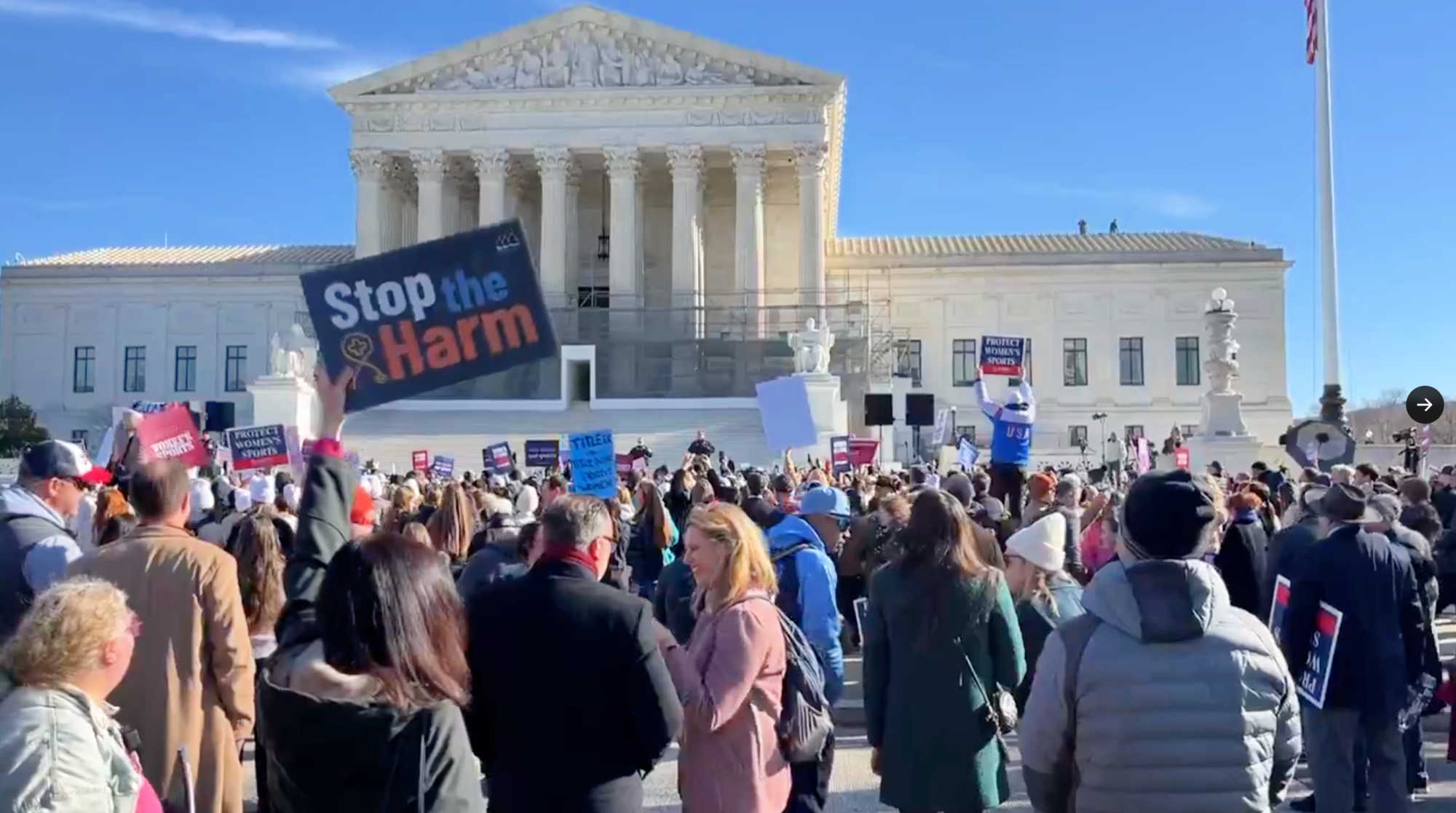
The U.S. Supreme Court on Tuesday heard more than three hours of oral arguments in two closely watched cases challenging state laws that bar transgender girls and women from competing on female sports teams in schools, a legal fight that places claims of sex discrimination against arguments centered on competitive fairness in women’s athletics.

At issue before the high court are Little v. Hecox, originating from Idaho, and West Virginia v. B.P.J., both of which test whether state bans on transgender participation in women’s sports violate Title IX, the federal law prohibiting sex discrimination in education, or the Constitution’s Equal Protection Clause. The court’s conservative majority appeared skeptical of challenges to the laws as questions unfolded, while liberal justices pressed concerns about discrimination and the broader impact on transgender youth.
In Little v. Hecox, the court is reviewing Idaho’s 2020 Fairness in Women’s Sports Act, which requires athletes to compete based on biological sex. The law effectively excludes transgender women from women’s sports teams. The challenge was brought by Lindsay Hecox, a transgender woman who sought to join Boise State University’s women’s track team, with legal backing from the American Civil Liberties Union. A federal appeals court previously blocked enforcement of the Idaho law, concluding it likely violated equal protection principles by singling out transgender individuals for scrutiny not applied to other athletes. Idaho officials counter that the restriction is necessary to preserve fairness and protect athletic opportunities for biological females.
The companion case, West Virginia v. B.P.J., centers on a 2021 West Virginia law with similar provisions. The statute was challenged by Becky Pepper-Jackson, identified in court filings as B.P.J., a 13-year-old transgender girl who was barred from competing on her middle school’s cross-country team. A lower court ruled in her favor, finding the ban discriminatory under Title IX. West Virginia argues the law safeguards the integrity of women’s sports, citing what it describes as physical advantages associated with male puberty.

The federal government’s position in the West Virginia case has shifted. The Biden administration supported Pepper-Jackson’s challenge, while briefs filed ahead of arguments reflect a reversal under the Trump administration, which now backs the state’s position.
During oral arguments, justices explored how far the court should go in balancing transgender rights with protections for women’s sports. Conservative justices, including Brett Kavanaugh, raised concerns that striking down the bans could undermine women’s athletic achievements. Liberal justices, such as Sonia Sotomayor, focused on the potential discriminatory effects on transgender students excluded from school activities. John Roberts and Amy Coney Barrett questioned whether a narrow ruling limited to sports participation could resolve the dispute without extending to broader transgender-related policies.
The cases do not directly address transgender medical care. That issue was addressed separately in U.S. v. Skrmetti, decided in December 2025, in which the Supreme Court upheld state bans on gender-affirming treatments for minors.
The legal battles arise amid a wave of state legislation since 2020. According to court records, 24 states have enacted laws restricting transgender participation in women’s sports. During the Biden administration, the U.S. Department of Education interpreted Title IX to protect transgender students, though that interpretation has been blocked in some jurisdictions through litigation.
Advocacy groups remain sharply divided. Organizations supporting transgender rights, including GLAAD, argue that the bans stigmatize vulnerable youth and lack evidence of widespread competitive unfairness. Supporters of the laws, such as Alliance Defending Freedom, contend they are necessary to preserve equity in women’s sports. Public opinion data cited in filings, including a 2025 Gallup survey, indicate that a majority of Americans oppose transgender athletes, or people born as males competing in women’s sports.
Legal experts say the court’s rulings, expected by June or July 2026, could shape how sex-based classifications are interpreted under federal law, with potential implications extending beyond athletics to education policies involving bathrooms, prisons, and other sex-segregated spaces. While no immediate policy changes are expected before decisions are issued, the arguments have intensified national debate over gender, sports, and civil rights.

Official transcripts and audio recordings of the arguments are available through the Supreme Court’s public records, as the country awaits guidance from the court on one of the most contentious issues in current education and civil rights law.