




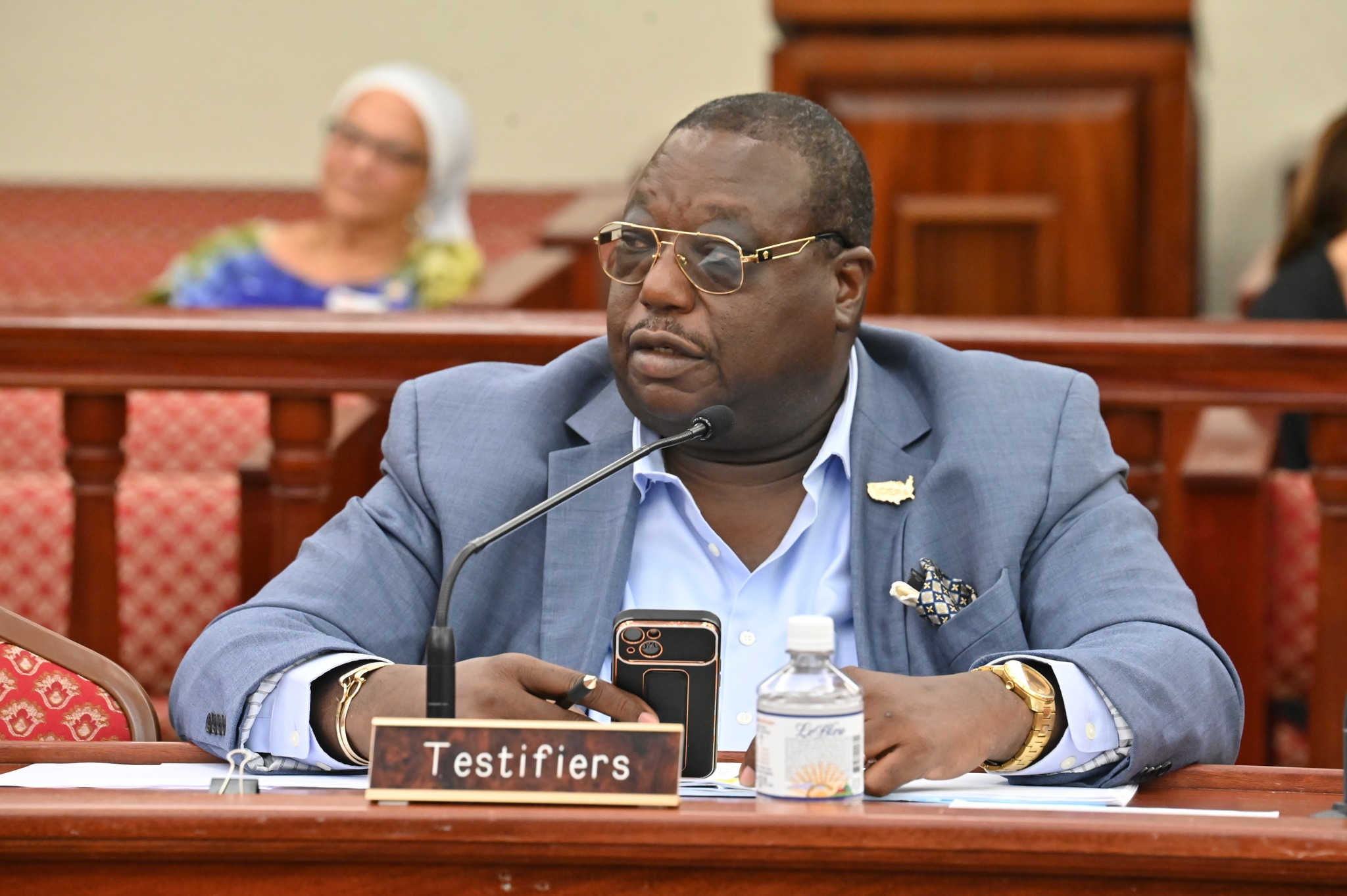
An application filed in the V.I. Superior Court that sought to temporarily halt Tuesday’s scheduled V.I. Board of Elections meeting—and all future sessions—until the question of Raymond Williams’s legitimacy as board chair is resolved. The filing argues that Mr. Williams must be removed from his position.

The civil complaint, filed on the court's docketing system two hours after the 10 a.m. start time for Tuesday's meeting, was submitted by board members Lawrence Boschulte, Harriet Mercer, and Atanya Springette, as well as Collister Fahie, a recent candidate for the Legislature. The plaintiffs claim that Mr. Williams’s ongoing tenure as VIBOE chair is untenable due to several glaring conflicts of interest. His behavior as chair, as well as these unresolved conflicts have “brought the VIBOE into disrepute,” the plaintiffs allege.
According to the lawsuit, the plaintiffs – which include three board members – have variously “had their access to board meetings and committee meetings of the board arbitrarily canceled, capriciously rescheduled, and intentionally disrupted by Raymond Williams,” after making what they say were valid complaints to the board as a whole regarding the issue of conflict of interest.
Mr. Williams’s service as VIBOE chair is not compatible with his position as Executive Director of the V.I. Lottery and as a member of the Public Services Commission, the complaint alleges. It cites language from Title 32, Chapter 13 of the Virgin Islands Code which mandates that the Director of the Lottery “devote his entire time and attention to the duties of his office,” and prohibits the Lottery Director from being engaged in “any other profession or occupation.” A legal opinion from former Attorney General Denise George which seemingly cleared Mr. Raymond of conflict allegations “relied on overly broad and farfetched definitions of the words ‘profession’ and ‘occupation’, which any reasonable person would find not only defies basic logic but lacks legal sufficiency and jurisdiction,” the complaint states. Further attempts at clarification from current Attorney General Gordon Rhea have gone unanswered, the plaintiffs say.

Mr. Williams’s continued role as chair is also challenged by an alleged admission to fraud, the lawsuit argues. It references 2022 testimony before the Legislature during which Mr. Williams admitted that he “knowingly and intentionally paid an unqualified employee…a salary in full for 9 months…even though he was aware said employee was unable to perform the job role.” Under questioning from then-senator Janelle Sarauw, Mr. Williams reportedly admitted that the decision to continue paying the unqualified lottery employee, which was “not okay,” was made by him. According to the lawsuit, this is an admission of fraud, thus disqualifying him from the chairmanship of VIBOE.
The complaint also accuses Mr. Williams of abuse of authority under the color of law. The charge stems from Mr. Williams’s conduct as chair. He has directed the board secretary to refrain from taking or presenting minutes to board members, prevented board members from speaking or making motions, and “unilaterally, arbitrarily and capriciously” prevented online access to sub-committee meetings by the public and other board members, the lawsuit alleges.
The decision by the chair to force a return to in-person meetings of VIBOE is also a violation of constitutional rights to equal protection, due process, and free association, the complaint argues. The previous chair of VIBOE established the practice of permitting virtual attendance at meetings – by board members and the general public. That practice of hybrid meetings was supported by Mr. Williams, the lawsuit argues. He “actively participated in these VIBOE meetings via Teams” until it was his turn to lead the board, the complaint states.
According to the lawsuit, further constitutional violations include his ongoing failure to address Act 8690, which plaintiffs say include troubling provisions that strip VIBOE of all real power, and create a conflict with the law as laid out under Title 18. “These conflicting laws must be remedied to avoid controversy, uncertainty, and a repeat of the debacle of having the Supervisor of Elections filing suit against her employer…as was witnessed in late 2024,” the suit says. The provisions in Act 8690 were never officially sanctioned by VIBOE, the lawsuit states, claiming that the ensuing chaos resulting from the conflict “directly affected the 2024 election,” by disenfranchising voters, interfering with the candidacy of at least one candidate, and undermining “the integrity and efficacy of the entire election process.”
The process by which the offending provisions of Act 8690 became law amounted to a conspiracy, the lawsuit further alleges. Plaintiffs accuse Mr. Williams of conspiring with Elections Supervisor Caroline Fawkes to “undermine, subvert, and unlawfully change the powers of the VIBOE” by “allegedly placing said powers under the auspices of the Supervisor through Act 8690.” In furtherance of the conspiracy, Mr. Williams “refuses to allow a special meeting of the VIBOE to either rescind, repeal, or amend Act 8690,” despite repeated requests from other board members for such a meeting “to singularly address this obvious fraud.”
In light of the serious allegations of conflict of interest, conspiracy, abuse of authority under the color of law, violation of constitutional rights, and fraud, the plaintiffs argue that a temporary restraining order from the court halting all future VIBOE meetings is in order, until the question of Mr. Williams’s chairmanship is resolved.
“Plaintiffs have tried to continue the business of the VIBOE but have hit an impasse as Defendant has repeatedly placed his thumb on the scale,” the complaint states.

Apart from making a determination on Mr. Williams's status as chair, the complaint also asks the court to weigh in on whether plaintiffs Boschulte and Springette, who are husband and wife, are both allowed to serve simultaneously on the board. While precedent seemingly exists due to the previous service of two sisters who were elected to the board simultaneously, the court has been asked to “determine this question with finality.”