

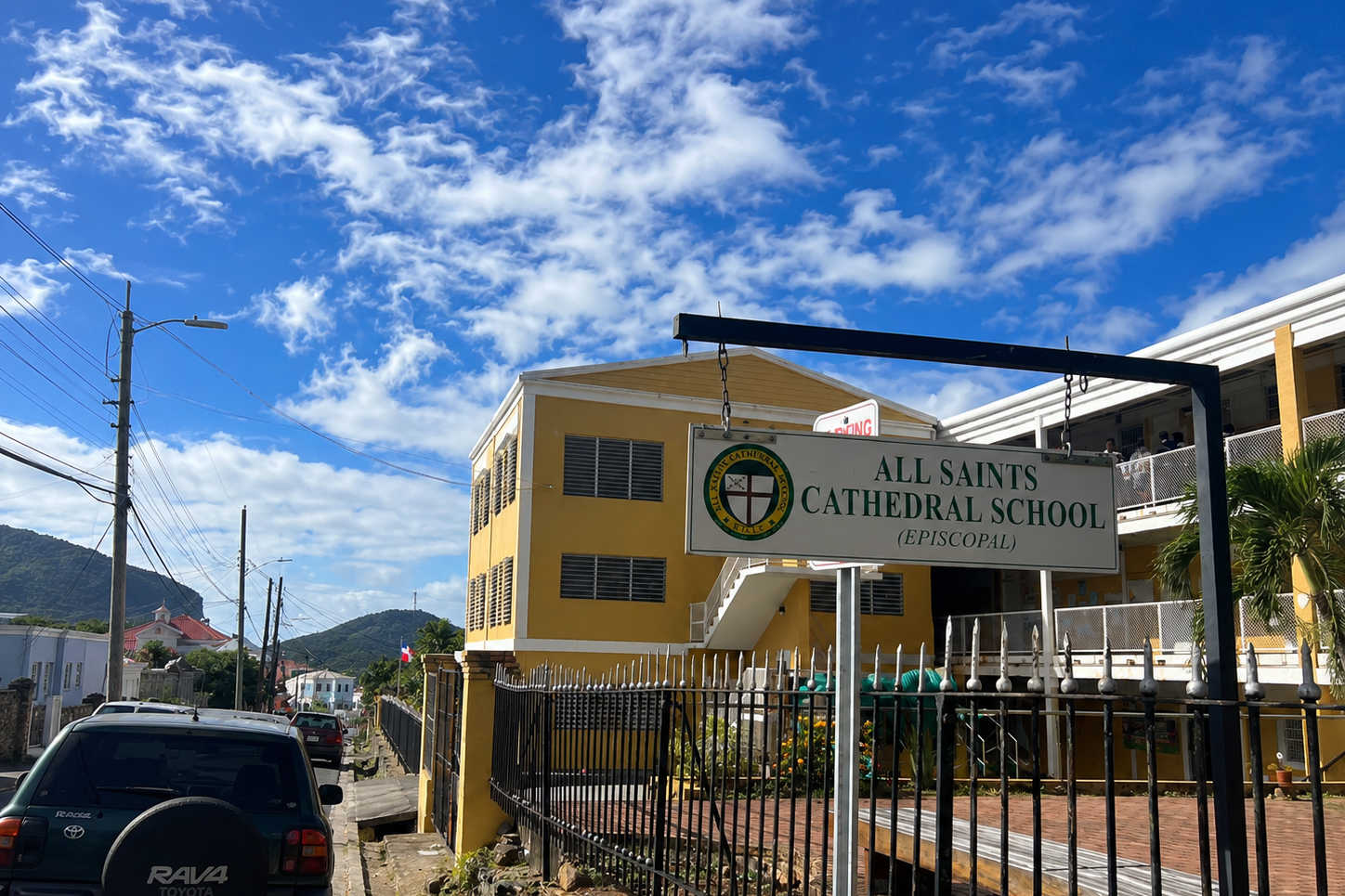
All Saints Cathedral School’s graduation ceremony is cleared to proceed Thursday evening after Superior Court Judge Pedro K. Williams denied an emergency request to block the school from finalizing or announcing salutatorian honors.

The civil action was filed by Alaine Lockhart-Mollah and Eric H. Mollah, individually and as grandparents and guardians of a graduating student. The plaintiffs sought a temporary restraining order, preliminary and permanent injunctive relief, declaratory judgment and damages against All Saints Cathedral School, Head of School Karla Sarauw, Board of Trustees Chairman Jimez Ashby, the All Saints Board of Trustees and teacher Jennifer Cannon.
The plaintiffs alleged that the student had been improperly denied salutatorian status because of delayed grade postings, grade manipulation or ranking miscalculations, and administrative failures in handling academic records. They argued that without court intervention, the school would proceed with graduation and class honors based on an incorrect ranking.
Judge Williams, however, found that the plaintiffs had not provided evidence to support those claims at this stage.

The court noted that the allegations were “presented largely upon information and belief and are not accompanied by supporting evidence in the pleading.” Judge Williams said the complaint did not attach or identify the school’s grading or ranking policies, report cards, transcripts, grade records, ranking calculations, communications, witness statements, or other documentary evidence showing grade manipulation, policy violations, negligence or improper calculation of class rankings.
“As pled, the allegations consist primarily of conclusory assertions without evidentiary support,” the judge wrote.
That finding was central to the court’s denial of the temporary restraining order. Under Virgin Islands law, a party seeking such emergency relief must show, among other things, a reasonable probability of success on the merits, irreparable injury if relief is denied, that the balance of harm favors relief, and that granting the order is in the public interest.
On the first factor, Judge Williams found that the plaintiffs had not shown a probability of success on the merits. He noted that declaratory relief is not itself a cause of action, but a remedy. For the remaining claims, he pointed to the high legal threshold courts apply when asked to review academic decisions, including grade and ranking determinations.
The court said judges generally do not involve themselves in academic evaluations unless a challenged decision is arbitrary, capricious, irrational, made in bad faith or contrary to law. In this case, Judge Williams found that the plaintiffs had not provided the records or other evidence needed for the court to assess whether such a standard could be met.
On the issue of irreparable harm, the court also ruled against the plaintiffs. Judge Williams found that even if graduation proceeded and the student did not receive the salutatorian distinction at the ceremony, a later court order could still direct the school to adjust the student’s grades and distinction if the plaintiffs ultimately prevailed.
“This would allow the student to still ultimately have the salutatorian distinction,” the order states.
The judge therefore concluded that the plaintiffs had not shown that they would be irreparably injured if the temporary restraining order was denied.
Judge Williams also considered whether granting the restraining order would cause greater harm to the school. He acknowledged that the school would be unable to proceed with graduation in its normal fashion if the order were granted, but also noted that the ceremony could be postponed or distinctions announced later. The court found that factor neutral at best.
The public interest factor weighed against granting the order. Judge Williams wrote that the plaintiffs had not provided evidence that the alleged grading problems were systemic or affected many students at All Saints.
He further found that blocking the ceremony would harm other students.
If the court granted the requested relief, Judge Williams wrote, it “would deprive many of the other students at the school from being able to have a normal and timely graduation ceremony.”
For those reasons, the court denied the plaintiffs’ application for a temporary restraining order.
Judge Williams also denied the request for a preliminary injunction. He said a party seeking preliminary injunctive relief must go beyond allegations and submit supporting evidence, such as documents or affidavits. The plaintiffs’ filings, he found, did not do so.
“In this case, the Plaintiffs’ filings are nothing more than mere allegations as they have not submitted sufficient supporting evidence with their moving papers,” the order states.
The denial of the preliminary injunction was issued without prejudice, meaning the plaintiffs are not barred from trying again. Judge Williams granted them 21 days from the order to file an amended complaint and motion.
In a footnote, however, the judge cautioned that if the plaintiffs amend their filings, they “ought to be cognizant of the high hurdles the Court articulated in this order.” He also reminded them that any amended complaint must comply with the Virgin Islands Rules of Civil Procedure.

With the emergency relief denied, All Saints Cathedral School’s graduation ceremony is set to proceed at 6 p.m. Thursday.