




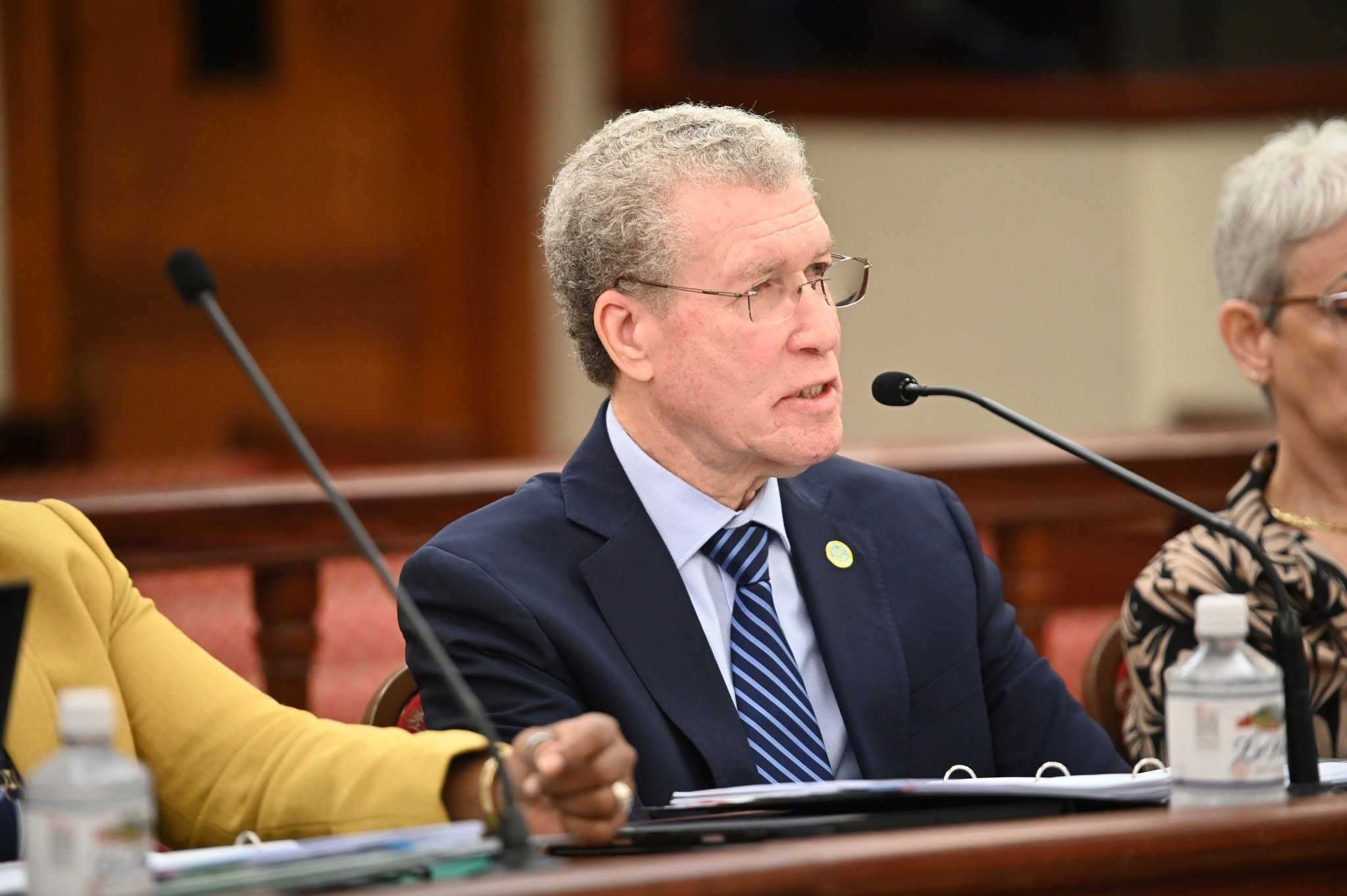
ST. THOMAS — Chief Justice Rhys Hodge used his final budget presentation before retiring at the end of 2026 to urge lawmakers to guarantee the Judicial Branch a fixed percentage of the General Fund, arguing that the current process has consistently underfunded the courts and left the Judiciary struggling to pay vendors, complete capital projects and absorb the costs of newly appointed justices.

Appearing Thursday before the Senate Committee on Budget, Appropriations, and Finance, Chief Justice Hodge recommended that “at least 5%” of the General Fund be allocated to the Judiciary. Such a formula, he said, would ensure the courts receive a “proportional share of funding both when the economy is strong and equally so when it is weak.”
Based on the proposed fiscal year 2027 General Fund budget of $958.2 million, a 5 percent allocation would establish a $47,910,000 budget ceiling for the Judicial Branch, the chief justice said. He later told lawmakers that the ideal allocation would be 5.5 percent of the overall General Fund budget.
The Judiciary’s actual fiscal year 2024 request is slightly higher. It is seeking $48,591,590 to fund operations, along with separate appropriations of $144,743 for the Judicial Council and $1,527,872 for the Office of Conflict Counsel.

The $48 million operational request includes $37,296,759 for personnel and fringe benefits, $5,926,485 for other services and charges, $2,292,346 for capital expenditures, $1,926,000 for utilities and $650,000 for supplies.
Chief Justice Hodge described the request as “conservative and reflects the minimum funding level needed to sustain efficient operations…”
As a separate and independent arm of the government, the Judiciary is not required to submit its budget to the Executive Branch. Chief Justice Hodge said, however, that the Executive places an “arbitrary place-holder budget ceiling” in the proposed budget it submits to the Legislature.
That ceiling is “always much lower than the budget requested by the Judicial branch” and is typically the amount ultimately appropriated, he said.
Between 2017 and 2021, the Judiciary received the “exact same appropriation of $35,246,781 each fiscal year despite submitting budget requests as high as $46,609,252.” During that period, Chief Justice Hodge noted, the General Fund increased to $924,198,794 in fiscal year 2022.
The chief justice maintained that “a budgetary process that favors just the funding recommendations from the Executive branch is the submission of a balanced budget is a significantly flawed approach…”
Instead, he called for “a neutral funding principle for courts, which is predictable and commensurate with the state of the economy.”
Chief Justice Hodge noted that Puerto Rico allocates 4.5 percent of its substantially larger budget to its Judiciary. Senator Hubert Frederick described the chief justice’s recommendation as “reasonable.”
Mr. Frederick suggested that lawmakers further examine the 5 percent proposal “because the cost of just arbitrarily putting a flat number on these two separate branches of government is pretty confining.”
“Count me in as a stronger supporter of going to a flat rate…” he said.
Senator Kurt Vialet cautioned that increasing the Judiciary’s allocation would affect other government spending unless overall collections improve.
“It’s one pot of money…If we don’t increase collections then the pot remains the same, then when you increase, you have to decrease someplace else.”
Chief Justice Hodge responded that lawmakers must eventually decide which obligations should take priority.
“At some point you have to bite the bullet and find where else to get money from, and I think before you create a rainy day fund, you should fund the current day,” he said.
The Judiciary’s latest budget request does not sustain a 4 percent market adjustment that was included in its fiscal year 2025 and 2026 budget requests, as well as a supplemental request for 2026.
“The fact remains that by the time implementation becomes reality, the market dispensary will be even greater than 4%,” Chief Justice Hodge warned.
The Judiciary has also been denied funding for two additional chambers following the appointment of new Supreme Court justices.
“After absorbing the additional cost for expansion of the 4th Chamber in 2024, we are once again challenged with absorbing the cost of the 5th Justice of the Supreme Court…to the detriment of other critical expenses.”
Although the Judiciary “welcomes and applauds” the appointment of additional justices, Chief Justice Hodge said “the issue remains the financial impact of the unfunded personnel obligations within an already underfunded judicial system.”
Funding shortages have also disrupted capital improvement projects.
Chief Justice Hodge testified that “underfunding in the current fiscal year and the delayed funding releases ultimately resulted in a 69-day work stoppage on the Phase II Roof Replacement and the Office Expansion project at the R.H. Amphlett Leader Justice Complex.”
Work resumed in late June, but “the balance of the requested funding is still needed to fulfill our contractual obligations together with the cost of delay.”
The Judiciary also owes vendors $2,928,974.08.
“We just don’t have the money,” Chief Justice Hodge acknowledged.
Senator Marvin Blyden described the Judiciary’s testimony as a “very compelling argument.”
“We'll have to make sure that you know you're fully funded,” Senator Ray Fonseca added.
In his final closing remarks during a legislative budget hearing, Chief Justice Hodge asked lawmakers to establish a permanent process that would prevent the Judiciary from repeatedly receiving what he described as an inadequate Executive recommendation.
“I just simply want to ask that the Legislature actually consider formulating a process, so that not every year the Chief Justice and the staff has to come here and ask for a budget only to get an inadequate amount, that's basically the governor's recommendation,” he said.
Despite “chronic underfunding and other challenges including the substandard condition of our facilities and high employee turnover”, the chief justice said the court’s performance “remains high.”
During fiscal year 2025, 1,190 new cases were filed in the Civil Division of the Superior Court, while 1,955 cases were disposed of. The Judiciary reported a 131 percent case-clearance rate and an 8 percent reduction in the caseload.
The Criminal Division received 690 new matters and resolved 1,014, resulting in a 147 percent clearance rate and a 48 percent reduction in the caseload.

As of May 31 of the current fiscal year, 302 new criminal cases had been filed and 542 had been resolved. During the same period, 689 civil cases were filed and 640 were disposed of.