




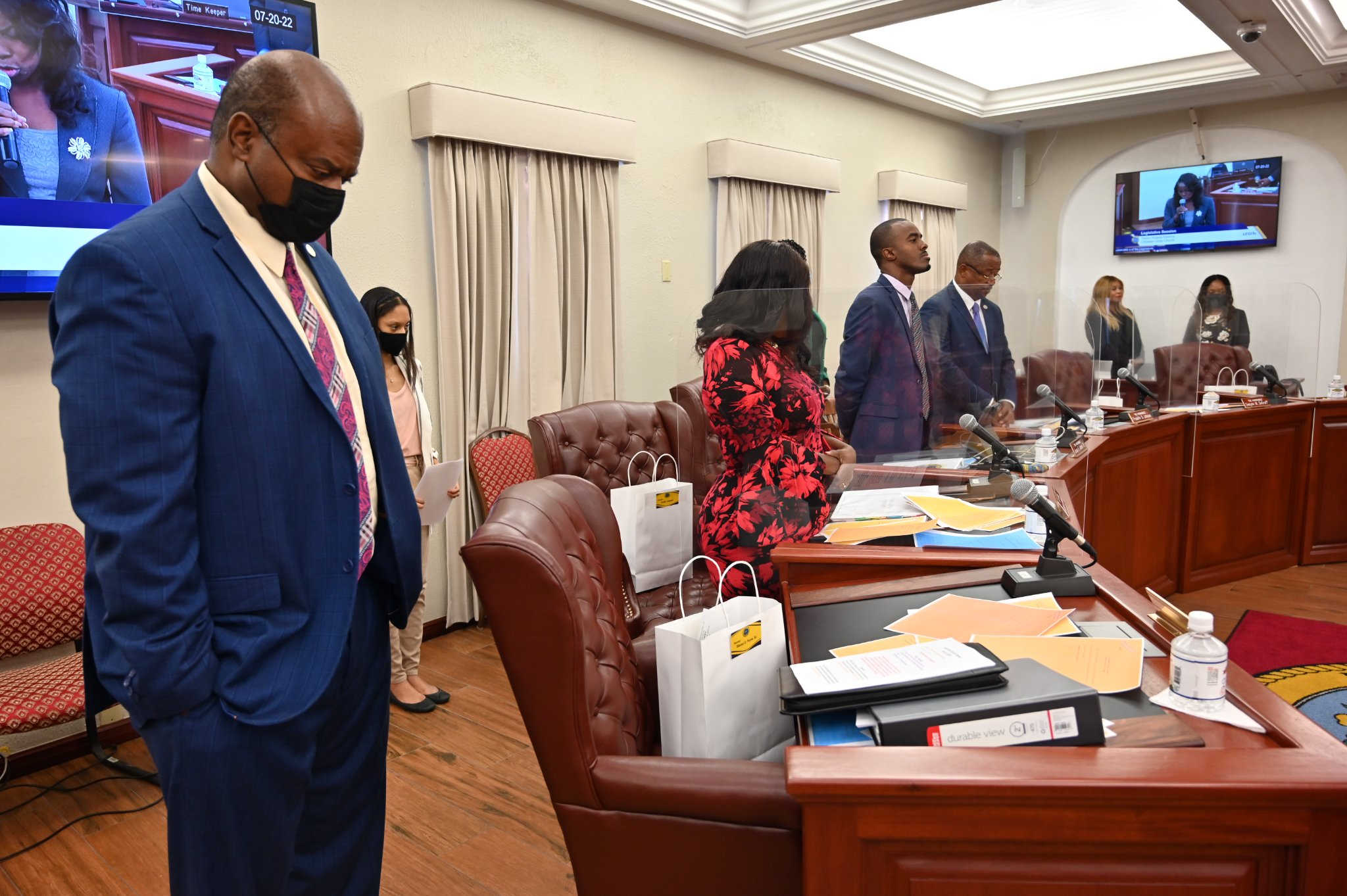
The conviction of former at-large Senator Steven Payne Sr. in a Florida court on Wednesday marks the culmination of a years-long saga that began with exclusive investigative reporting by the V.I. Consortium, which first exposed multiple sexual harassment and assault allegations against Payne.

The Consortium’s coverage, beginning in April 2022, revealed complaints from a young female staffer and two other women—Chezni Jones and Steffi Emilien—who detailed allegations of abuse spanning from Payne’s time as a V.I. Police Department officer through his tenure as a legislator. The revelations triggered a Senate ethics investigation, Governor Albert Bryan’s call for a V.I. Department of Justice inquiry, and Payne’s expulsion from the 34th Legislature.
That reporting—later corroborated through criminal proceedings—laid the foundation for the Florida case that ended Wednesday, when a Jacksonville jury found Payne guilty of sexual battery on a minor after a three-day trial.
Jury Finds Payne Guilty After Three-Day Trial

A Florida jury found Payne guilty of one count of sexual battery on a minor following a three-day proceeding in the Fourth Judicial Circuit Court in Jacksonville.
According to WTJX Trial Watch coverage of the courtroom proceedings, the six-member panel, comprised of three women and three men appearing primarily in their thirties, reached its decision after about three hours of deliberation.
The former senator—once a police officer and later a public official expelled from the 34th Legislature—stood motionless as the verdict was read aloud. His mother and sister wept quietly, while the victim, Steffi Emilien, maintained her composure.
Emilien later told reporters that the moment represented long-awaited relief after years of waiting and emotional strain. “I was very nervous, like my legs were shaking,” she said. “I was trembling.”
A Long Fight for Justice
From the witness stand, Emilien described the verdict as a shared victory—one not just for herself but for others who had endured similar trauma. She said she and other young women who once knew Payne had always been truthful about what occurred.
“We know this guy like the back of our hand, and I literally had to live with him for years, and I had to be in the band dealing with everything,” she said.
Speaking directly to those who supported her through the process, Emilien continued: “It was really hard for us, and I just hope that whoever was on our side, I hope you’re smiling right now. I hope you’re celebrating. This was a big win for us, and we can finally continue our healing process.”
Alongside Emilien’s testimony, jurors also heard from Chezni Jones, who recounted an encounter from 2005, when Payne was a Virgin Islands Police Department officer and her mentor. Jones told the court that Payne lured her to a beach under the pretext of showing her defensive tactics and then attempted to make her touch him inappropriately before she escaped.
Also in attendance was Dene Dessuit, Payne’s former staffer whose sexual harassment complaint in 2022 resulted in his expulsion from the Legislature and who has since filed a civil suit in the Virgin Islands alleging assault and false imprisonment.
According to courtroom records and WTJX Trial Watch, prosecutors were permitted to present testimony from both Emilien and Jones as evidence of prior behavior, though testimony connected to Dessuit’s civil case was excluded.
The Relationship and the Crime
Prosecutors described Payne as a father figure who took advantage of his position of authority over Emilien, who had relocated from St. Lucia to St. John and performed in the youth band VI Avengerz, which Payne managed. When her living arrangement on St. John collapsed, she moved in with Payne’s girlfriend. After the 2017 hurricanes, she moved to Florida—where, prosecutors said, the abuse escalated.
The jury concluded that between August 1, 2018, and February 27, 2019, Payne sexually assaulted Emilien at his sister’s home in Jacksonville, Florida, using a vibrator. She was 17 at the time.
Trial testimony revealed two earlier incidents: once on St. John, where Payne allegedly kissed her inappropriately, and later in Florida, where he allegedly compelled her to massage him and shower with him during a trip to an amusement park.
Proceedings began Monday with jury selection, followed by testimony on Tuesday and closing arguments Wednesday.
Before closing, the defense informed the court that Payne would not take the stand. The following morning, both sides presented their final arguments.
During closing statements, prosecutors framed Payne’s actions as deliberate and manipulative, telling jurors that he exploited his authority over Emilien, who had trusted him as a guardian. Assistant State Attorney Shaina Ruth emphasized that Payne used his position to “test and control” his victim before carrying out the abuse.
The defense, led by Christopher Carson, urged jurors to separate emotion from evidence, arguing that Emilien’s claims were uncorroborated and born of anger. Carson suggested that the allegations arose from “feelings of rejection” after Payne allegedly cut off communication with her when she wanted to return to the United States.
He also pointed to the absence of physical evidence, including the alleged sex toy, and challenged inconsistencies in witness statements. Carson warned the jury that “an emotional decision is a poor decision” and insisted they rely solely on proof presented in court.
In rebuttal, Assistant State Attorney Jaclyn Blair told jurors that credible testimony itself constitutes evidence under the law and pointed to what prosecutors described as a pattern of grooming and abuse across multiple victims.
Afterward, Judge Meredith Charbula instructed jurors on the elements required for conviction: proof of penetration by an object, that the victim was between 12 and 18, and that Payne occupied a familial or custodial role. She also reminded them that reasonable doubt may arise from evidence, a lack of evidence, or contradictions in testimony, but that they could not base their verdict on sympathy or anger.
Deliberations began at 12:20 p.m., and roughly three hours later, jurors returned their verdict: guilty.
Following the verdict, Payne was handcuffed and taken into custody. The charge—a first-degree felony—is punishable by up to life imprisonment. Sentencing is expected in early November, though prosecutors noted that calculating the minimum under Florida’s sentencing matrix would be “a complex process.”
Payne’s mother, sister, girlfriend, and brother, former Senator Clarence Payne, were present in court.
He was represented by attorneys Christopher Carson and Darcy Galnor. The prosecution team consisted of Assistant State Attorneys Jaclyn Blair and Shaina Ruth.
From Exposure to Conviction: The Consortium’s Reporting Trail
The V.I. Consortium’s reporting first revealed Payne’s alleged misconduct—coverage that spanned Senate ethics proceedings, gubernatorial orders, and criminal developments across jurisdictions.
April 7, 2022: The Consortium reported that Payne was under Senate investigation for sexual harassment of a female staffer, confirmed by Senate President Donna Frett-Gregory.
April 11, 2022: The publication detailed Chezni Jones’s account of a 2005 assault while Payne was a police officer.
May 25, 2022: The Consortium released an exclusive interview with Steffi Emilien, who described three separate assaults occurring in St. John and Florida while she was still a minor.
May 26, 2022: Governor Albert Bryan Jr. called the allegations “serious and disturbing” and ordered V.I. Attorney General at the time, Denise George, to investigate.
July 20, 2022: After an ethics inquiry confirmed misconduct, the Senate voted 14–1 to expel Payne, citing violations of its harassment and ethics rules.
Sept. 9, 2023: Payne was arrested in Orlando on a Duval County warrant for sexual battery.
Mar. 23, 2024: The V.I. Supreme Court dismissed Payne’s civil challenge to his expulsion, affirming the Legislature’s constitutional authority.

The Consortium’s investigative series not only uncovered Payne’s misconduct but also shaped the chain of events that led to his prosecution and conviction in Florida—turning what began as a local ethics scandal into a case of international accountability.