

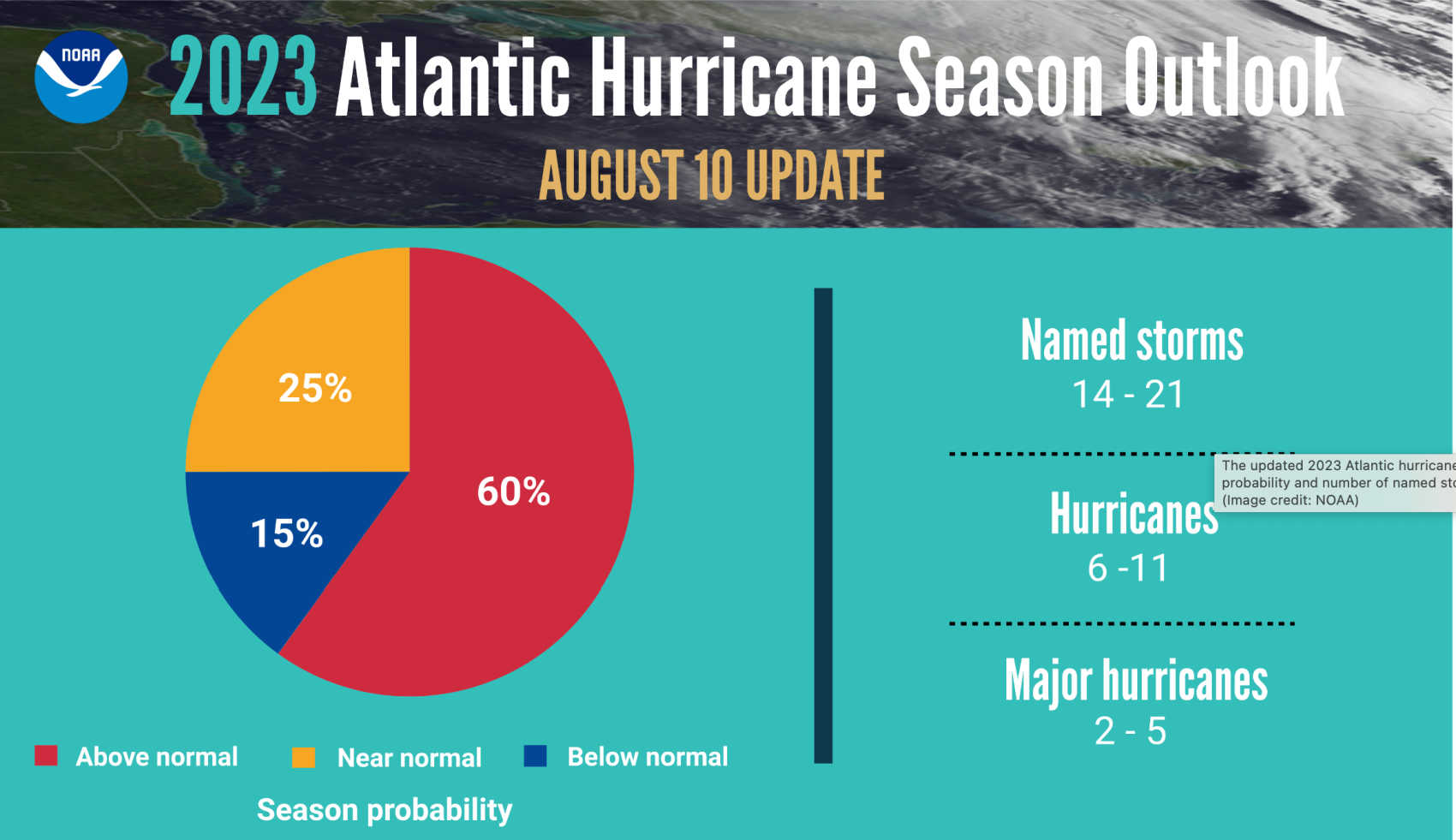
Scientists at NOAA’s Climate Prediction Center, a division of the National Weather Service, announced an updated forecast for the 2023 Atlantic hurricane season today. The prediction has been adjusted from a near-normal level of activity to an above-normal one. The change is attributed to current ocean and atmospheric conditions, notably record-warm Atlantic sea surface temperatures, which are anticipated to counteract the generally inhibitive conditions of the ongoing El Nino event.

The revised likelihood for an above-normal Atlantic hurricane season now stands at 60%, up from the 30% predicted in the May outlook. Consequently, the chances for near-normal activity have been slashed to 25% from May's 40%. The Atlantic now holds a 15% chance of experiencing a below-normal season.
NOAA's comprehensive update, spanning the entire six-month hurricane season ending on November 30, projects:
- 14-21 named storms (with winds reaching at least 39 mph)
- 6-11 of these potentially escalating to hurricane status (winds surging to 74 mph or above)
- 2-5 possibly becoming major hurricanes (winds accelerating to 111 mph or more)
It's worth noting that NOAA has provided these forecasts with a 70% confidence, and these ranges consider storms that have already formed this season.

Reflecting on the season's beginnings, the Atlantic has already witnessed five storms achieving at least tropical storm strength, inclusive of one hurricane. An average season typically generates 14 named storms, seven of which transform into hurricanes and three into major hurricanes.
Matthew Rosencrans, the lead hurricane season forecaster at NOAA’s Climate Prediction Center, elaborated, "The principal climate influencers this year are the ongoing El Nino and the warm phase of the Atlantic Multi-Decadal Oscillation, coupled with the record-warm Atlantic sea surface temperatures. Taking these into account, we're expecting increased activity and recommend immediate preparations."
Despite the presence of El Nino conditions, which usually help in diminishing tropical activity during the hurricane season, these restraints have been tardy in their manifestation. As a result, the usual limiting impacts on tropical cyclone activity might be sparse for the majority of the remaining season.
Factors like the below-normal wind shear forecast, marginally below-normal Atlantic trade winds, and a near- or above-average West African Monsoon also played a pivotal role in refining this season's forecast.
Additional Insights
It's essential to understand that NOAA's hurricane predictions primarily revolve around overall seasonal activity rather than specific landfalls. These landfalls typically result from mesoscale weather patterns and can be estimated roughly a week prior to a storm nearing a coastline.
Ken Graham, the director of NOAA’s National Weather Service, reiterated the organization's dedication, stating, “We're committed to delivering prompt and precise forecasts to ensure individuals, families, and communities are well-prepared this hurricane season.” He emphasized the recent deployment of new forecasting tools, such as the Hurricane Analysis and Forecast System, as evidence of their commitment.
Launched in June, this new system aims to enhance hurricane forecasts and will operate alongside existing models for the 2023 season before becoming NOAA’s primary hurricane forecasting tool.

NOAA encouraged those in susceptible zones to maintain a detailed hurricane plan and remain updated through official sources as the season unfolds.