




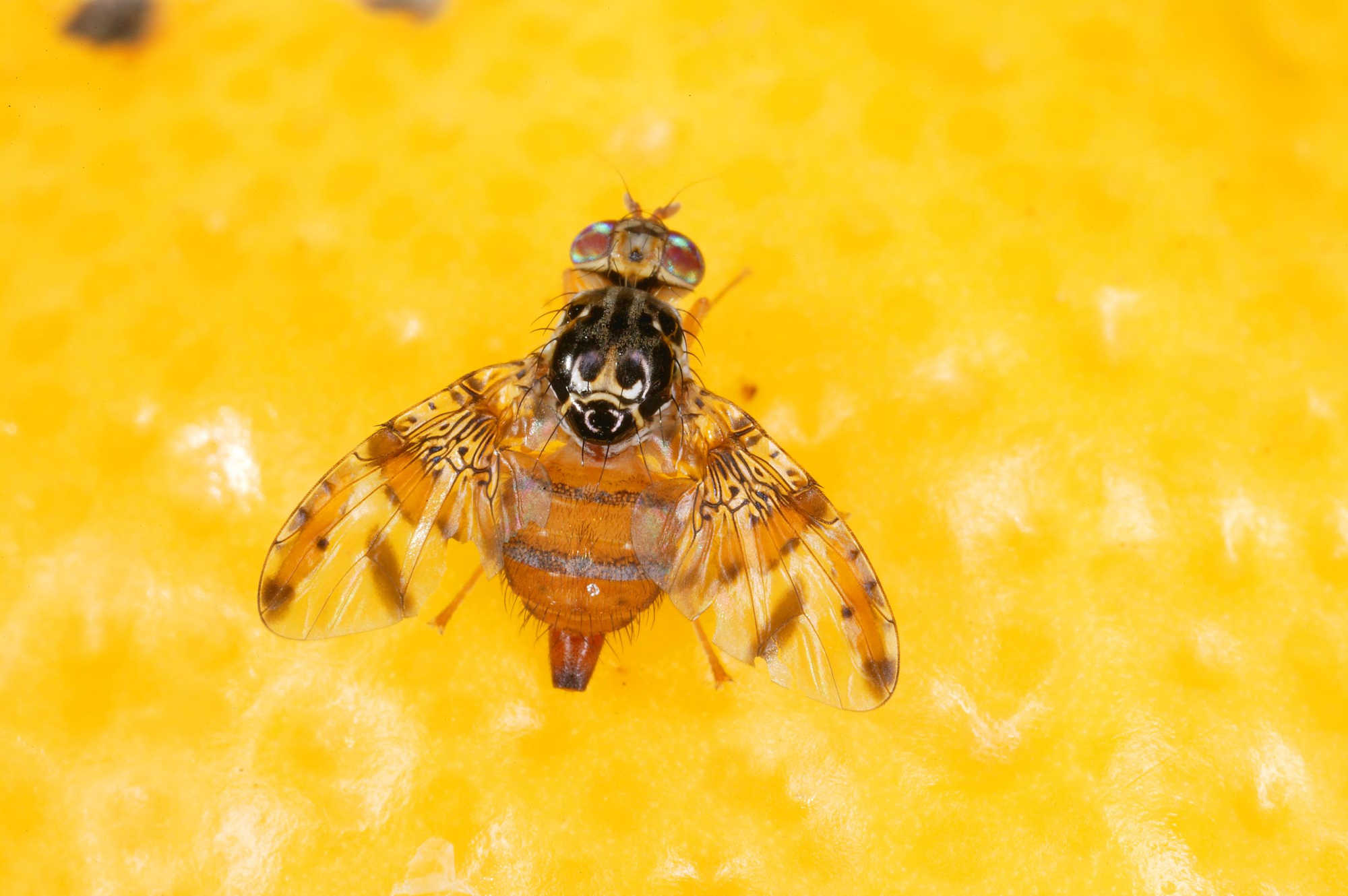
ST. CROIX — Federal agriculture officials have approved an emergency Mediterranean fruit fly eradication program for St. Croix that could include targeted pesticide treatments, removal of fruit from affected properties and the release of hundreds of thousands of sterile male flies, as new USDA documents provide the most detailed account yet of the outbreak and the measures being considered to eliminate it.

The U.S. Department of Agriculture's Animal and Plant Health Inspection Service completed an environmental assessment of the St. Croix program in September and issued a Finding of No Significant Impact, or FONSI, determining that the preferred eradication approach may proceed without preparation of a full environmental impact statement. The finding was signed September 24 by Tina Gresham, acting director of Specialty Crops and Cotton Pests within APHIS.
The federal documents also establish that the St. Croix outbreak is the first Mediterranean fruit fly incident to trigger a federal Medfly quarantine in the U.S. Virgin Islands. USDA describes a proposed quarantine boundary covering approximately 84 square miles — essentially the entire island of St. Croix, excluding its outer islands and cays.
The federal chronology adds significant new detail about how the outbreak developed. APHIS says two male Medflies were discovered separately on St. Croix in January 2026, prompting the federal agency and the V.I. Department of Agriculture to establish a surveillance and monitoring program. Four additional specimens were subsequently confirmed on August 17 and September 2 — three mature males and one unmated female collected from traps in tropical almond trees on residential properties in Christiansted.

In its broader environmental assessment, USDA said the four August and September finds demonstrated an active infestation with breeding potential and triggered federal participation in a regulatory quarantine and eradication program. Survey trapping and inspections have since expanded outward from the Christiansted detection locations.
USDA's response guidelines provide a relatively low threshold for triggering aggressive intervention. For Ceratitis fruit flies, two wild flies found within a three-mile radius during one life cycle can trigger both eradication and quarantine. A single mated female, larva or pupa can also meet the threshold.
The federal documents follow the V.I. Department of Agriculture's September 25 declaration of a phytosanitary emergency and islandwide territorial quarantine. The local department instructed residents not to move fresh fruits, vegetables or host plants off St. Croix and said the objective was to contain and eradicate the pest before it became established in the territory.
Targeted Ground Spraying Could Be Used
USDA evaluated three options: taking no federal action, maintaining quarantine and commodity certification without a coordinated eradication effort, or undertaking an integrated pest-management eradication program. APHIS selected eradication as its preferred alternative.
The eradication program is designed to combine several methods rather than rely on a single treatment. Those measures may include expanded trapping, targeted chemical applications, removal of host fruit, movement controls and, if officials determine it is necessary, the sterile insect technique.
The chemical treatment described in the assessment is not islandwide aerial spraying. If officials find evidence of a breeding population on a property, USDA says potential host trees and shrubs may receive a targeted, ground-based application within a minimum 200-meter radius of the detection.
Program workers could use hand or hydraulic sprayers to apply GF-120 NF Naturalyte Fruit Fly Bait, which combines the insecticide spinosad with a food bait designed to attract the flies. Treatments could be repeated every one to two weeks for approximately one Medfly life cycle — generally 21 to 30 days under local conditions.
The FONSI concluded that the program's methods are target-specific and are not expected to negatively affect public health and safety when used as described. USDA says people known to have pesticide sensitivities would receive advance notice before treatments occur. ea-medfly-st-croix-usvi-fonsi
Residents whose property will be treated, or from which fruit must be removed, are generally to receive at least 48 hours' notice, although work can proceed immediately when a homeowner gives permission during an initial visit.
Fruit Could Be Stripped From Affected Properties
USDA's strategy also contemplates fruit stripping when evidence indicates Medflies are breeding on a property.
If immature flies, a mated female or other evidence of a breeding population is detected, host fruit could be removed from the affected property and adjacent properties. USDA says the stripped fruit would be placed in heavy plastic bags and transported to a landfill for burial beneath at least one foot of fill. Removal could be repeated if additional flies are discovered.
Surveillance will also become considerably more intensive around detection locations.
The August and September specimens were captured with Jackson traps baited with trimedlure, which attracts sexually maturing male Medflies. USDA plans to deploy Jackson traps across a broad area around detection sites, supplemented with Multilure traps capable of attracting both males and females.
Where a single Medfly is confirmed, trapping density increases sharply. Traps in the half-mile core around a detection may be serviced daily for seven days, with additional traps in the surrounding area checked frequently before moving to a weekly schedule. Monitoring continues for three Medfly generations after the last fly is detected.
Sterile Medflies Could Be Released Across Treatment Areas
Perhaps the most unusual component being considered is the sterile insect technique, under which large numbers of sterile male Mediterranean fruit flies would deliberately be released into affected areas.
The sterile males mate with wild females, but no viable offspring result. Repeated releases eventually reduce the wild population until it disappears.
USDA says the technique is already being used in its San Juan Medfly program in Puerto Rico and could be deployed on St. Croix. If selected, APHIS would target releases of at least 250,000 sterile male Medflies per square mile every week within the treatment area.
The flies would be transported from USDA's fruit-fly facility in Puerto Rico to St. Croix and released from ground vehicles traveling existing roads and parking areas. Releases would continue for at least two Medfly life cycles after the last detection. If the outbreak became sufficiently large, USDA said it could consider moving some insect-rearing operations to St. Croix.
The technique remains an option rather than a certainty; the environmental assessment says APHIS “would consider” its use on St. Croix.
Produce Movement Faces Tight Restrictions
The quarantine also carries consequences for farmers, roadside vendors, businesses and residents moving fruits and vegetables.
USDA says commercial and homegrown produce subject to the quarantine may not be moved without inspection, treatment and certification by Medfly program officials. Open-air produce stands, mobile vendors and other fruit handlers would be required to enter compliance agreements requiring them to protect host material from infestation and sell approved produce.
Potential enforcement measures identified in the environmental assessment include mandatory agricultural baggage inspections at airports and seaports, regulatory checks and limited use of road patrols where necessary.
Fresh produce generally should not be moved from properties under quarantine. USDA says fruit and vegetables may be consumed or processed at their place of origin, while movement outside the quarantine requires approved processing or treatment and regulatory authorization.
The restrictions are intended to address the primary way the pest moves long distances: infested fruits carrying eggs or larvae. Female Medflies pierce ripening fruit to deposit eggs, and the larvae subsequently feed inside the pulp, causing the produce to rot. The pest can attack more than 300 kinds of fruits, vegetables and nuts.
USDA says there was no commercial host-crop production within 4.5 miles of the August and September detection sites, although commercial cultivation elsewhere within the proposed quarantine includes crops such as avocado, peppers and mangoes — all potential Medfly hosts.
USDA Finds No Significant Environmental Impact
In approving the preferred approach, USDA concluded that the eradication program would not significantly affect the quality of the human environment.
APHIS said the proposed treatments would be localized, target-specific and designed to minimize exposure. The agency also determined that the program was not expected to significantly harm wetlands, park lands, prime farmland, threatened or endangered species, migratory birds or other non-target wildlife when implemented according to the environmental assessment.
The agency also concluded that the proposed eradication effort should not cause substantial negative economic or quality-of-life effects for St. Croix residents and determined that no full environmental impact statement was required.
The alternative, federal officials warned, carries its own risks. Allowing the fly to become permanently established could result in additional pesticide use, higher agricultural production costs, reduced crop yields, trade restrictions and economic losses.
USDA says eradication programs have successfully prevented Mediterranean fruit flies from becoming established on the continental United States. A similar infestation in Puerto Rico in 2015 was eradicated, while another Puerto Rico Medfly response is underway in 2026.

For St. Croix, federal officials say monitoring and treatment would continue until sufficient time has passed without another detection. USDA's standard calls for the equivalent of three Medfly life cycles after the last specimen is recovered, with at least one life cycle also passing after control treatments end, before an area can be released from federal quarantine requirements.