
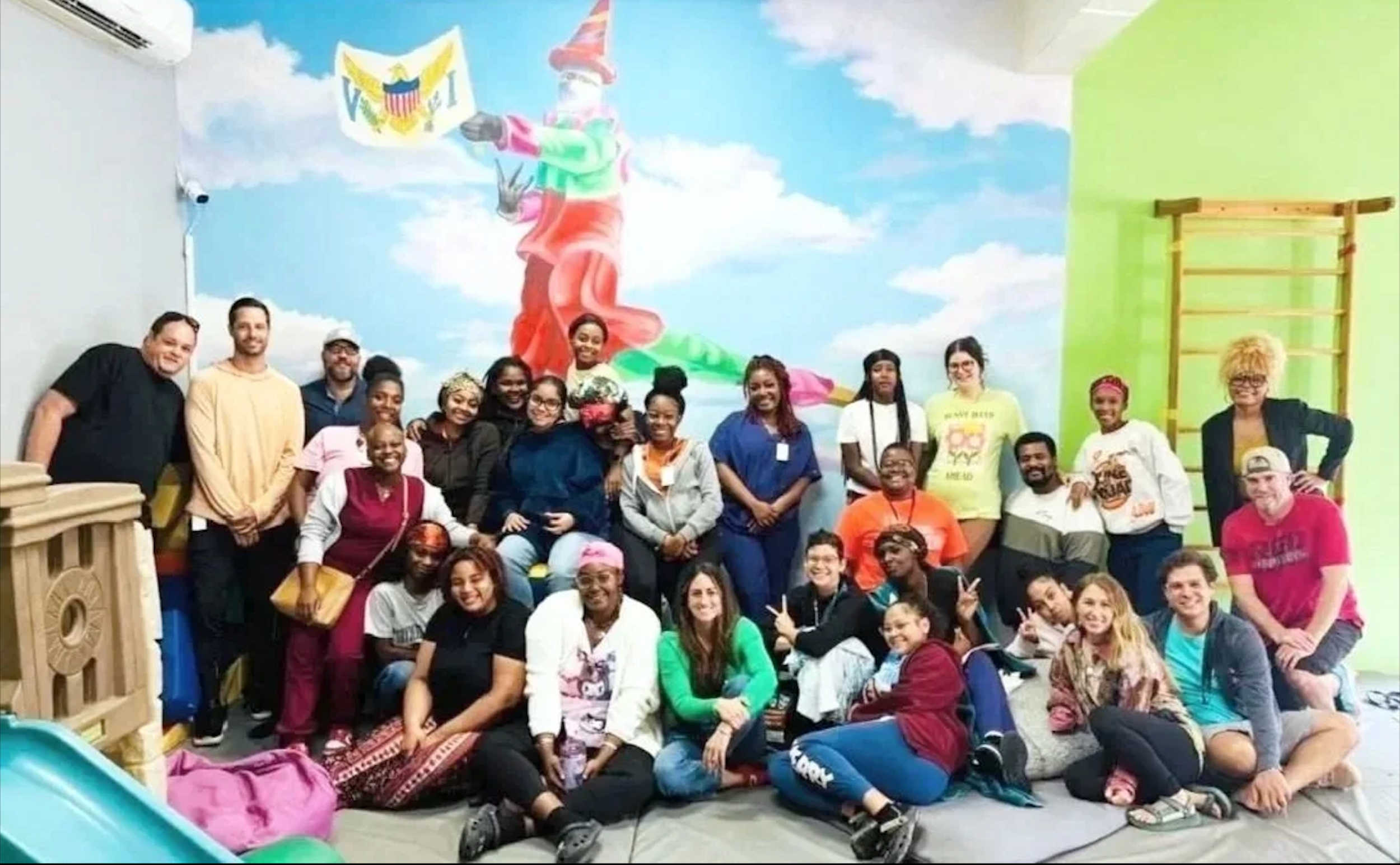
ST. CROIX — Tropical Behavioral Services told Economic Development Commission members Thursday that tax benefits are central to its plans to expand autism and behavioral-health services beyond St. Croix, saying the company currently reaches only 5 to 10 percent of children in the territory who need diagnosis and support and could otherwise face another five to seven years before establishing a St. Thomas facility.
TBS, which currently operates in Castle Coakley, is seeking EDC beneficiary status as it looks to open a second facility on St. Thomas and eventually establish a third location on St. John. Company officials said the tax relief would allow them to hire clinical staff more quickly, improve wages and benefits, expand employee training and accelerate a territory-wide model that has taken seven years to establish on St. Croix.
“They’re a unique team with unique talents, and they’re quietly doing an enormous amount of good for the community,” legal counsel Mark Skandier told commissioners. “Benefits will allow TBS to help more people, to hire more people and do it at an exceptionally faster rate.”
TBS President Kevin Hensley described the Castle Coakley operation as “a preview of what’s to come if we receive these EDC benefits.”
He said families seeking autism services currently face limited options when adequate support is unavailable in the territory. Many parents, he said, “either have to leave the island, or they are left on their own to deal with a situation without training and no clear path forward, watching their child fall further and further behind.”
Executive Clinical Director and co-owner Megan Crowley said TBS is trying to change that experience for families.
“We take the children that don’t get the support and don’t have access to that, and that means a lot to me,” she said, becoming emotional as she described helping a student who had previously been removed from other school placements.
The company’s staffing model makes growth particularly labor-intensive. Rebecca Hensley told commissioners that TBS generally requires one staff member for every client it adds.
“I’ve never worked in a business that staffs one to one. For every client that we bring on, we have to bring on an employee,” she explained. “With this model, as access to services grows, our local workforce grows with it.”
She said the additional cash flow generated by a reduced tax burden could also be directed toward compensation. “We can offer stronger wages and benefits to a labor pool who will then invest those earnings back into the local economy.”
TBS does not have an outside investor, Ms. Hensley told commissioners, leaving the company without the capital it says would be necessary to rapidly replicate its St. Croix operation elsewhere.
“We don’t have the capital,” she said, while maintaining that “we can make this happen” with EDC support.
Training Local Clinicians
Company officials also highlighted their investment in developing a local clinical workforce.
Responding to questions about TBS’s partnership with Endicott College, Ms. Crowley said the company pays the full cost of an employee-training program that extends beyond tuition.
“We’re paying for that 100%,” she said. “We’re covering the cost for their fieldwork supervision…so our employees are getting paid and doing their fieldwork supervision right here.”
The partnership has also resulted in accommodations for TBS employees pursuing professional certification, including permission to complete at least one normally in-person course online.
“We’ve worked really hard with them to make it work with our employees,” Ms. Crowley said.
She described the relationship as essential to developing qualified professionals who can remain in the Virgin Islands.
“We need local clinicians, and there’s no other way to get there,” she emphasized.
Mr. Hensley said the University of the Virgin Islands would also feature prominently in TBS’s future plans, while Ms. Crowley described an existing relationship with UVI that the company hopes to deepen.
Commissioner Questions Financial Case
Commissioner Jose Penn, however, questioned whether the financial information submitted with the application demonstrated that the company truly needed EDC assistance.
“It’s nearly as though you don’t need benefits,” he said after reviewing the figures.
Mr. Penn encouraged TBS to provide more detailed financial projections. “When you’re dealing with this entity, having a more in-depth breakdown is in your best interest.”
Mr. Hensley responded that the company’s apparent financial strength is partly the result of reinvesting almost all of its revenue into the operation rather than accumulating capital.
“It’s taken us seven years to get to this point, but we only serve between five and ten percent of the children that need diagnosis and need our help in the territory,” he said.
EDC benefits, he argued, would allow TBS to accelerate expansion and hire qualified clinical staff more quickly, “so that we get from 5% or 10% coverage of the kids in the Virgin Islands to 40,50,60, and eventually 100% of the kids.”
Mr. Penn said he regarded the work itself as important but remained concerned that the projections did not fully account for the expense of territory-wide expansion.
“I feel like this project, this service is essential,” he said.
However, he added, “If you have buildings that you have to build, furnish, operate, it’s not reflected in your projections.”
As part of its application, TBS has committed to at least $100,000 in capital investment during its first year as a beneficiary and annual charitable contributions of at least $15,000.
St. Thomas Expansion Hinges on Benefits
When commissioners questioned whether the EDC program was the appropriate vehicle for financing TBS’s expansion, Mr. Hensley said the company’s experience establishing itself on St. Croix illustrates how long growth could take without assistance.
“It's been five or seven years and we've finally been able to sort of afford a facility on Saint Croix, without benefits, you know that time frame applies again to Saint Thomas.”
He said the decision to expand to St. Thomas carries financial and operational risks that the company may not be willing to assume without the tax benefits.
“We're like a small family company. A move to St. Thomas brings all kinds of risks. I have personally never done business in St. Thomas. Navigating the business environment there, the real estate environment there is very much a risk that I don't necessarily know that we take if we don't have these benefits.,” he told commissioners.
“To have the confidence to go and recreate what we did on Saint Croix over there without these benefits, it's just simply something we wouldn't necessarily really take on. If I'm being honest.”

With Thursday’s public hearing concluded, the EDC will consider Tropical Behavioral Services’ application and issue a decision at a later date.