

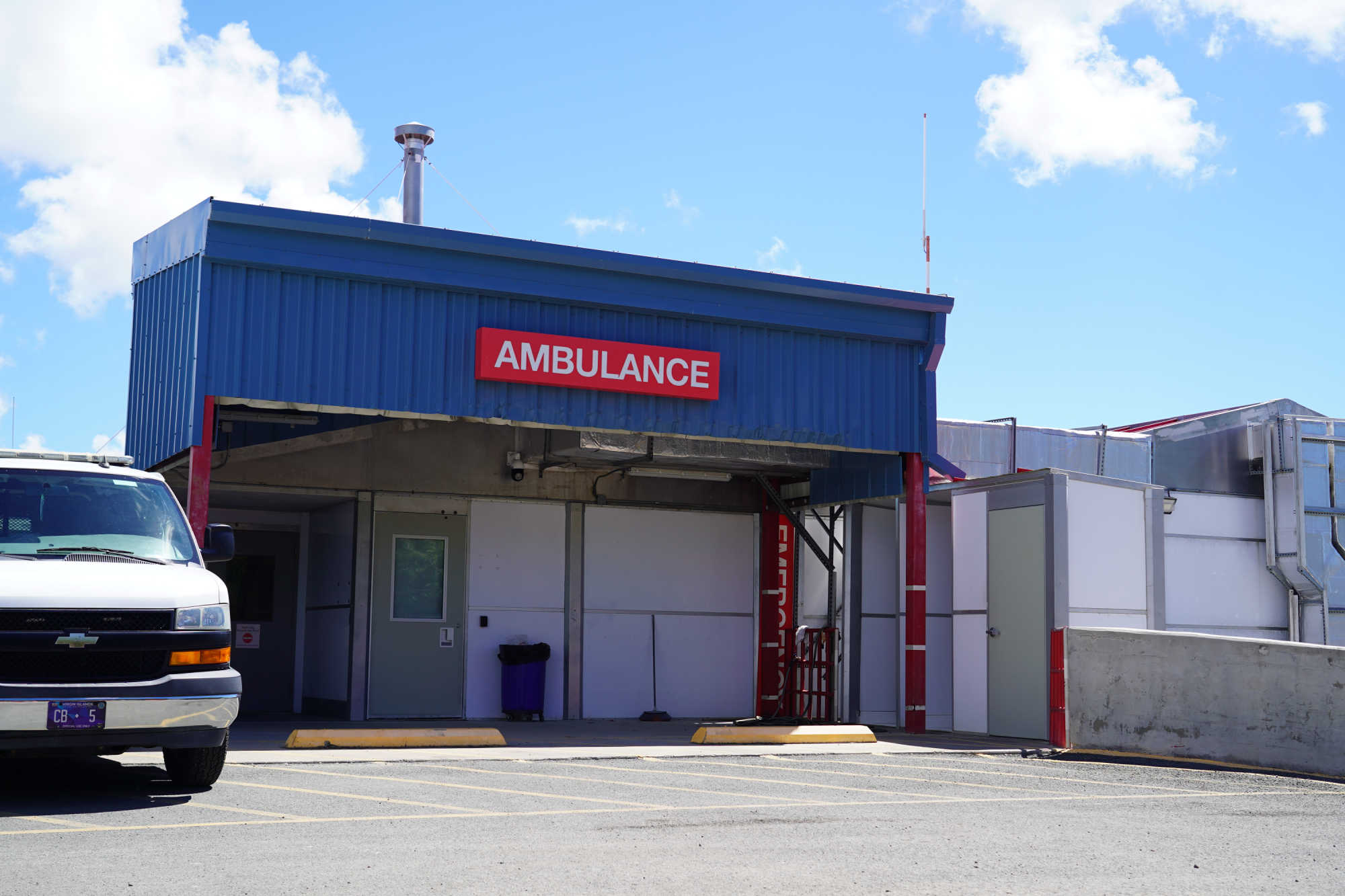
ST. CROIX — The Governor Juan F. Luis Hospital and Medical Center on Wednesday attributed its failure to maintain payments on a medical equipment financing agreement to financial pressures and the effects of a cybersecurity incident earlier this year, responding to a $6.36 million federal default judgment that also orders the return of leased medical equipment and grants creditors rights to hospital assets.

However, the hospital offered no explanation for why it failed to respond to the federal lawsuit or appear in court to defend its interests before the judgment was entered. The omission drew sharp criticism from Senate Vice President Kenneth Gittens, who demanded answers from hospital leadership, its governing board and the Virgin Islands Attorney General.
“This is totally unacceptable and inexcusable. A $6.36 million default judgment involving our public hospital is not simply a financial setback; it is a serious failure of accountability that demands answers,” Mr. Gittens said Wednesday, following The Consortium's reporting on the court ruling.
The hospital, meanwhile, acknowledged that it still owes money under the agreement but said it has made approximately $2.9 million in payments to date. JFL also disclosed that it has identified the outstanding obligation as a priority for funding under Governor Albert Bryan Jr.'s proposed $250 million bond-financing package, which includes $40 million for the St. Croix hospital.

According to JFL, the underlying financial agreement was established in 2024 during a period of significant financial challenges and was intended to help address outstanding obligations and sustain hospital operations.
The hospital said it maintained scheduled payments through October 2025, but its financial circumstances deteriorated the following month.
“Beginning in November 2025, ongoing financial pressures, compounded by the impact of a cybersecurity incident earlier that year, affected the hospital's ability to maintain its previous payment schedule at the previously established level,” JFL stated.
Hospital officials said they communicated those challenges to the vendor and continued making payments as financial resources permitted. However, the statement did not provide a detailed accounting of the approximately $2.9 million paid, including how much was remitted after October 2025 or how those payments relate to the $6.36 million judgment.
While the statement addressed the financial circumstances surrounding the missed payments, it did not address the hospital's failure to participate in the legal proceedings, a matter Mr. Gittens identified as a serious concern.
The senator noted that since the lawsuit was filed on March 31, 2026, JFL officials had appeared before the Legislature at least three times, including twice before the Committee on Health, Hospital and Human Services and once before the Committee on Finance during budget hearings.
Despite those appearances, the hospital and the Virgin Islands Government Hospitals and Health Facilities Corporation failed to answer the complaint or appear at the September 21 federal court hearing in Michigan.
“How in the world did this happen, who knew about it, and why was this matter not addressed before it reached this point?” Mr. Gittens asked.
He called on the Virgin Islands Attorney General to publicly explain what legal action was taken on behalf of the hospital, why the defendants failed to respond and appear in court, and what steps are now being taken to address the judgment and protect the public's interests.
As The Consortium reported Wednesday, U.S. District Judge Brandy R. McMillion entered a $6,357,600 default judgment against JFL and the territorial hospital corporation on September 22 in favor of VFI KR SPE I LLC and Varilease Finance, Inc.
The creditors filed their lawsuit in March, alleging that JFL breached a two-year lease agreement that began April 1, 2025, and required monthly payments of $149,400 for approximately $6 million worth of medical equipment.
According to the complaint, the hospital made only a partial payment in November 2025 and failed to make payments in December 2025, January 2026 and February 2026. The companies also alleged that JFL failed to provide required financial statements covering several fiscal years.
After receiving no response from either defendant, the plaintiffs obtained a default judgment carrying 13 percent annual interest on the unpaid monetary award.
Judge McMillion also ordered the hospital to return the equipment identified in a 30-page inventory within 30 calendar days of the September 22 ruling. That deadline expired October 22.
The equipment includes ventilators, operating tables, ultrasound scanners, infant incubators, hospital beds, patient monitors, sterilization systems and other medical devices and operational equipment.
The court further ordered foreclosure of an existing all-asset lien, granting the creditors immediate possession of assets covered by their security interest. The monetary judgment must be reduced by the resale value of equipment returned or seized and any other assets delivered to the creditors.
The judgment was registered Tuesday in the District Court of the Virgin Islands, opening the way for potential enforcement proceedings locally.
JFL addressed concerns about the potential loss of equipment essential to patient care, stating that no medical equipment had been removed by the hospital as of Wednesday.
“We understand the concerns raised regarding the medical equipment referenced in the court judgment, particularly its importance to patient care,” the hospital said.
“As of this statement, the hospital has not removed any medical equipment. Maintaining access to the equipment and resources necessary for patient care remains a priority as the hospital works with legal counsel to address this matter.”
JFL did not say whether it has sought a stay of the judgment, negotiated an extension of the equipment return deadline or reached any agreement with the creditors to prevent repossession.
The hospital said it has identified the outstanding obligation as a high payment priority and included it among the financial needs it hopes to address through the administration's proposed bond package.
Governor Bryan submitted the $250 million financing proposal to the 36th Legislature on October 23. The legislation would provide $45 million to Schneider Regional Medical Center and $40 million to JFL, along with funding for the Virgin Islands Water and Power Authority, Waste Management Authority, tax refunds, retroactive wages and other government obligations.
The financing remains subject to legislative approval, and the hospital's statement did not specify how much of its proposed $40 million allocation would be directed toward satisfying the judgment.
For Mr. Gittens, the administration's request for additional borrowing makes the questions surrounding JFL's handling of the lawsuit even more pressing.
“We cannot continue to ask taxpayers to finance government failures without demanding accountability from those responsible," Mr. Gittens said. "With the Administration seeking legislative approval for a $250 million bond-financing package that includes funding for our hospitals, the public deserves to know how these obligations are being managed.”
The senator said he recognizes the hospital's financial difficulties but maintained that those challenges do not excuse failures in oversight or the protection of the institution's interests.
“I recognize the serious challenges facing JFLH, but those challenges do not excuse inaction, poor oversight, or a failure to protect the institution,” Mr. Gittens said.
He also called for hospital leadership and the Territorial Board to account for their handling of the matter.
“Hospital leadership and the Board must answer for their actions – or lack thereof – and the Attorney General must provide an explanation. Accountability is not optional, transparency is non-negotiable, and the people of the Virgin Islands deserve nothing less.”

JFL, for its part, said it remains committed to addressing the outstanding obligation while maintaining essential healthcare services for St. Croix residents.