




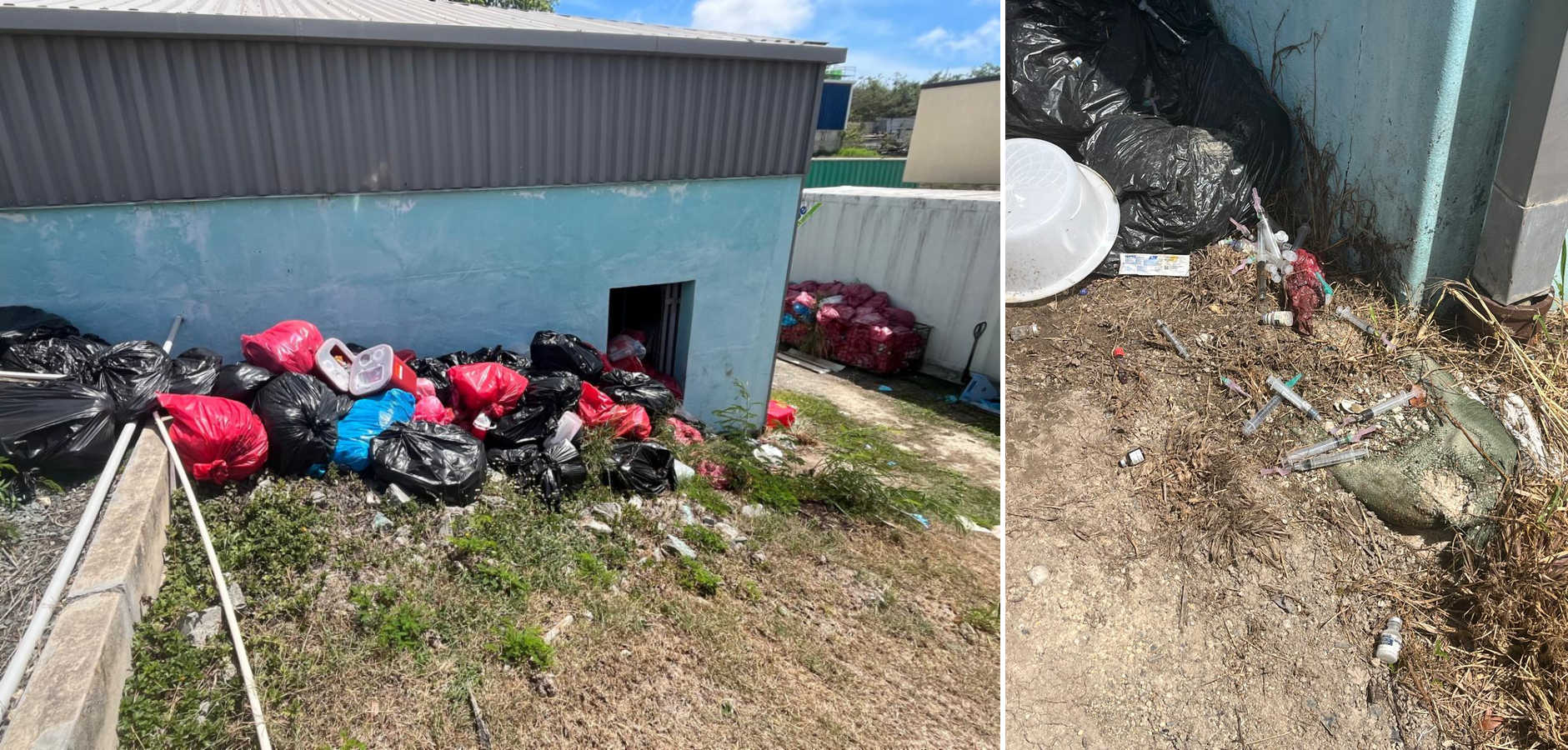
ST. CROIX — Senate Vice President Kenneth L. Gittens called Monday for immediate action to address medical waste behind the Governor Juan F. Luis Hospital, saying he found torn bags overflowing with needles, blood vials and other discarded medical materials.

In an October 5 statement, Mr. Gittens said an anonymous source alerted him to the situation before he visited the area and contacted hospital officials. “What I saw was alarming — torn bags on the ground overflowing with medical waste including needles and blood collection materials, blood vials and bandages,” he said. “My concern is for public health and the real risk this poses to the hospital employees and patients in particular. We need to ensure that there are proper protocols in place.”
The senator said he met with Chief Operating Officer Adeline Williams-Connor because the hospital’s chief executive was unavailable at the time. According to his account, he was told that a private hauler handles the hospital’s medical waste, that there were difficulties getting it off-island, and that another trailer for storing the waste would not be available until next week.
Mr. Gittens urged hospital leadership to find an immediate solution, even if temporary. He said the area received some cleanup after his visit, but maintained that the problem remained far from resolved. The release did not identify the private hauler or explain the reported difficulties with off-island transportation.

General guidance from the Centers for Disease Control and Prevention calls for storing regulated medical waste in labeled, leak-proof, puncture-resistant containers and disposing of it regularly to avoid accumulation.
A member of the Legislature’s Committee on Health, Hospitals and Human Services, Mr. Gittens said he had brought the matter to committee Chairman Ray Fonseca and hospital board Chairman Dr. Jerry Smith and asked that it be addressed immediately.
He also proposed evaluating on-island treatment capacity as a contingency: “I have asked the COO and the Hospital Board Chairman to secure additional appropriate dumpsters and explore the cost and feasibility of establishing additional on-island medical waste treatment capacity, including an appropriate medical waste sterilization system, such as an autoclave, and/or a medical waste incinerator, subject to applicable regulatory and environmental requirements. We should determine whether having such capacity available could provide the hospital with a more reliable contingency option when off-island transportation or disposal becomes a challenge,” Mr. Gittens said.
The territory’s reliance on off-island medical-waste disposal has drawn legislative attention before. In November 2024, The Consortium reported on legislation sponsored by then-Senator Donna Frett-Gregory to require a territorial medical-waste management plan and regulations. Governor Albert Bryan Jr. approved the measure, Bill No. 35-0408, on December 31, 2024, according to his transmittal letter to the Legislature.

Mr. Gittens said raising the issue was intended to draw attention to conditions needing correction, rather than create unnecessary public fear about the hospital. He described JFL as essential to the territory’s healthcare system and acknowledged the work of its staff, while arguing that the institution’s importance required difficult questions when problems arise. He added, “We have a responsibility to support our hospitals, but supporting our hospitals also means holding those responsible for its operations accountable."