




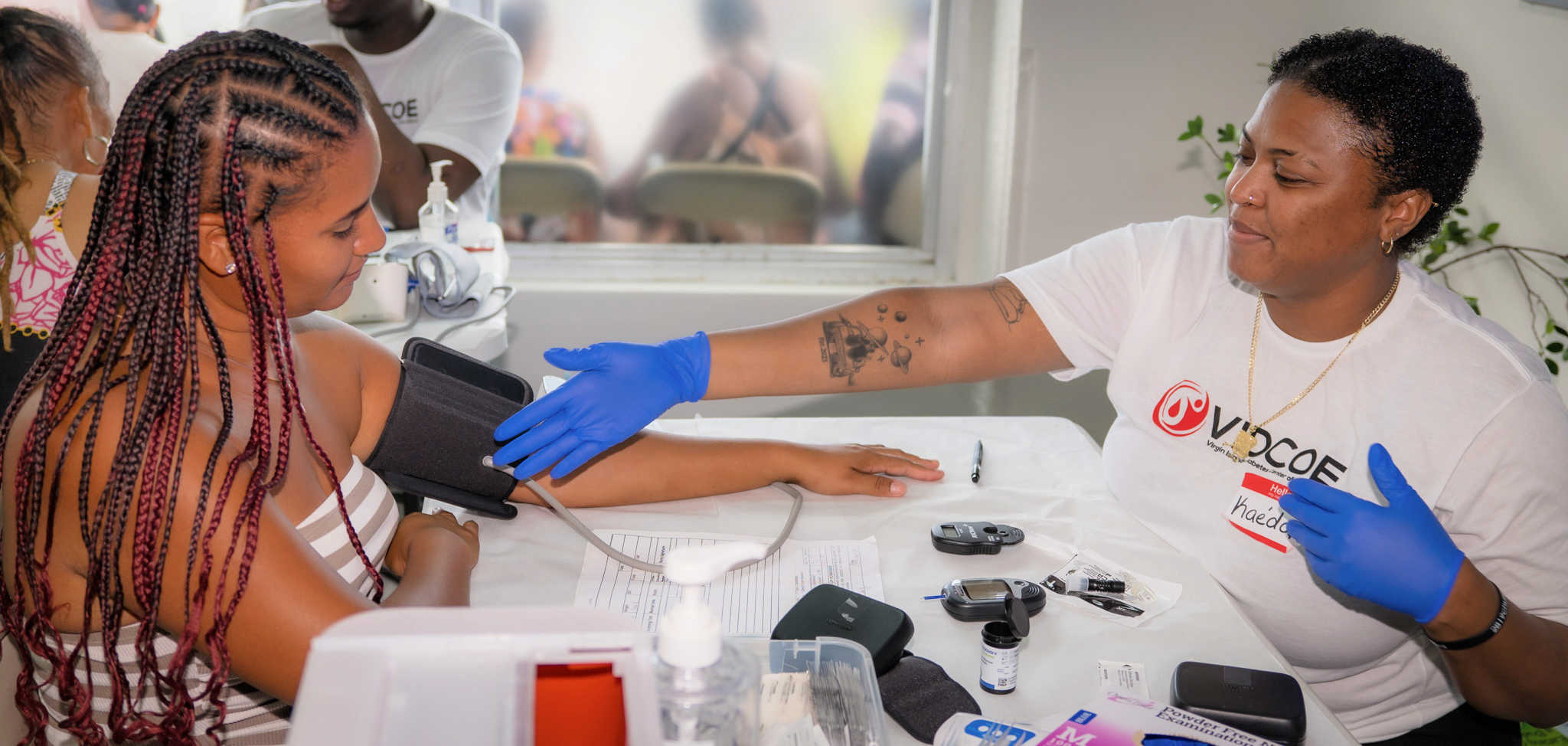
ST. CROIX — A bill seeking $1 million for the Virgin Islands Diabetes Center of Excellence advanced out of the Committee on Budget, Appropriations and Finance on Tuesday, with lawmakers proposing to reduce the allocation to $750,000 and restore a separate $500,000 appropriation for the center's existing operations.

The proposed changes emerged amid concerns about the suitability and financial condition of the Community Facilities Trust Fund, which Bill No. 36-0302, sponsored by Senator Novelle Francis, originally identified as the source of funding for the center's Chronic Care Management Program.
According to VIDCOE Executive Director Dr. Julia Sheen, the proposed program is “designed for patients living with diabetes and multiple associated conditions.” It would identify high-risk patients and develop individualized care plans, with staff coordinating regular contact, patient education, specialist referrals, and follow-up care after emergency treatment.
Dr. Sheen explained that the requested $1 million would “build on infrastructure already in place,” with 64 percent allocated to the “workforce needed to deliver care management.” The remaining funds would support technology, electronic health record integration, communication systems, and remote-monitoring equipment.

She assured lawmakers that the funding was “intended as capacity-building support, not an assumption of perpetual public subsidy,” indicating that VIDCOE would not seek a recurring appropriation for the new program.
Senator Francis described the proposal as “a strategic investment in the Territory's healthcare services by expanding access to coordinated, high-quality care for residents living with diabetes and related conditions.”
He said that “in accordance with Act 7012, permission to allocate the committee's trust fund was requested by Governor Albert Bryan Jr.” According to Mr. Francis, that permission was granted.
However, several lawmakers questioned whether the Community Facilities Trust Fund was the appropriate source for the proposed expenditure.
Senator Marvin Blyden expressed support for the center's work but questioned the proposed funding mechanism. “That funding source, I don't think, aligns with what you're trying to do,” he said.
Senator Dwayne DeGraff cited findings from the Legislature's Post Audit Division, which reported that “according to the Department of Finance, the Community Facilities Trust Fund lacks sufficient reported resources to support the proposed $1 million appropriation.”
Mr. Francis responded that the Department of Finance had assured him that “in FY 2027, there will be between $1 million and $2 million placed in that account.”
Senator Kurt Vialet raised a separate concern about whether the appropriation would be consistent with the fund's intended use. He noted that the Community Facilities Trust Fund “is supposed to be utilized for the development, operation, and maintenance of community and/or sports facilities or urban redevelopment projects.”
“You could go a far stretch and try to fit it under, but we would be setting precedents by placing it under this particular funding source,” Mr. Vialet remarked.
As an alternative, Mr. Vialet informed Dr. Sheen that lawmakers intended to provide a one-time $750,000 allocation for the Chronic Care Management Program, reducing the original request by 25 percent. He also said the Legislature would restore a $500,000 miscellaneous budget allocation for VIDCOE's existing operations that had been inadvertently omitted.
Dr. Sheen had appealed for the restoration of that funding during her testimony, describing it as “instrumental in sustaining VIDCOE's existing operations.” She emphasized that the operational appropriation and the requested funding for the Chronic Care Management Program were “complementary, not duplicative.”
When asked whether VIDCOE could proceed with the reduced $750,000 allocation, Dr. Sheen assured Mr. Vialet that the center would “definitely work with that.”
The proposed adjustments would still require legislative action as the bill moves through the Committee on Rules and Judiciary.
Despite the emerging compromise, Senator Hubert Frederick remained opposed to directing additional money to the nonprofit organization, arguing that government healthcare facilities were already struggling with insufficient resources.
“We have two hospitals that are haemorrhaging; they don't even have money for supplies…This is a diversion of funds that's supposed to go to an agency within our government, and that's my fundamental issue,” he said.
While acknowledging that VIDCOE provides valuable services, Mr. Frederick warned against establishing a practice of redirecting funds intended for specific purposes to organizations favored by lawmakers.
“I don't want other people to come up here and do the same thing. Then we're gonna have to pick winners,” he said.
“We can't start taking money from funds that are specific to help an organization that we like, just because we like you,” Mr. Frederick continued. “I don't pick teams because I just like them. It has to be because the rules are the rules. I use the funds as they are intended to be used.”
Dr. Sheen pushed back against the suggestion that government healthcare agencies could independently meet the territory's chronic disease management needs.
“If we think that the local government can provide services comprehensively to this population, then we are truly misguided in that thought. You need organizations like VIDCOE, like the health centers, and other healthcare organizations that are nonprofit organizations,” she said.
Mr. Francis defended his effort to secure funding for the program, maintaining that the need for expanded diabetes care justified exploring available financial resources.

“I believe that with creativity…we could see where it will be justified for us to be able to use this fund,” he said. “I'm not looking to be creative because I like VIDCOE, [but] because there is a need for it.”