




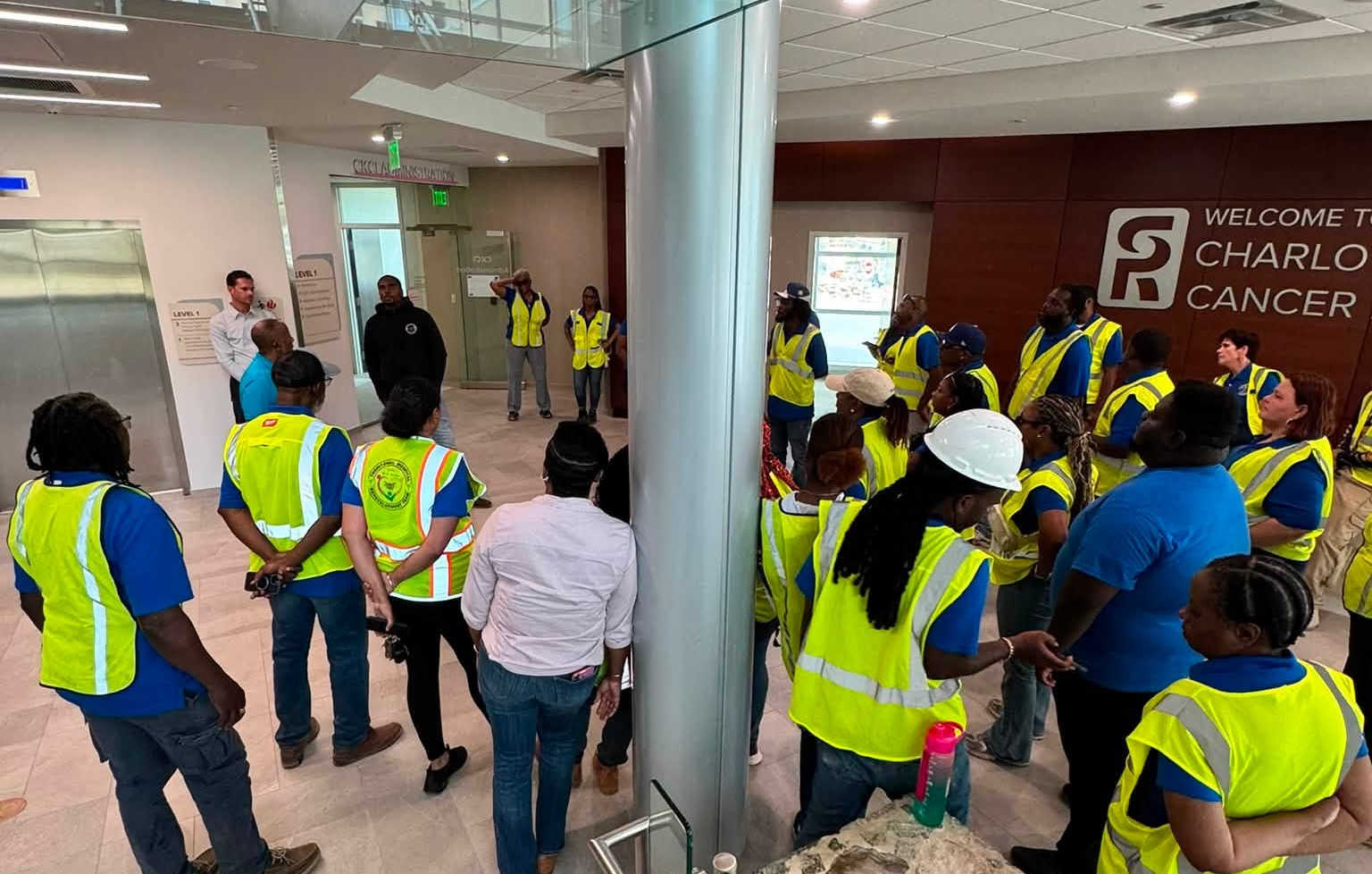
ST. THOMAS — Construction of the Charlotte Kimmelman Cancer Institute is 99 percent complete, with officials targeting November 2026 for the return of cancer-care services closer to home as they work through equipment procurement, staffing, regulatory and operational-readiness requirements.

The facility has reached “substantial completion with all major systems…installed and fully operational,” Darlene Baptiste, chief executive officer of the territory’s hospitals, told the Senate Committee on Health, Hospitals and Human Services on Wednesday.
Darryl Smalls, executive director of the Territorial Hospitals Reconstruction Team, and Ms. Baptiste said the remaining work is focused largely on preparing the institute to receive patients rather than completing major construction.
However, officials are still confronting challenges involving minor medical and information-technology equipment. The project also carries uncertainty over a 2 percent local match that reconstruction officials had intended to cover using HUD funding administered through the V.I. Housing Finance Authority.

Ms. Baptiste said specialized equipment, including the CT simulator and linear accelerator, is undergoing “ongoing commissioning, calibration, acceptance testing, and radiation safety verifications prior to its clinical use.”
Funding for a PET scanner has been approved through community project funding, and CKCI is “waiting notification from the U.S. House of Representatives to that award,” she said.
The scanner is expected to improve cancer diagnostics by “improving disease staging, treatment planning, and post-treatment surveillance while reducing the need for off-island travel.”
As the contractor completes minor remaining tasks, hospital leadership will concentrate on “establishing clinical governance, workforce readiness, operational systems, quality assurance, regulatory compliance, and patient care processes.”
That work includes commissioning equipment, integrating medical records, procuring and installing additional equipment, recruiting and onboarding personnel, and validating workforce policies.
CKCI has recruited radiation oncologist Dr. Jacqueline Dunmore Griffith and administrator Angela Warner.
Several other positions must still be filled, including radiation therapy professionals, medical physicists, oncology nursing support, pharmacy personnel and administrative employees.
“Our goal is to offer patients a seamless experience from diagnostic to treatment through follow-up care, while minimizing off-island travel, whether clinically appropriate,” Ms. Baptiste told the committee.
When the institute reopens, it is expected to provide “radiation oncology services supported by a multidisciplinary team.”
Ms. Warner anticipates that CKCI could serve between 20 and 25 patients each day once the radiation oncologist and supporting personnel are in place.
CKCI was among several critical healthcare facilities heavily damaged by the 2017 hurricanes.
Federal funding allowed the institute to be rebuilt within its existing footprint using modern designs and construction requirements. The new structure is expected to withstand Category 5 winds and rain.
Of the project’s $35,186,153.39 contract value, $34,932,144.84 has been spent.
A contract has also been executed for furniture, fixtures and equipment, which could be installed “as early as September 2026,” Mr. Smalls said.
Mr. Smalls identified the procurement of minor medical equipment as “one of the greatest challenges” facing the project.
Solicitations have resulted in “non-responsive bids,” he said during the discussion with lawmakers, including Senator Novelle Francis.
Despite those difficulties, Mr. Smalls said procurement efforts were continuing within the applicable rules.
“all efforts to procure this equipment is being undertaken while ensuring that we comply with all applicable procurement rules…”
Obtaining information-technology equipment has also presented difficulties. Those delays will not prevent construction from being completed, but Mr. Smalls warned that “delays in the delivery and installation could affect the facility's operational readiness.”
He later told Senator Marvin Blyden that officials remain confident the necessary minor medical equipment will arrive before the planned opening.
“we are confident that we're going to be able to have that equipment in the territory in time for the opening as we have scheduled moving forward.”
Senate President Milton Potter questioned whether the facility would be ready in November.
“I always leave room for, you know, disappointments. But yes, I am confident that we will be able to make this happen because it's a collective effort by the team,” Mr. Smalls responded.
HUD Suspension Raises Question Over 2% Match
The project carries a 2 percent match that THRT intended to cover using HUD funding awarded to the territory through VIHFA.
Mr. Smalls confirmed to Senator Carla Joseph that the match funding has not been drawn down and would not be accessed until the “end of the project.”
Asked whether HUD’s suspension of VIHFA could affect the funding, he said it would be “premature” to reach a conclusion.
“We all received a notification of what transpired, so as the assessments are going through, we'll be able to make that final determination,” he added.
Ms. Joseph expressed concern about the potential consequences for completing the cancer institute.
“We have a lot of people who have cancer; they need that treatment. He's going to need the money to be able to pay off this cost with a 2% match… I am hopeful that there will be some concessions by HUD…” she stated.
Nearly $4.92 Million Needed to Operate CKCI
The estimated cost of operating CKCI in 2027 is $4,916,280.
Ms. Baptiste said the amount covers startup costs and four positions. That funding would be required in addition to the money needed to operate Schneider Regional Medical Center and the Myra Keating Smith Community Health Center.
The CKCI estimate covers “personnel, medical supplies, pharmaceuticals, technology, utilities, maintenance, and other resources essential for safe radiation oncology services,” she testified.
Expected funding sources include “projected patient service revenue, the Government of the Virgin Islands appropriation, and other operational service sources.”

Ms. Baptiste said executive leadership would “closely monitor financial performance to ensure sustainability and maintain the high quality of cancer care.”