




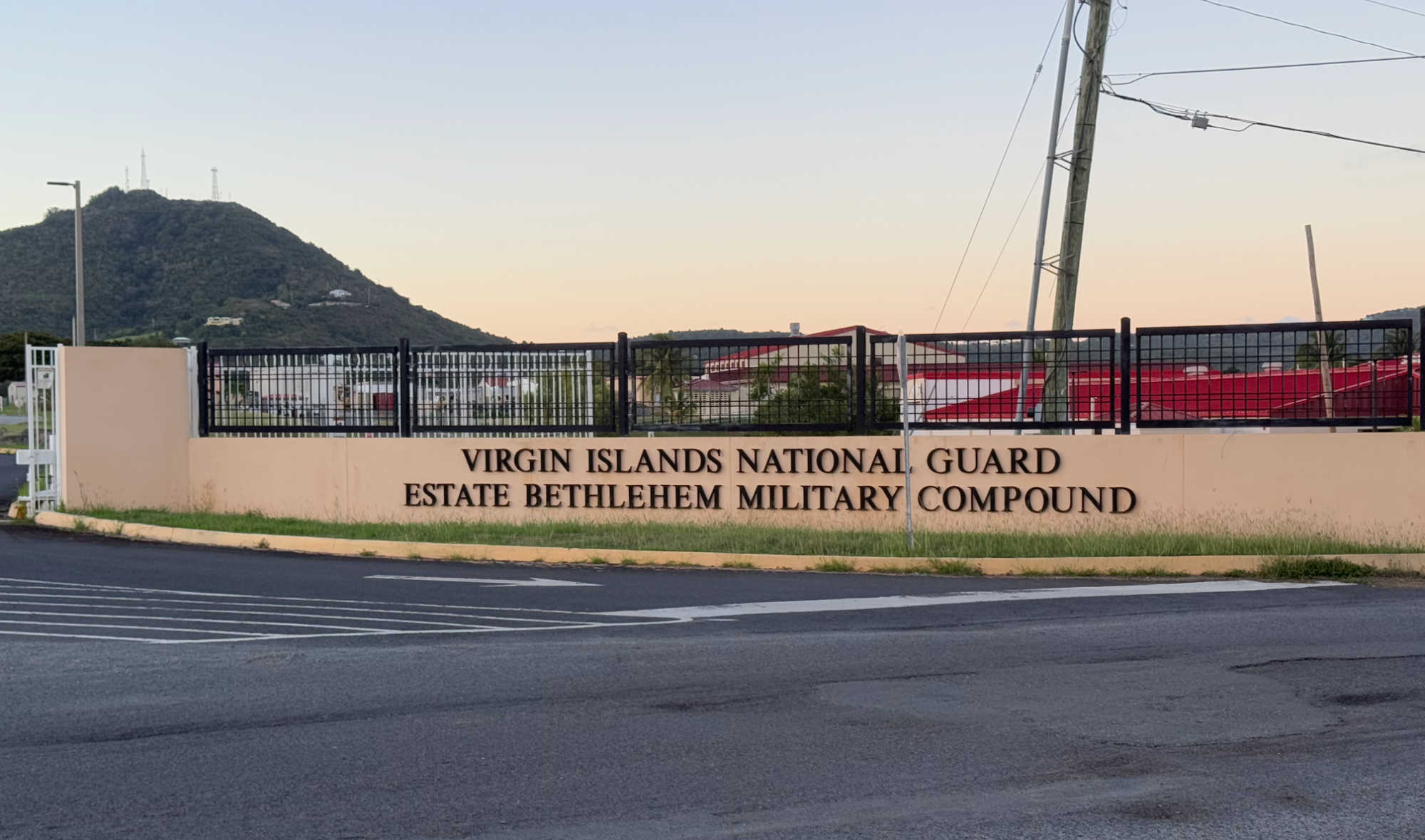
The Office of the Adjutant General told lawmakers Wednesday that delayed allotments from the Office of Management and Budget continue to affect V.I. National Guard operations, including payments owed to retired Guard members, while also raising concerns about federal matching funds and vendor obligations.

Major General Kodjo Knox-Limbacker described the agency’s challenge as the “Three As: what's appropriated, what's allocated, and what actually shows up in VING's budget.” He made the statement while presenting OTAG’s budget request before the Committee on Budget, Appropriations, and Finance.
For fiscal year 2027, OTAG is requesting $3,503,999 from the General Fund to “sustain a Ready, Relevant, Responsive, and Lethal Army and Air National Guard Joint Force.” The local request is “16 times less than the federal projected contribution of $56,377,323.92.”
Of the $3.5 million request, $150,000 is earmarked for the National Guard Pension Fund, which provides a “monthly stipend to qualified, retired Virgin Islands National Guard members,” according to OTAG Executive Director Nikita Ward. Another $200,000 would be deposited into the Territorial Active-Duty Fund.

Those annual appropriations are considered vital by the Virgin Islands National Guard. However, lawmakers heard that current-year allotments from OMB have been delayed. Ms. Ward said the last allotment was released in February 2026.
“We're still working with the Office of Management and Budget in effort to release appropriating funding for our operations” Ms. Ward said.
MG Knox-Limbacker attributed the delays to “fiscal constraints” and the government’s priorities. After “higher priority requirements are met,” he told Committee Chair Senator Novelle Francis, “then we wait for our turn into the queue to go back to the allotment and drawdowns.”
“We've only received. $1.1 million and we still have $2 million left to be allocated to us,” MG Knox-Limbacker explained.
The delayed funding has affected VING’s ability to make payments to 38 qualifying veterans. “Everyone is owed for third quarter and fourth quarter, because those releases, we haven't received as yet,” Ms. Ward told Senator Dwayne DeGraff, who was concerned to learn that retired veterans had not received what they are owed.
Upon closer review, however, Senator Francis found that OTAG had received a $75,000 disbursement that was already in its account. With 30 veterans receiving $350 monthly, the total monthly disbursement is $10,500.
“So you have within your purview at least seven months to be able to cover those payments…So, there's no need right now for a delay in those payments,” Senator Francis said.
Senators Marise James and Kurt Vialet also questioned the justification for the non-payment.
Ms. Ward said the matter was tied to procedure. “We need the authorization letter from OMB, that we haven't received, in effort to submit the fund payment in the ERP system,” she told Senator Vialet.
According to OTAG, formal documentation has been sent to release funding for all four quarters, but only two quarters were granted. Those processes are required because the funding comes from the Miscellaneous section of the budget. Senator Francis said he would contact OMB to determine the status of the authorization letter.
MG Knox-Limbacker warned that delays in payments to retired Guard members could affect the Guard’s ability to recruit and retain personnel.
“Today’s recruits look closely at how we treat yesterday’s veterans,” he said. Persistent delays, he added, could “severely damage our current recruitment and retention metrics.”
OTAG is hoping the same allocation challenges do not continue in FY2027, particularly because the $3.5 million local request includes $595,000 to execute the cost share for federal funds under the FY2027 Master Cooperative Agreement Program.
Colonel Deborah Lobbenmeier said VING anticipates an “overall funding increase of 10% over FY2026 actuals, going from total funding of $47.8 million in2026, to $53.3 million in 2027.” She described the matching fund as “crucial because the federal share cannot be committed without the territory’s percentage being available.”
MG Knox-Limbacker also warned that “persistent local payment delays put out federal matching dollars at risk.” Vendor payments have also been affected by local revenue shortfalls.

Notwithstanding those challenges, VING intends to continue executing its local and federal duties.