




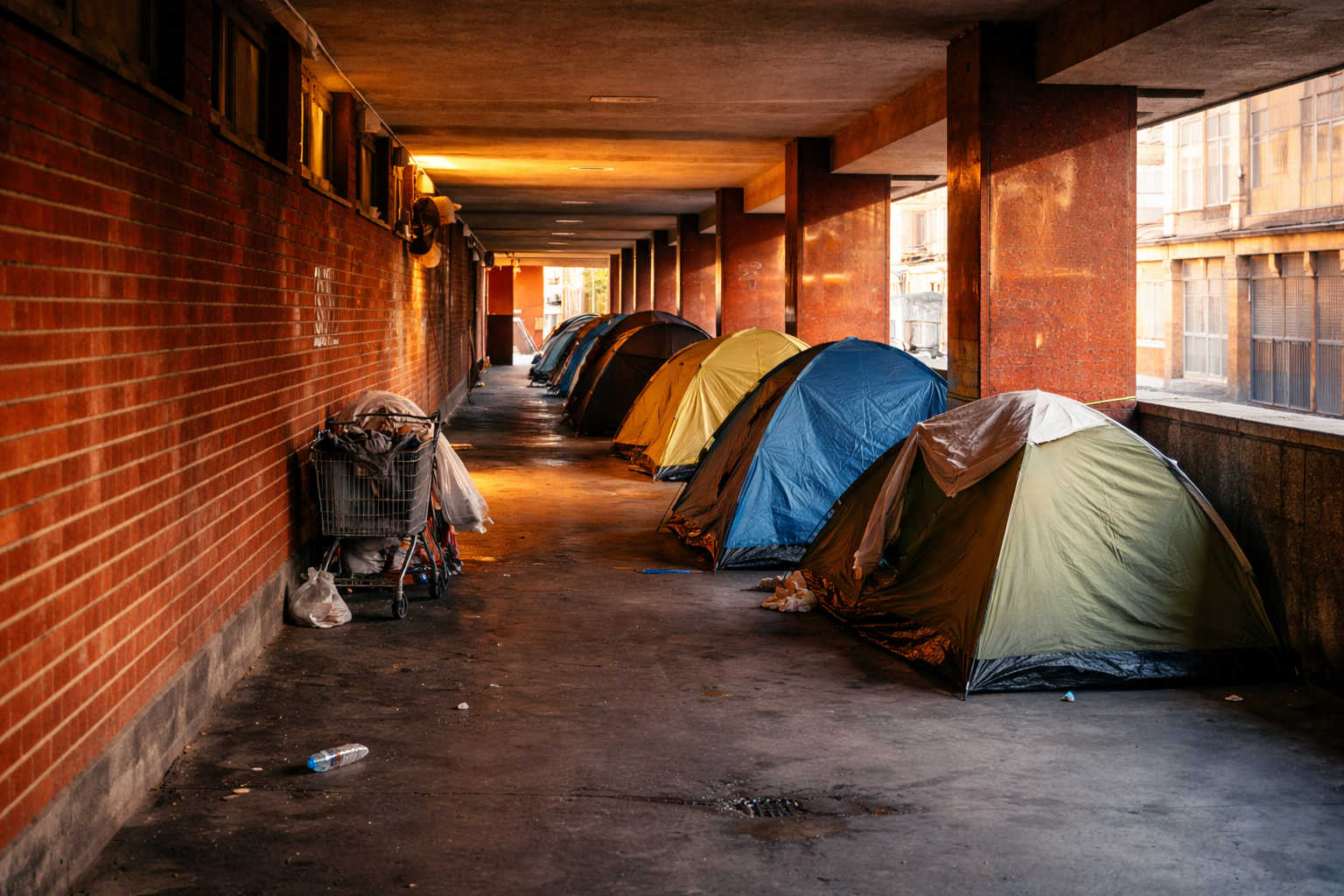
With new Supplemental Nutrition Assistance Program requirements taking effect September 1 and as many as 5,000 Virgin Islanders potentially affected, housing, homelessness and social-service officials are warning that even a partial loss of benefits could deepen food insecurity, push more residents toward unstable housing and leave the territorial government and nonprofit providers absorbing additional costs.

The concerns surfaced Friday during the monthly meeting of the Continuum of Care Council on Homelessness, where representatives discussed preparations for the new SNAP work and volunteer requirements and what could happen when recipients who have not met them check their Electronic Benefits Transfer cards next week.
“I’m not sure if the whole community has a realistic understanding of how detrimental this is to the whole system of people being able to be fed in the Virgin Islands,” said Emmanuela Perez-Cassius, representing the Virgin Islands Housing Authority.
Sarah Burke of the Department of Human Services said the agency is preparing for an influx of residents seeking help once the rules take effect. DHS continues to estimate that roughly 5,000 people could potentially be affected, although Ms. Burke did not provide an estimate of how many have actually failed to satisfy the new requirements and will lose benefits.

“We understand that when they check their EBT cards and no benefits are going to be there, it’s going to be really hard, and so they’re going to be coming in,” she said.
DHS has arranged a multi-partner outreach effort during the first half of next week, when Ms. Burke said the department typically experiences the most traffic. Residents who discover that their benefits have been interrupted will be able to meet participating organizations on-site and attempt to correct deficiencies in their qualifications in hopes of restoring federal food assistance the following month.
Concern Over Who Absorbs the Cost
“My concern is…who’s going to absorb the cost in the territory,” Ms. Perez-Cassius said.
She expressed concern that a significant number of recipients could fall off the SNAP rolls despite efforts to help residents meet the requirements. VIHA and its partners have been working to ensure that clients complete the necessary paperwork and appear on volunteer lists, but response has been limited.
“We have made a lot of initiatives to ensure that the people [are] getting the right paperwork [to] ensure that their names are on the volunteer list, and we’re not getting a lot of feedback. And I’m starting to get nervous,” she said.
Karen Dickenson, founder and CEO of The Collective Collaboration, questioned whether employment could realistically substitute for SNAP assistance for thousands of affected residents.
“Employment is very limited here,” she said.
Ms. Dickenson argued that the SNAP changes must also be viewed alongside broader reductions in federal assistance, saying her organization is already seeing signs of growing need through its weekly food distributions.
“I don’t know if we’re looking at the entire picture,” she said. “I’m seeing it just from the food distribution that we do on Thursdays. People, the lines are getting longer…and people are concerned.”
She warned that rising food insecurity could spill into other social problems, including homelessness and crime.
“You talk about the criminal element, and you talk about the sufferation. You talk about the expansion of homelessness, and when we look at all of this, it doesn’t bring our community to a good nucleus in terms of serving our people.”
Ms. Dickenson predicted that some people already living at the margins could turn to petty theft or robbery after losing a dependable source of food assistance. “When that is gone, the next thing is to rob, steal. So it’s compounding. When you think you solve one problem, another problem is created.”
She also criticized the territory’s level of preparation, arguing that the looming impact had been foreseeable. “We knew what was happening, and the powers that be didn’t take a concerted effort to look into this.”
Homelessness Providers Call Situation a Crisis
Continuum of Care Council on Homelessness Chair Danny Derima agreed that the territory is approaching a serious situation.
“It is of a crisis position here in the territory,” he said.
Mr. Derima questioned the practicality of requiring people already struggling to meet basic needs to become more self-sufficient under increasingly restrictive conditions. “It’s challenging to ask persons that have some difficulty in sustaining themselves to become more self-sufficient,” he said. “It’s challenging and in some cases impossible.”
He urged agencies and nonprofit organizations to prepare for increasing demand as the gap between community needs and available resources widens.
“It’s going to get worse,” Mr. Derima said.
He also criticized the Trump administration’s approach to social-support policy. “They seem to be shaping these policies and procedures towards blaming the persons that are experiencing the challenges,” he said.
Mr. Derima encouraged organizations to remain focused on helping vulnerable residents obtain basic necessities. “It’s a hard thing to watch, and a hard thing to try to see how we can dig ourselves out before we really get too far underwater,” he said.
Ms. Perez-Cassius, meanwhile, urged organizations to intensify efforts to ensure clients complete the paperwork necessary to preserve their benefits. VIHA has compiled a list designed to match public-housing residents with businesses willing to accept volunteers, but she said participation has remained a challenge.
“We got to make sure we double down on them to avoid them getting into the already stretched population of homelessness,” she said. However, “our residents are not following through on ensuring that they’re on the list.”
Ms. Burke suggested that some residents may not respond until the loss of benefits becomes immediate. “I know that Monday this week is going to be very hard because our community is more reactive than proactive.”
She said DHS nevertheless intends to assist residents as much as possible despite the department’s own staffing and funding constraints.
Providers Say Homeless Population is Changing
The discussion also broadened to changes social-service providers say they are already observing among people experiencing food and housing insecurity.
Ms. Dickenson said more people are living in vehicles and that an increasing number of residents in various housing situations are seeking food assistance.
“Every tune we go out to feed, we see the numbers increase. We see new faces,” she said.
Mr. Derima said he has observed “an uptick in homeless Caucasians in St. Thomas,” including people gathering around the site of the recently demolished Adelita Cancryn School.
“I’ve passed through that area, and they seem to abscond themselves out of everyone’s eyesight. I saw a handful….and I’m sure, based on what we’re seeing now, there’s much much more.”
Ms. Dickenson said she recognized at least one of the families Mr. Derima described and noted that unhoused children were involved.
“That is a serious situation,” she said.
She suggested the territory consider a policy to help indigent people from outside the Virgin Islands return to their home jurisdictions when appropriate, noting that some arrive with public-assistance benefits from mainland states.
“A lot of time…they have a food stamp card from that state. They have a Medicaid card from that state.”
Having homeless people from the mainland remain in the territory “burdens our society and the justice system and the hospital,” she said.
Continuum of Care Vice Chair Suzanne Magras said the government has already begun preparing at a higher level for increasing needs. Citing Bureau of Economic Research Director Haldane Davis, she said, “Additional funds have been requested to deal with the situation in the new budget.”

Ms. Burke said the scale of the approaching challenge will require agencies responsible for housing, employment and social services to work together rather than address the effects separately.