



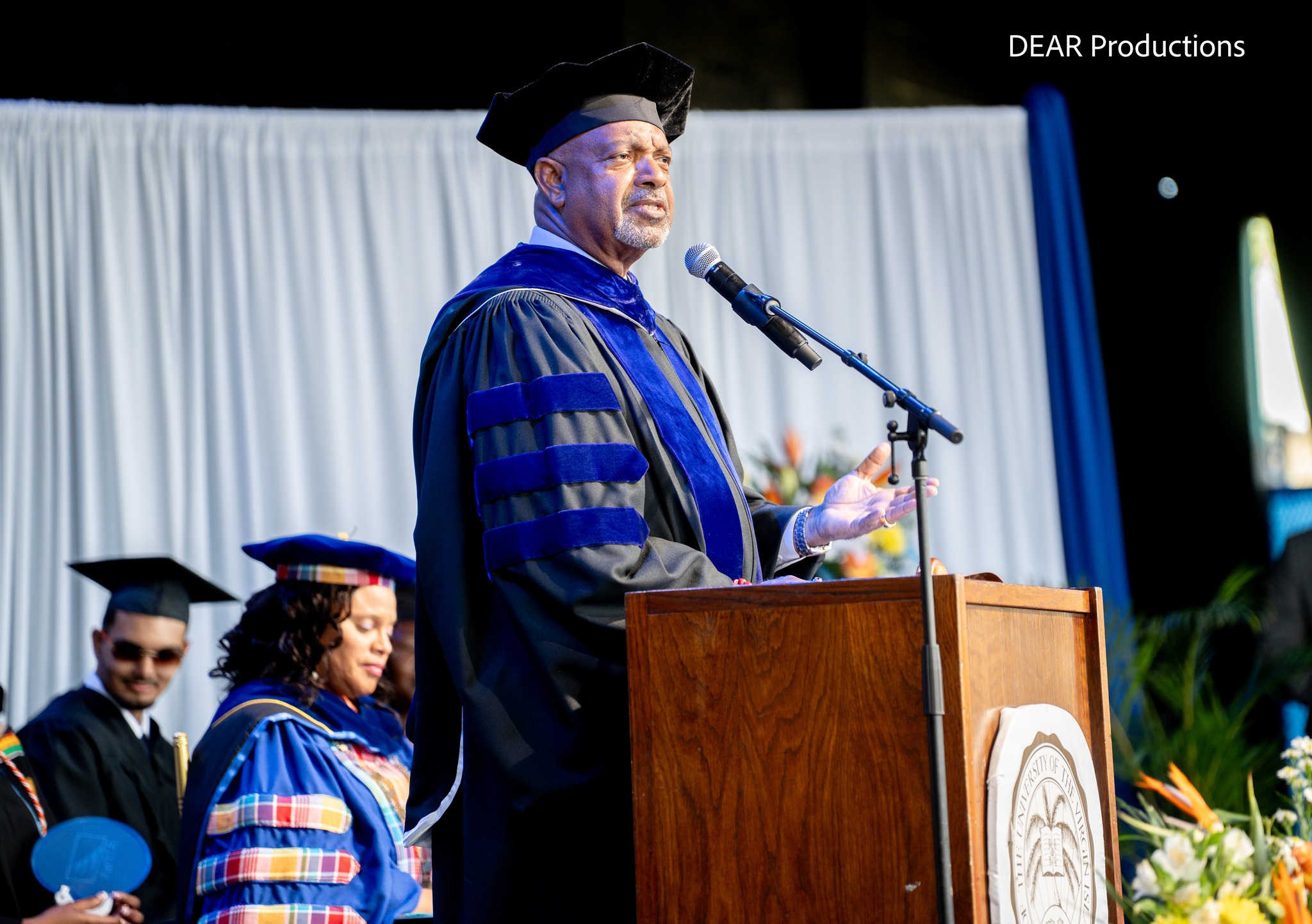
Lieutenant Governor Tregenza Roach used his remarks at the University of the Virgin Islands’ St. Croix commencement ceremony on Friday to deliver a far-reaching message on the future of the territory, telling graduates that the current relationship between the U.S. Virgin Islands and the United States should not be viewed as permanent, and warning that the next generation will be called upon to decide what the Virgin Islands ultimately becomes.

Speaking before the Class of 2026 at the Island Center for the Performing Arts, Mr. Roach said the territory’s status as an unincorporated territory of the United States places the Virgin Islands in a political relationship that many residents do not fully examine beyond the fact that they cannot vote for president.
“But the one that they don't speak about really cuts to the core of what that status is,” Mr. Roach said. “It is that the Constitution of the United States is not fully applicable to the territory of the Virgin Islands, and the provisions that are applicable are only done so by acts of Congress, which has plenary authority over the territories.”
Mr. Roach explained “plenary” in plain terms, telling graduates that it means “everything, all authority.” He said that reality is especially important “in the time that we are living in,” because the Virgin Islands remains “a non-self-governing territory of the United States.”

His remarks placed the commencement ceremony within a much larger conversation about self-determination, colonial history, and the responsibility of young Virgin Islanders to think seriously about the territory’s political future. The U.S. Virgin Islands became a U.S. territory in 1917, when the United States purchased the Danish West Indies from Denmark for $25 million. The purchase was driven largely by strategic concerns in the Caribbean, and U.S. citizenship was later conferred on Virgin Islanders.
The territory’s modern system of self-government developed gradually. The Organic Act of 1936 helped establish the foundation for local government, while the Revised Organic Act of 1954 provided the framework that still shapes much of the territory’s governing structure. The first elections for constitutional officers were held in 1970.
Still, Mr. Roach told graduates that the larger question of status remains unresolved. He pointed to the United Nations framework for non-self-governing territories, saying the territory must eventually choose among pathways such as independence, full integration into the administering state, or free association, a negotiated relationship with the United States or another state.
“In your lifetime, this status will change at some time. It will change,” he said.
Mr. Roach connected that warning to current global tensions and the vulnerability of a territory whose ultimate authority rests with Congress. “Here we are an unincorporated state territory at the mercy of the Congress of the United States, and one day you will have to choose what this place will become,” he told the graduates.
The lieutenant governor also raised the possibility of deeper ties with the British Virgin Islands, a neighboring British Overseas Territory with close cultural and geographic connections to the U.S. Virgin Islands. He noted that the BVI is separated from the U.S. Virgin Islands by only a short distance, especially when viewed from the east end of St. John, and said both territories share cultural similarities that should not be ignored.
“We have a neighboring territory, the British Virgin Islands, separated by only 10 miles, if you look out to them from the east end of St. John, but culturally very similar to who we are,” Mr. Roach said. He added that one option discussed in the United Nations context is whether both territories could decide together that they have the resources “to combine and become a country of ourselves,” stressing that such a choice would be one “that nobody has imposed on us.”
Mr. Roach framed that possibility not as a declaration of policy, but as an issue worthy of serious consideration. He pointed to the collective assets of both territories, including the natural environment, airports, hospitals, higher education institutions, vocational training, and a shared language and culture.
“If you consider that possibility, here is a territory with one of the most pristine environments in the world,” he said, referring to the combined U.S. and British Virgin Islands. He then cited “three international airports, at least three hospitals,” a cancer center on St. Thomas, a cardiac center on St. Croix, a community college, a university, a medical school, vocational institutions, “and a people with a common language and culture.”
The remarks stood out at a ceremony otherwise focused on academic achievement, community pride, and the promise of the graduating class. Mr. Roach began his speech on a deeply personal note, saying he was still grieving the loss of his sister, Violet Alicia Brown Roach, who died earlier this month and was buried last Saturday.
He said his sister had to be transported to the mainland for care, an experience he used to underline the importance of strengthening healthcare capacity in the territory.
“We talk about people going to the states for care, and we focus on a lot of things,” he said. “We say the money that we could make from the insurance is leaving the territory, and we bemoan the facilities that we have, but one of the important things about traveling for care, right, is that you realize that it isn't just medicine, it isn't just doctors, it isn't just the care of medical professionals, but healing requires your family, your friends, your loved ones, your community.”
That, he said, is why the Virgin Islands must remain committed to building “world-class health facilities here for the treatment of our own people.”
The healthcare remarks tied into his larger message that the Virgin Islands must build the institutions and human capacity needed to support its people, whatever status path the territory eventually chooses. The territory’s relationship with the federal government remains central to that discussion. In the proposed fiscal year 2026 budget, federal funds and federal grants remain a major part of the government’s financial picture, with hundreds of millions in federal funds built into the operating budget and billions in disaster and non-disaster grant funding projected to be available, much of it connected to long-term recovery and mitigation work.
The scale of that federal support illustrates both the benefits and vulnerabilities of the current arrangement. Federal funding supports recovery, infrastructure, education, healthcare, and essential government programs, but shifting federal priorities, delays, grant requirements, and congressional authority continue to shape local decision-making.
Mr. Roach’s speech also returned repeatedly to the role of the graduates in determining the territory’s future. He said he was proud of their accomplishments and of the faculty who helped instill in them “this desire, this wish to learn to become and to build your communities.”
“This place, which we have inherited and which we will leave, will depend on us to make good choices for it,” he said. “And I want you to consider the people who have gone before you, who have paved the way for you to be here when you make these choices for the Virgin Islands, and when you help it become to its full potential.”
Mr. Roach closed by urging graduates to remain in the territory and help build it. He also issued a strong defense of free tuition at UVI, saying the program must be sustained and that leaders cannot speak about supporting young people without investing in them.
“Free tuition is not going away,” he said, adding that the governor, lieutenant governor, and future legislatures must “find a way to make it live.”
He said that when the program came into existence after a bill he submitted, applications from public school students in the Virgin Islands increased by 67 percent in the first year it took effect. Mr. Roach said that impact shows the importance of backing young people with real investment rather than rhetoric.

“We cannot give lip service to young people unless we are willing to invest and to make an incredible stake in your future, so that you do not come out with some of the student debt bills that we had, because every generation should make it better for the one that follows,” he said.