

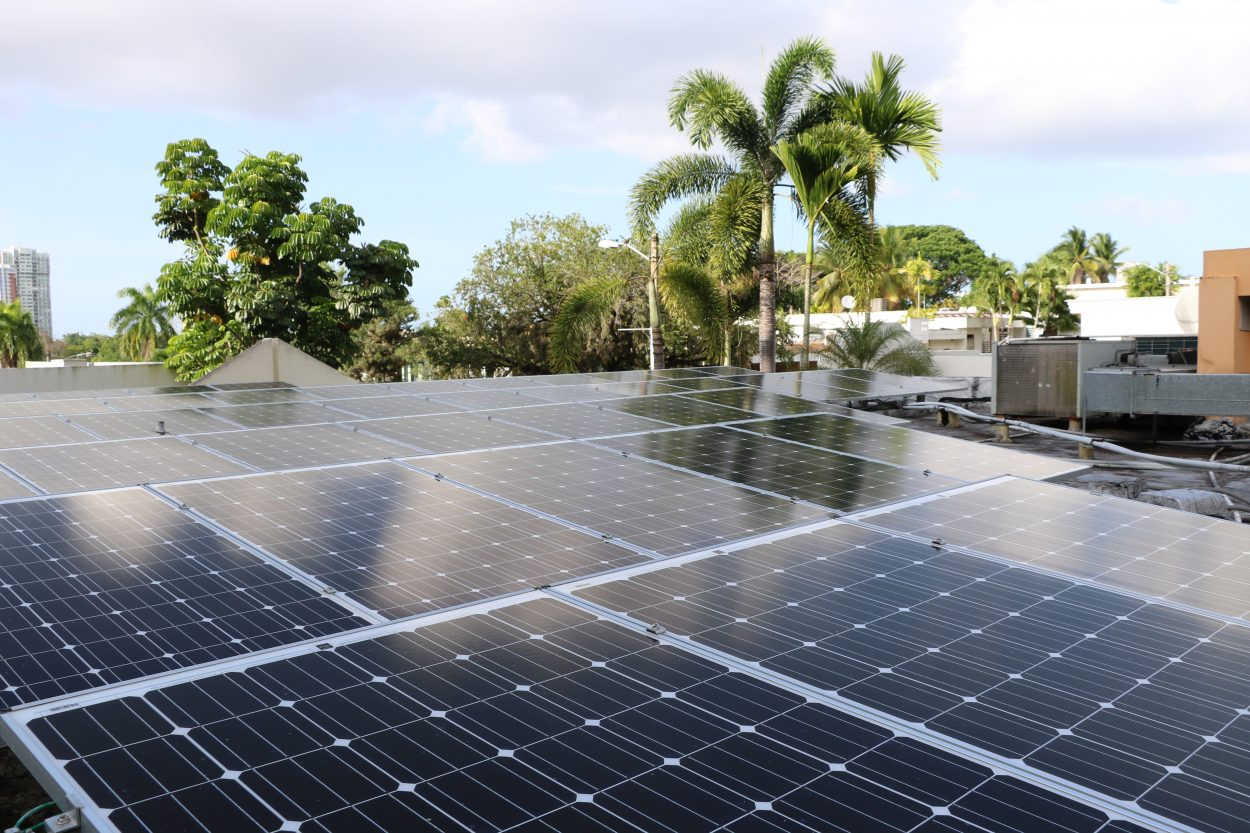
A recently concluded government study has found that Puerto Rico has the potential to easily outstrip its current and future demand for electricity by relying on sustainable power generation methods such as wind and solar, but the territory needs to move quickly to address current needs and carefully in order to meet future energy requirements.

That’s the top line from a preliminary report released on Monday, covering the first twelve months of a two-year study funded by the Federal Emergency Management System.
In 2019, Puerto Rico pledged to move to 100 percent renewable power generation by 2050. According to U.S. Secretary of Energy Jennifer Granholm, the PR100 study “is all about figuring out how.”
The project was launched in February 2022, and in the year since, members of the National Renewable Energy Laboratory (NREL) and other subject matter experts and stakeholders have been assessing Puerto Rico’s power generation capacity in order to develop models to consider different scenarios when it comes to how the territory is going to build out additional capacity.

One startling finding of the research thus far is that currently, instability is built into Puerto Rico’s power grid. NREL researcher Tom Harris said in a webinar on Monday that the territory currently produces hundreds of megawatts fewer than required by current demand. This means that Puerto Rico needs to immediately get construction of utility-scale wind and solar power installations underway in order to meet their needs today. The study suggested that a focus on solar was prudent, as there is inadequate land space for large-scale wind power generation capacity.
However, results from the study thus far suggest that over the next three decades, large-scale installations alone — of renewable or fossil fuel generation systems — will not be able to provide all the power Puerto Rico needs. Therefore, researchers say distributed systems, namely rooftop solar installations, should be the main thrust in moving the territory towards its sustainable energy target.
Territorial authorities will be able to choose from one of four scenarios when planning long-term deployment of distributed solar power generation - from the narrowest deployment where photovoltaic systems are only installed on selected buildings to the widest, where the systems are made available to everyone with a roof to install them on.
Even with the smallest deployment, the study finds that Puerto Rico could generate more than enough power to meet demand, over 10 times more in some scenarios.
A territorial electrical system that relies heavily on rooftop solar deployment also has the benefit of being more resilient. Marcelo Elizando of the Pacific Northwest National Laboratory (PNNL) told webinar attendees that smaller renewable power generation systems spread across a wide area recover power faster than the current system of fewer, larger power plants.
For an island whose electricity grid was all but destroyed by Hurricane Maria in 2017 and then crippled again by Hurricane Fiona last year, reliability and recoverability after natural disasters is a crucial issue.
The green energy revolution in Puerto Rico is, according to Governor Pedro Pierluisi, already underway. He noted that over 45,000 rooftop solar installations have been interconnected to the grid in the past two years, more than in the previous decade. “My commitment to the transformation of Puerto Rico’s energy is unwavering,” Mr. Pierluisi declared.
Several concerns from attendees at the webinar went unaddressed, however, including whether important agricultural land would be sacrificed in favor of developing utility-scale solar farms. The willingness of current players in Puerto Rico’s energy sector to transition from fossil fuel to solar or wind generation was also questioned. Officials say these and other concerns will be addressed in due course.
The next year of the PR100 study will be spent refining the various scenarios under which the territory’s renewable power generation capacity can be improved, and developing models which authorities can then put into practice.
The mood of officials on Monday’s webinar was cautiously optimistic, relieved that early research has generated such promising results, but aware that a successful outcome — the end of Puerto Rico’s chronic energy woes — requires commitment, dedication, and the ability to make smart, and perhaps difficult, choices.