




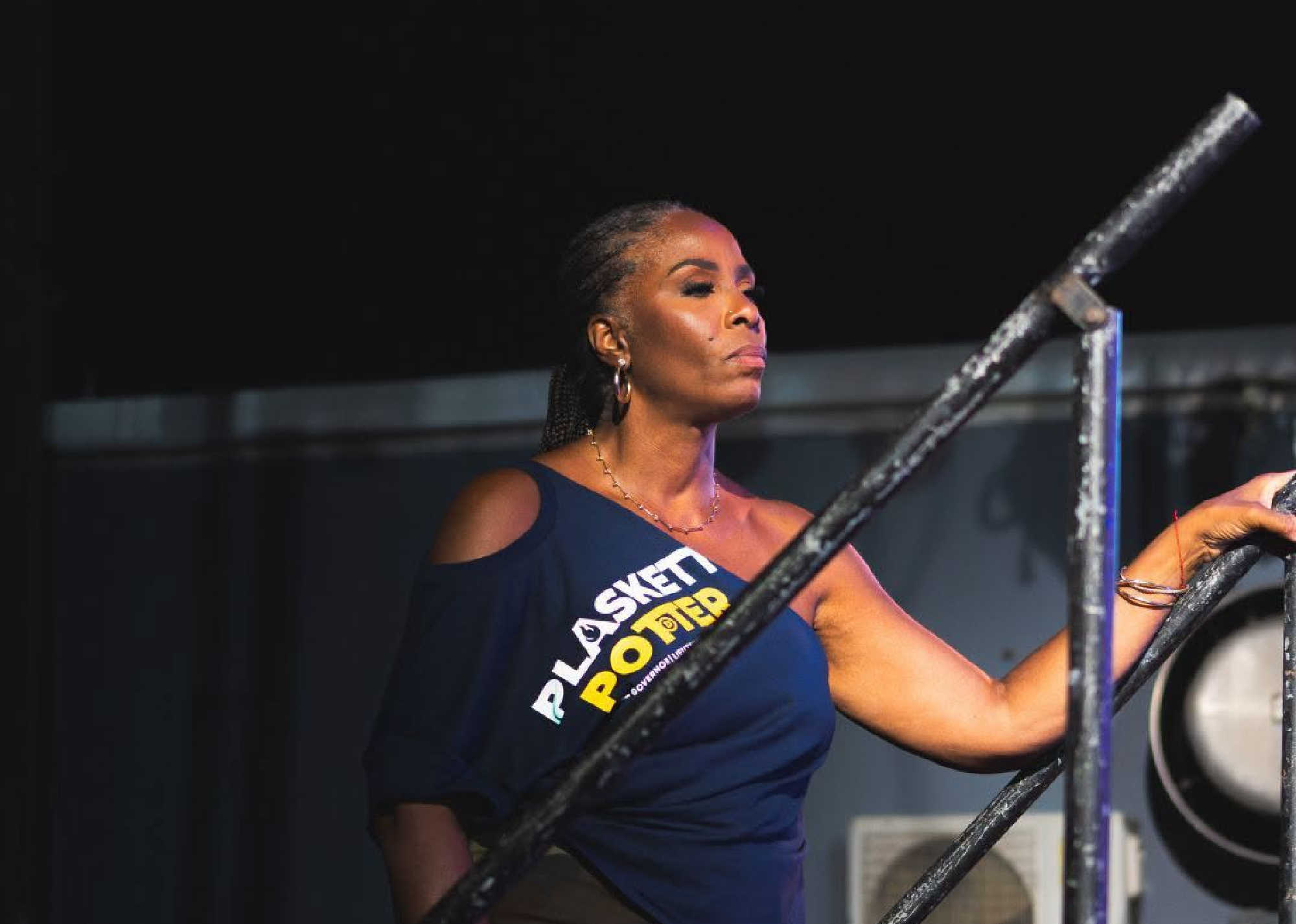
Anyone expecting a government job under Stacey Plaskett if she is elected governor should also expect to work for it — and keep working once hired — the Democratic gubernatorial nominee told supporters in some of her bluntest remarks yet about how she intends to run an administration.

Speaking during a Sept. 25 general campaign meeting with supporters, Plaskett made clear that employment in a Plaskett-Potter administration would not amount to a guarantee of continued government work for anyone unwilling or unable to perform.
“I will fire your ass if you don't work,” Plaskett said while describing her expectations of people who work for her. “Straight up, straight up, do your damn job. Cause I’m not doing your job, and the work has got to happen.”
The congresswoman also sought to shut down any notion that government jobs are already being distributed among supporters before the Nov. 3 general election, saying she has not promised positions and reminding the room that she and running mate Milton Potter are still candidates, not yet the territory's next administration.

Later in the speech, Plaskett returned to that point when describing supporters who already refer to her by the title she is seeking.
“People try and call me Governor. I’m like, no,” she said, before describing her current position as delegate to Congress as an “amazing job” and an “incredible honor.”
The employment comments stand out in a political environment where questions about patronage, personal connections and whether government hiring is based on competence have long been part of the territory's public conversation. Plaskett did not use the word nepotism during that section of the speech, but she presented performance and accountability as requirements for anyone hoping to work under her.
She was also well aware that the remarks were being heard beyond the campaign headquarters. The meeting was being livestreamed on V.I. Consortium's Facebook platform, something Plaskett acknowledged immediately after delivering the warning.
“I know we’re on VI Consortium,” she said, joking that Consortium viewers “like a little sauce.”
“So I feel I need to give them a little sauce,” she added, telling the audience that being at home allowed her to speak more freely than she sometimes does elsewhere.
The comments were part of a much broader argument Plaskett made that evening: that Virgin Islanders should stop measuring successful government by whether it merely performs the basic functions expected of it.
Plaskett said her campaign had already spent considerable time developing proposals in education, healthcare, disaster recovery, government finances, agriculture, public safety, housing and other areas. But as the campaign moved from the Democratic primary into the general election, she said she pushed her communications team to go beyond simply presenting policies on basic government responsibilities.
“That's what any functional government should look like,” she said of reliable energy, education, healthcare and other essential services. “We are too great to just be satisfied with the basics. Our people should have more than just the basics.”
Plaskett tied that message to the territory's history and the sacrifices made by generations of Virgin Islanders and people who migrated to the islands and made them home. She referenced families with deep roots in the territory as well as people who arrived from Puerto Rico, the wider Caribbean, Palestine, Jordan and elsewhere.
“We are worthy of more,” she said.
She also addressed criticism during the campaign that she has spent much of her adult and professional life outside the territory, including her years working in New York and Washington. Plaskett rejected the suggestion that those experiences make her less connected to the Virgin Islands, instead arguing that they represent knowledge and experience that can now be brought home.
“What I am is that sacrifice brought back home,” she told supporters. “I want to bring all the benefits of what I have learned in Washington, prosecuting in New York, operating where I have, back home where it belongs.”
Using the biblical story of Joseph being sent to Egypt before later becoming positioned to help his family during famine, Plaskett described the Virgin Islands as being in its own form of drought — not necessarily in the literal sense, but in the economic and social conditions confronting many residents.
“There are some people who are doing well, but most people are not,” she said, arguing that even residents who are prospering should want to see the broader community succeed.
Her speech then moved through several of the issues that Plaskett said a government under her leadership would have to confront simultaneously rather than treating them as isolated problems.
On public safety, she said lowering crime requires more than policing and must include addressing conditions that contribute to crime in the first place. Young men need employment and training for the modern economy, she said, while children who fall behind academically by sixth grade must receive intervention instead of being allowed to continue falling further behind.
She called for after-school and summer programs, support for young people involved in sports and the arts, and stronger services for residents confronting mental-health challenges.
Plaskett also linked opportunity to housing, arguing that young Virgin Islanders need pathways toward stability and equity, while small businesses need an economic environment in which they feel they are receiving a fair chance.
Energy, she said, should move beyond the goal of simply being reliable and become affordable as well.
Healthcare became one of the most personal portions of the speech. Plaskett reflected on the deaths of both of her parents during the previous two years and said their declining health prevented them from spending their final years in the Virgin Islands.
“I feel like I failed them because I brought them home in a box,” she said.
She recalled the sacrifices her parents had made while living away from the territory, including helping relatives pursue careers in medicine, nursing and law, only for her parents themselves to be unable to return home as they aged because the healthcare they needed was not available locally.
“They didn't enjoy it in the place that they loved most, which was home,” Plaskett said.
Her vision, she argued, must also look beyond repairing existing government shortcomings and toward taking greater advantage of the Virgin Islands' location and economic potential. Plaskett said colonial powers historically valued the islands not simply because of their beaches, but because of their ports, soil and strategic location between major regions of the world.
“We need to realize that for ourselves,” she said.
Plaskett repeatedly returned to work as the central theme of both her campaign and a possible administration. She asked supporters to remain engaged through Election Day and said any celebration after a victory would have to be short-lived before the work of governing began.
“This campaign is about work,” she told the gathering. “Be ready to do what's necessary through November 3, and then after November 3, we gotta celebrate for a minute, but then January 4, back to work, back to work.”
She also emphasized that territorial progress cannot be measured island by island. When St. Croix improves, she said, the entire Virgin Islands benefits; the same is true for St. Thomas and St. John.
Of St. John in particular, Plaskett said the campaign had encountered residents who believe they have been neglected.
“We were watching people on St. John who feel that they are absolutely forgotten,” she said. “As St. John prospers, so the Virgin Islands prospers.”
The congresswoman also urged supporters not to treat her Democratic primary victory as the end of the race. Plaskett and Potter captured the party's gubernatorial nomination in August and will appear as No. 3 on the general-election ballot, but she repeatedly told supporters that significantly more work remains before Nov. 3.
“We know that the primary was just a fraction of Virgin Islanders,” she said. “We've got so much work to do to get to November 3.”
Plaskett ended by framing the election not around the possibility of becoming the first woman elected governor of the U.S. Virgin Islands, but around what she said the territory could accomplish collectively.
“We're going to make history, not by electing a first female governor, but by living a dream, by working together to move ourselves forward,” she said.

Early voting for the general election begins Oct. 16 on St. Croix and St. Thomas and continues through Oct. 31. On St. John, early voting begins Oct. 23 and ends Oct. 31. Election Day is Nov. 3.