




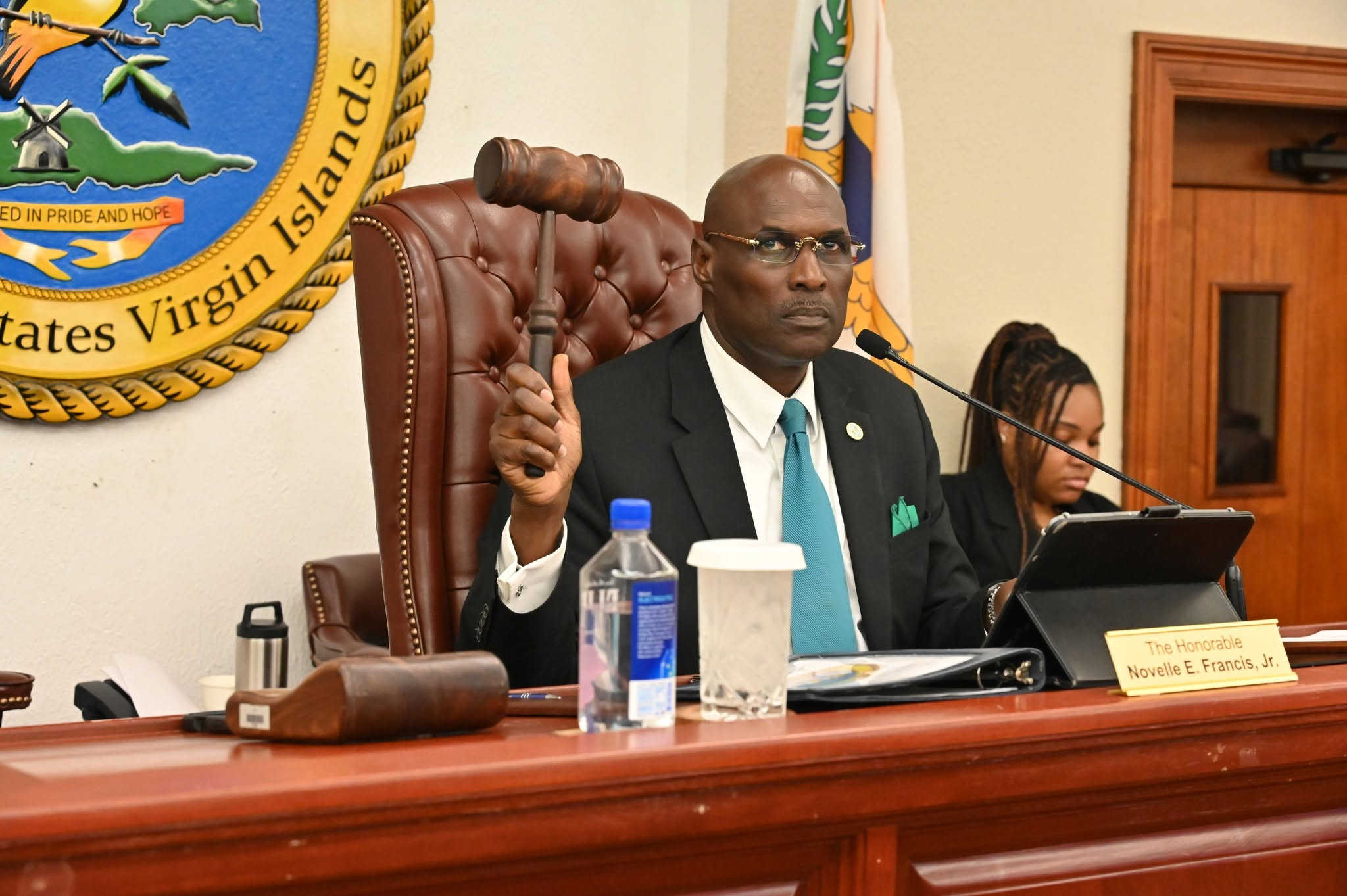
The Fiscal Year 2027 budget is headed toward a final Senate vote with its financial structure largely locked in after the Committee on Rules and Judiciary advanced the spending measures Wednesday under a closed rule, preventing substantive amendments once the package reaches the floor.

The Legislature’s own budget process provides for FY budget bills to move from the Budget, Appropriations and Finance Committee through Rules and Judiciary and then to the full body under closed rule. The Rules Committee’s jurisdiction specifically defines that procedure as prohibiting substantive amendments during floor consideration.
Sen. Novelle Francis Jr., who chaired the 21 budget hearings conducted over the summer, said the restriction is intended to prevent “any slippage or movement in terms of the numbers that have been derived collectively by the Budget Appropriations and Finance Committee.”
Wednesday’s Rules Committee meeting marked the next stage of a budget process that moved through the Budget Committee on Monday, when Mr. Francis characterized the territory’s financial condition as “precarious” amid weaker revenues, collection concerns and uncertainty surrounding federal funding from HUD and FEMA. The Legislature’s official account of Monday’s proceeding likewise cited lower revenues, federal uncertainty and the need to improve government collections.

The warnings continued Wednesday, but with lawmakers placing particular emphasis on containing government spending.
Sen. Alma Francis Heyliger said the Government of the Virgin Islands must “really start focusing on cutting costs across the board,” arguing that government is “a little bit overblotted, and the monies I personally think needs to go to specific areas, it's lacking.”
She urged lawmakers to pay closer attention to agencies that receive significant annual government support and singled out the V.I. Waste Management Authority. “It was supposed to be set up to ultimately be able to pay for itself, and here we are…almost 20 years later, still dumping almost $35 million into an agency that is ultimately supposed to be self-run,” Ms. Francis Heyliger said.
The budget package advanced Wednesday includes a $32.5 million General Fund appropriation for VIWMA. Separate measures also direct money from other funds toward Waste Management and other agencies, including a $6.3 million Anti-Litter and Beautification Fund appropriation shared between VIWMA and the Department of Public Works.
Ms. Francis Heyliger said the government should examine whether agencies originally envisioned as more self-sustaining can reduce their dependence on the General Fund. “If we really focus on cleaning up some of these” and determine how to make certain agencies more self-sufficient, she said, limited public funds could be directed toward areas with greater need.
She expressed hope that projects and programs in the coming fiscal year would be executed properly and begin producing “the much-needed funds we need to run the government of this territory.”
Sen. Avery Lewis similarly emphasized the importance of accelerating disaster-recovery work and bringing additional economic activity into the territory. He said that regardless of “whoever's taking the helm of government house,” federally funded projects must proceed as planned while the territory works to “let the world know we're open for business, bring new revenues in, because we cannot continue business like this.”
Sen. Milton Potter said passage of the spending package would not end the Legislature’s responsibility. “There's more work ahead, and passing a budget is not the same as executing one well,” he said.
Mr. Potter, who is running for lieutenant governor with Delegate Stacey Plaskett rather than seeking another Senate term, urged continued legislative scrutiny after appropriations are approved. Elections System filings list the Plaskett-Potter gubernatorial ticket for the 2026 election.
“The Legislature must continue to stay engaged through oversight, through hearings, and through the same scrutiny that shaped this document to make sure that every appropriated dollar reaches the people it was meant for,” Mr. Potter said.
Rules and Judiciary Chair Carla Joseph echoed that position, saying lawmakers remain “committed in this body, as the people's representatives, to assure that the monies are being managed well, and they are being managed correctly.”
The Legislature’s official release says the Rules Committee approved the FY 2027 measures and forwarded them to the full body for consideration at the next scheduled legislative session. Lawmakers said during Wednesday’s proceedings that the budget session is expected Friday, when all 15 senators would have an opportunity to vote on the package.
Among the strategies incorporated during the budget process were efforts to use vacancy savings to address outstanding vendor obligations while directing resources toward staffing in revenue-generating offices, particularly agencies responsible for tax collection.
Those priorities mirror concerns raised during Monday’s Budget Committee meeting, when lawmakers repeatedly said that stronger collections would be essential to maintaining government services and balancing the FY 2027 spending plan. The Legislature said Monday that revenues were down and that improved collection, new investment and execution of disaster-recovery projects would be central to stabilizing government finances.

With the closed rule now in place, however, the substantive budget negotiations are effectively over. The next question is whether the full Legislature approves the spending package — and, as senators stressed Wednesday, whether the government can actually collect the revenues and control the spending on which the plan depends.