




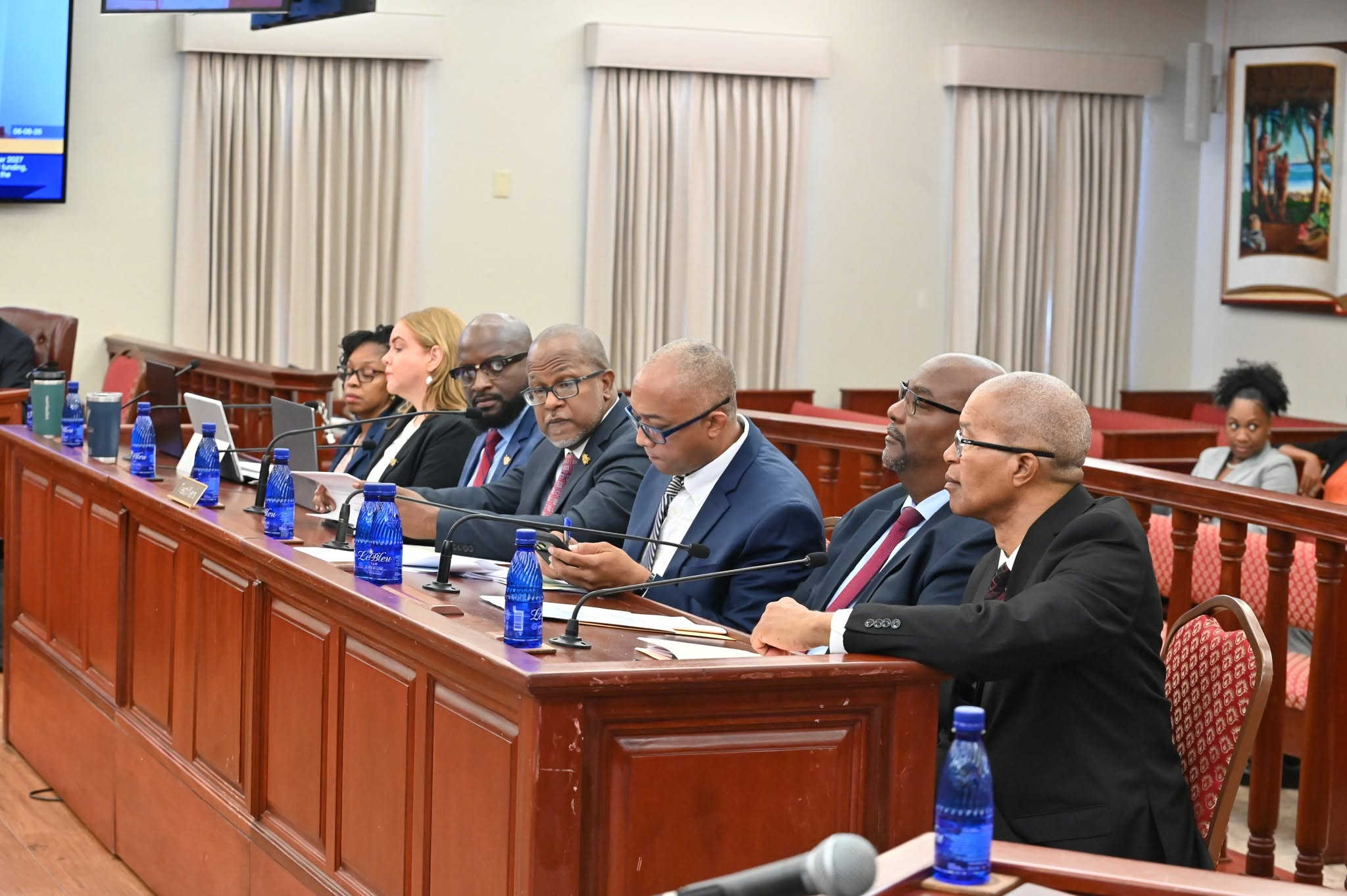
The Government of the Virgin Islands is proposing a $1,638,468,438 budget for fiscal year 2027, with officials projecting higher tax collections, significant disaster recovery spending, and targeted investments in infrastructure, recreation and housing.

Details of the proposed $1.6 billion spending plan were presented Monday by the government’s financial team before the Committee on Budget, Appropriations, and Finance, marking the start of a new budget cycle.
Of the total proposal, general fund collections are expected to reach $958,000,000, driven heavily by tax revenue. Julio Rhymer, director of the Office of Management and Budget, said personal income taxes are projected to grow by 2%, moving from $421.79 million to $427.95 million. Mitigation and disaster recovery projects are also expected to generate an additional “$71.7 million versus $21.9 million.” If achieved, collections could increase to $499.66 million.
Corporate income taxes are also expected to rise slightly, from a 2026 projection of $72.32 million to $72.45 million in the upcoming year. Mr. Rhymer described the projections for both personal and corporate taxes as “prudent,” citing global conflicts and the broader world economic climate.

Real property taxes are projected to increase by 2%, moving from $55.01 million in 2026 to an estimated $56.23 million in FY2027. According to Mr. Rhymer, that estimate is “supported by the steady growth in real property values and the continued strength in demand.”
Gross receipt taxes are projected to record a 6.3% increase, moving from $230.42 million in 2026 to $244.97 million in FY2027. Mr. Rhymer said the upward trend is “attributed to the anticipated capital project bundles and construction activities.” Gross receipt taxes from disaster recovery projects are expected to climb to $29.7 million in FY2027, compared to $9.1 million in 2026, potentially bringing collections to $274.7 million.
Excise taxes are also projected to increase. The financial team anticipates a 14% rise, from $37.67 million to $43.01 million in FY2027. Mr. Rhymer attributed that growth to the tourism sector and “planned capital construction industry activities.” An additional $7.1 million from mitigation and disaster recovery projects could also be collected, pushing the potential total to $50.11 million, or 25.45%.
Through May 2026, the Bureau of Internal Revenue collected $610 million in FY2026. Director Joel Lee told the Committee that collections are “$14 million over last year.” However, he said the Bureau did not anticipate some “high net worth taxpayers leaving the territory.” He estimated that those taxpayers could have “added probably an additional $20 million to the $14 [million] we’re already over.”
Mr. Rhymer also pointed to expected growth in the Hotel Tax/Non-Hotel category, where collections are projected to move from $64.44 million to $68.62 million. Although those revenues are not deposited into the general fund, he said the growth “shows stability for the Tourism Revolving Fund.”
According to Mr. Rhymer, gross revenue collections are projected at $1,041,586,689. Total expenditures, meanwhile, are expected to reach $1,638,468,440.00.
Along with the general fund, the GVI is expected to manage $93,386,689 in other appropriated funds and $43,599.476 in non-appropriated funds. Federal funds for FY2027 total $543,282,273.
Mr. Rhymer also provided clarification on federal grants, stating that total federal grants “decreased slightly to $20,587,648,241.71.” He said federal grants are expected to continue declining “due to increased disaster funding spending in the territory.”
Disaster recovery remains a major part of the government’s fiscal outlook. Mr. Rhymer said the Office of Disaster Recovery anticipates $733.9 million will be spent on recovery projects in FY2027. The financial team expects that activity to generate $36.7 million in revenue through gross receipts and other “residual revenue.”
He also told lawmakers that the line of credit has been “instrumental in allowing the territory to keep pace with the disaster.” Mr. Rhymer urged the Committee to consider expanded borrowing capacity, stating that “any opportunity to leverage increasing the line to facilitate the advancement of critical projects as we enter [the] construction phase should be considered.”
The FY2027 budget was developed under the theme “Investing Today for the Communities of Tomorrow – Infrastructure, Recreation, and Housing.” Mr. Rhymer said the proposal is “not simply a financial plan; it is a roadmap that prioritizes people, progress and sustainability.”
He said the government intends to make “targeted investments to modernize and maintain critical systems including roads, drainage networks, public facilities, and utilities.” The proposal also includes “significant resources” to upgrade parks, sports facilities and similar public assets. According to Mr. Rhymer, investment in recreation is part of the government’s effort toward “promoting healthier lifestyles.”
Housing is another central element of the budget proposal. Mr. Rhymer said the GVI will take “decisive steps to address housing availability, affordability, and sustainability.” He said the government intends to encourage “public-private partnerships to accelerate housing projects,” among other strategies.
The budget was developed against the backdrop of global economic pressure and local inflation. Mr. Rhymer said inflation reached 7.6% in 2025, “driven largely by the territory’s heavy reliance on imported goods, which totaled $4 billion.” Even with positive growth in the local economy, officials acknowledged that residents continue to face higher costs.
While the territory has seen a “big boost” in gross receipt taxes, Mr. Lee said the "cost of goods that consumers are paying has unfortunately increased.” He added that he would be remiss not to say that consumers are “feeling that pinch.”
Mr. Rhymer said the financial team remains “committed to prudent fiscal management.” He testified that the FY2027 budget “reflects a balanced approach that maximises available resources, leverages funding opportunities, and ensures accountability in every dollar spent.”
Responding to Senator Kenneth Gittens on proposed austerity measures, Mr. Rhymer said that “what we look at across the board, is cutting out the fat.” He identified reducing government leases as a key area of focus. He also assured Senator Gittens that officials will assess the “true need” for government vehicles in certain departments, as well as “fuel consumption.”
Senator Kurt Vialet urged the Bureau of Internal Revenue to ensure that revenues are collected, particularly as construction projects intensify. He specifically referenced contractors and potential challenges involving the non-submission of withholding taxes for subcontractors. He urged Mr. Rhymer and the financial team to develop a “definitive plan” to “collect what’s out there.”

Budget hearings are scheduled to begin on June 16, when the Committee on Budget, Appropriations, and Finance is expected to analyse the projected revenue and expenditure of each department and agency forming the Government of the Virgin Islands.