




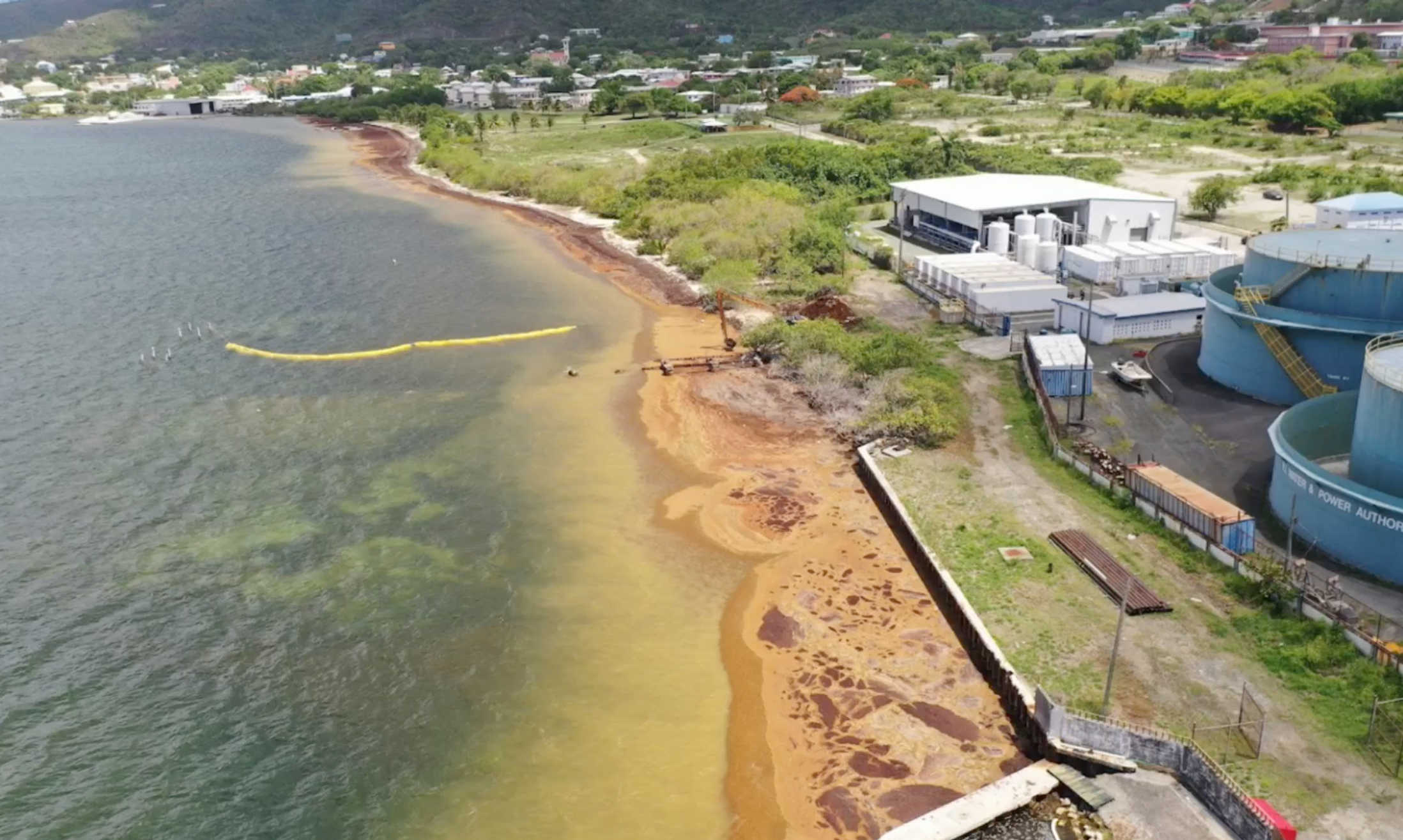
David Warrington, the Region 2 administrator at the Federal Emergency Management Agency (FEMA) is scheduled to visit St Croix this week to meet with the Operations Safe Water Task Force to determine the extent at which sargassum seaweed has disrupted businesses and family dwellings on the island.

On July 22, Governor Albert Bryan announced an executive order declaring a state of emergency on sargassum which has reached unprecedented levels in the U.S. Virgin Islands, particularly on St Croix.
In the midst of persisting drought conditions, an unusual amount of seaweed arriving on the territory’s coasts has caused water shortage by blocking intake screens and clogging filters at the Richmond Power Plant’s reverse osmosis unit. The sargassum has made it increasingly difficult for the V.I. Water and Power Authority to keep the water intake on. A lack of water being processed and stored can also affect electricity supply.
The decrease in potable water production is a concern, according to Daryl D. Jaschen, director of the V.I. Territorial Emergency Management Agency, who said during a situation report on Monday that WAPA has less than half its storage capacity.

“WAPA’s storage levels right now is at 10,382,524 gallons which represents approximately 47.19 per cent of storage capacity. The Seven Seas, who does the desalination output is 3,216,000 gallons per day which is reduced from their capacity of 3.7 million gallons per day.”
Water consumption is currently at 3,548,942 gallons per day which means that there is only approximately 2.9 days of water left in storage — a situation that Mr. Jaschen described as “concerning."
“We are consuming just as much as we can produce right now, so we’re very concerned about that,” he said Monday during the Bryan administration's weekly press briefing.
In the last 24 hours, the director estimates that WAPA has lost 268,000 gallons of water. “The water haulers who come there are actually taking out 35,000 gallons of water per day. Even though we’ve had some rain, a lot of cisterns are still low and there is still a strong demand now to meet those customers who are not on the Water and Power Authority capacity,” Mr. Jaschen explained further.
As a result of the effects of the sargassum on water production, both the Department of Natural Resources and FEMA are working with international agencies to develop what the director said was a “predictive model for sargassum.”
“So, this model will be developed with tropical wind direction. With speeds, with current — we’ll be able to identify more of a timeline and preventive measures will be put in place based on the timeline.”
Meanwhile Governor Bryan says the federal declaration agreed to by U.S. President Joe Biden only provides support to remedy the water shortage and does not fund the cleanup of beaches and spaces invaded by sargassum.
Mr. Bryan said he originally thought the federal government would have provided 90 percent of the funding while the local government matched the other 10 percent, however he learned subsequently that his administration would need to come up with 25 percent of the funds needed.
“When we went to FEMA, we were hoping to get a federal declaration so we could have it for the entire Virgin Islands so we could get funds to pick up all of that sargassum that’s on all our beaches and really stinking up our neighborhoods and making it unpleasant for our tourists who come here as well,” he explained.
Instead, the governor said FEMA opted not to do that but to only support the territory for the “water piece.” He is therefore encouraging private businesses to join with the government to meet the shortfall in financing that will assist in beach cleanup.
As the territory waits on solutions to reduce its sargassum problem, the safety task force has developed guidelines for individuals working in and around areas with high sargassum blooms.

The team is providing safety equipment and is monitoring the seaweed for the presence of dangerous hydrogen sulfide levels which is a poisonous, corrosive, and flammable gas produce by decomposing sargassum.