




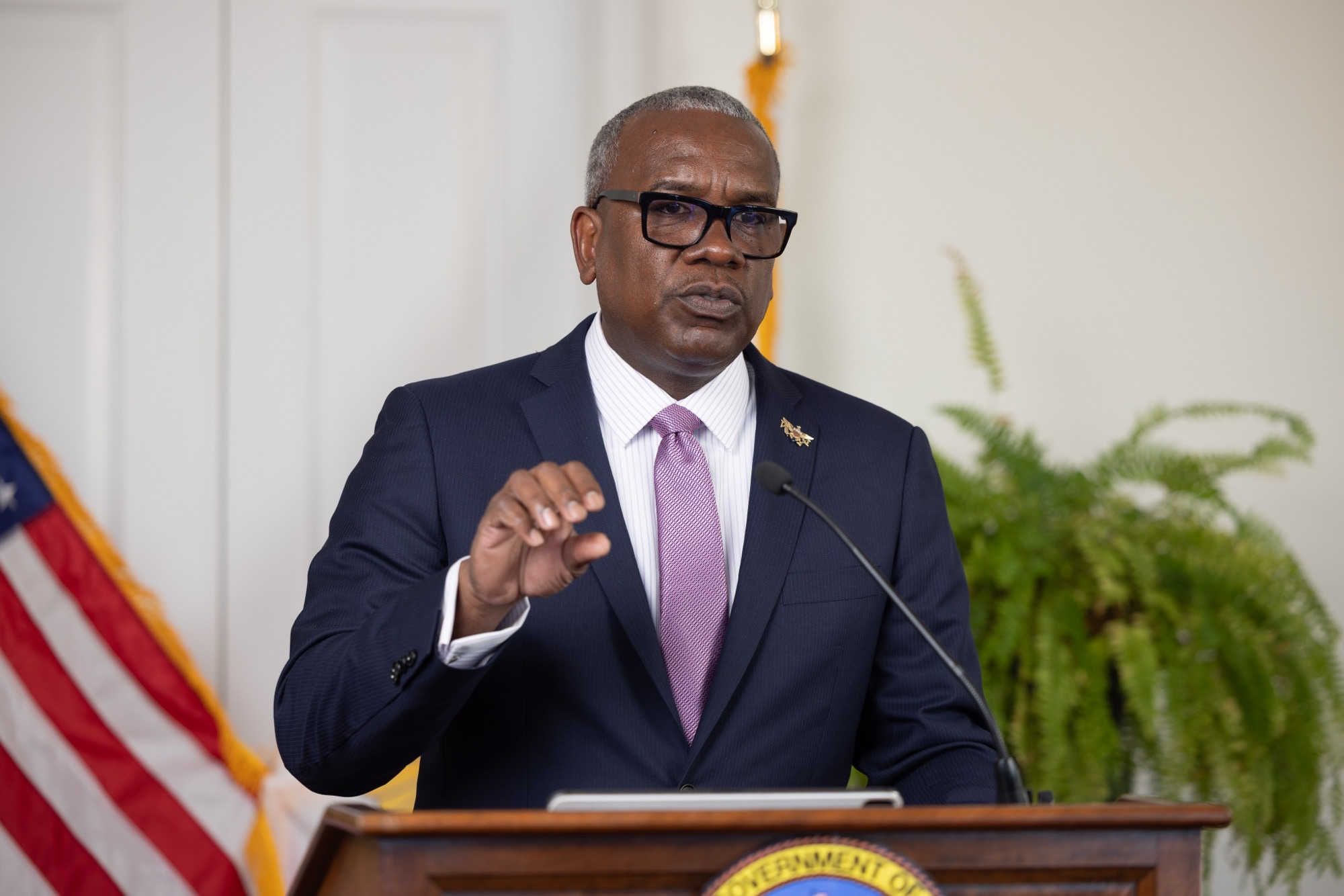
With the Government of the Virgin Islands facing the prospect of having to pay millions more to employees beginning October 1, Governor Albert Bryan Jr. continues to sound the alarm over the untenable financial situation in which he says the Legislature has placed the territory.

“By law it is the responsibility of the Legislature to approve a balanced budget, and as of today, I really am concerned about where we stand in that process,” Governor Bryan said during Monday's press briefing.
He was speaking about the upcoming salary hikes for the lowest-paid government employees, passed by the Legislature in early June. Lawmakers overrode the governor's veto to enshrine the measure into law, despite not identifying a funding source for the additional wages GVI will have to pay.
At the heart of the disagreement between the legislative and executive branches of government is the true cost of the pay raise. Senator Kurt Vialet, who unsuccessfully brought the measure forward in the 34th Legislature before re-introducing it in the 36th, estimated the total cost of implementing the increase at somewhere around $10 million. However, Governor Bryan argued that the salary increase would not just affect the targeted employees. Every worker above the minimum would now advocate for their own pay raise due to salary compression, he argued. The “cascade” of raises could bring the total cost of implementation to between $27 million and $40 million, based on figures cited by the governor and a fiscal impact analysis performed by the GVI finance team.

Apart from the direct financial hit to government finances, Governor Bryan said that the inflationary pressure caused by the salary increase will have a negative ripple effect across the entire territorial economy. “You're putting pressure on the private sector now to provide a minimum of $25 an hour to get a janitor, rather than what they were paying before,” said the governor, giving an estimated hourly figure of the upcoming Oct. 1 minimum wage. He predicted that higher salaries in government will serve to remove workers from the private sector pool, with the demand being created serving to drive private sector salaries higher, “which makes your corned beef more expensive.”
Outside of the economic and financial arguments, the governor also warned that the upward movement in salaries will discourage people from upskilling themselves as the government wants them to do.
Adding to GVI's fiscal pressure, a 3 percent raise in employer contributions to the GERS is also on the cards for October 1. Health insurance for government employees will also increase “to the tune of $20 million that the government is also going to have to pay.”
Altogether, Governor Bryan says, “these factors create kind of like a perfect storm, and shows how we continue to shoot ourselves in the foot when it comes to fiscal finance.” At a time when the government already owes approximately $160 million in retroactive pay, the territory's two hospitals owe “at least $40 million,” and other entities including the Waste Management Authority and the Water and Power Authority also owing millions, Governor Bryan says that spending must be prioritized and tightly controlled.
Governor Bryan acknowledged that government employees are deserving of higher salaries, calling the raise “a meaningful step that recognizes the value of our workforce.” At the same time, he expressed concern about “whether we can sustain the increase with the resources we have available for the upcoming year.” He cautioned, as he has in the past, about the opportunity cost of the measure, noting, “This is $40 or $50 million a year that's not going to pave your streets, not going to fix your schools, not going to help your hospitals.”
With just over a month to go before Act 8559 takes effect, Governor Bryan has signaled that he is open to working with the Legislature to make prudent amendments. “I'm even willing to look at a 10% increase every single year until we get to the $35,000,” he offered. He maintained that as currently structured, “this vast increase rapidly without any research and no financial planning by the Legislature is foolish at best and irresponsible in reality.”

“I don't say that as a criticism,” Governor Bryan said. “I say that as a reality of our fiscal situation.”