




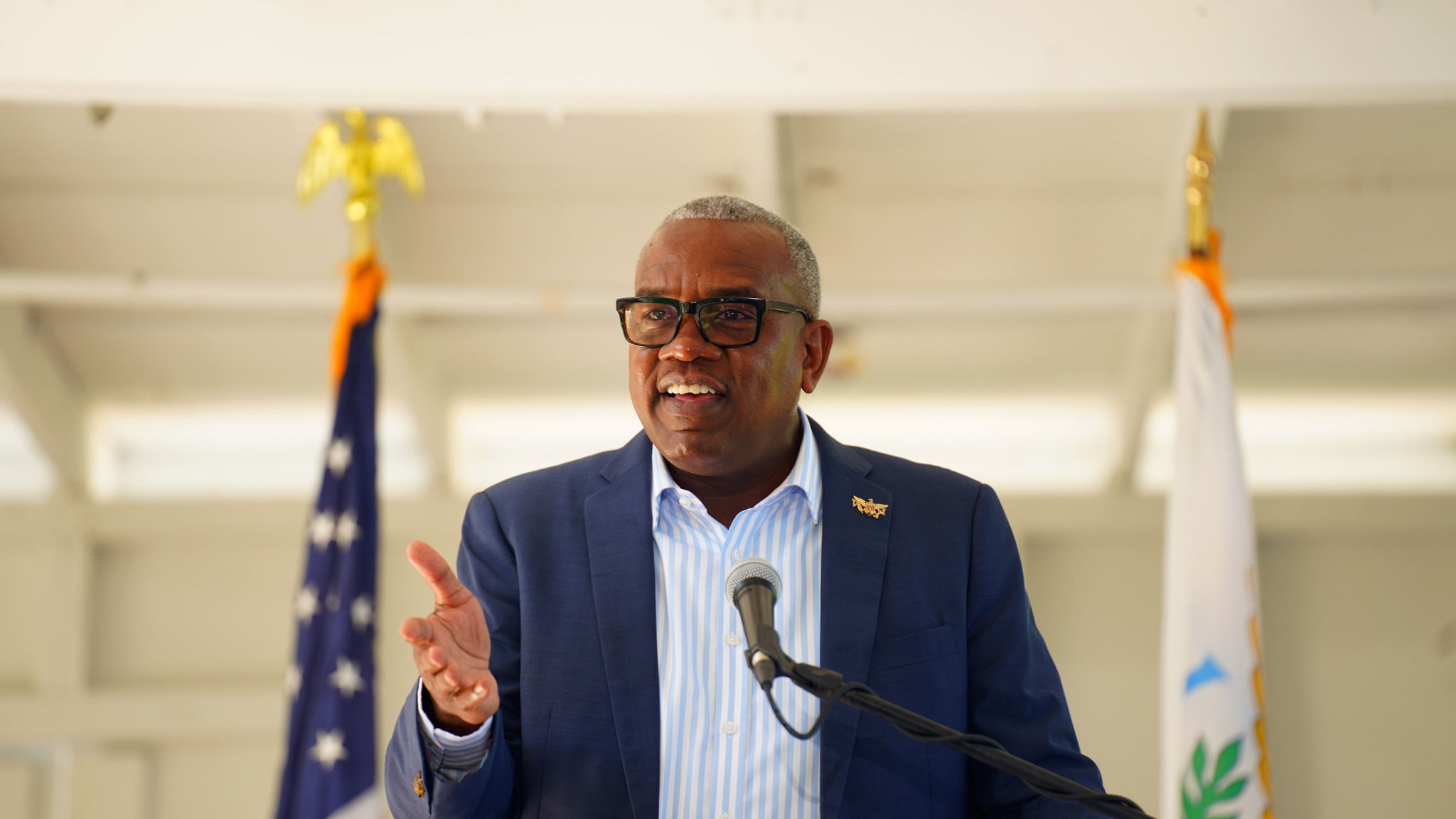
Governor Albert Bryan Jr. says the Virgin Islands must fundamentally change how it educates its young people if the territory hopes to keep pace with the rapidly evolving world of work. Speaking at the Workforce Development Summit on St. Thomas, the governor described the current educational model as “hopelessly fantasizing with the process rather than the outcome,” arguing that it was built for the Industrial Revolution and not for a world transformed by artificial intelligence.

“We have to change the motivating principle in education, because for a lot of students, they see the learning as pointless,” Bryan said. “This educational system was created to create the workforce for the Industrial Revolution. It’s done, but we’re still in the same practical thing.”
The governor, a vocal proponent of artificial intelligence, urged attendees to embrace the technology as a tool for learning and innovation rather than a threat to employment. Encouraging participants to download ChatGPT during the session, he predicted that AI will “revolutionize learning.” “It’s going to be able to teach you anything you want to learn,” he said, “but you’re going to have to know that you want to learn.”
Bryan moderated the discussion, which featured Michael Carty, chair of the Workforce Development Board; Daryl Wade, chief information officer at viNGN; and Siobhan James-Alexander, chief executive officer at One Communication. The session focused on bridging the digital divide, “future-proofing” students and workers, and preparing the territory for the economic and technological disruptions brought about by AI.

All panelists agreed that to truly prepare the next generation, the Virgin Islands must move away from traditional approaches and embrace new technologies while also emphasizing trades that will remain relevant in an AI-driven economy.
The Changing Nature of Work
Wade said the emergence of artificial intelligence should be seen as an opportunity rather than a threat. Developing a deeper understanding of AI, he argued, will give young Virgin Islanders a competitive edge as they enter the job market. “We are living in a world where that has to occur, or you will get left in the dust,” Wade said. He explained that tasks such as “initial contract writing” are already being automated. “That should be a thing of the past, because the person next to you is not going to be spending time on that.”
James-Alexander agreed that AI should not be viewed as a replacement for human workers but rather as an enhancement to human productivity. “We need to talk about AI in terms of being a tool versus your replacement,” she said. “I tend to rephrase it as an augmentation to the workforce.”
For Bryan, the Virgin Islands has an opportunity to get ahead of global change. “We have the opportunity to embrace change early,” he said, posing the question of how best to “future-proof” the territory’s youth.
Carty added that while predicting the jobs of the future is difficult, it is possible to identify the ones that will continue to be indispensable. He pointed to trades such as plumbing and carpentry as examples of “evergreen” professions that are likely to survive technological disruption. “There’s about to be a massive shortage of tradesmen across the world because of the same AI boom,” he warned.
He urged policymakers and educators to expose students early to both technical and trade skills. “You need to start, as early as possible, in a structured way, exposing students to this world — whether it’s as a trade or whether it’s using the tools,” he said.
Education Reform and the AI Era
The panelists agreed that preparing students for an uncertain future requires major changes in how schools operate. James-Alexander argued that technology adoption will remain slow unless teaching methods evolve. “The rate of adoption will not change if we continue to teach the way we teach, and classrooms shouldn’t be just these four walls,” she said. “How do we teach? It has to change. It can’t be behind a computer. It just can’t be in a classroom where everything seems so static. We need to evolve our classrooms as technology, as universities have changed.”
Bryan concurred, saying that the transformation must begin with teachers. “In order to do that major shift, the teachers have to change,” he said.
Carty observed that systemic change requires generational turnover in leadership. “To change that type of policy or thinking, the people making the decisions will have to change — will have to age out,” he remarked.
James-Alexander agreed that reform must start with those who guide the system. “Policy needs to change,” she said, adding that there is an urgent need to “retrain the trainers.” She challenged the audience: “We have to stop talking about it and do it. Are we brave enough to do it?”
Balancing Trades and Technology
While artificial intelligence continues to reshape industries around the world, the Virgin Islands faces a different but related challenge: ensuring there are enough skilled workers to meet local needs. Carty noted that as the territory prepares for a major construction boom, the demand for tradespeople is soaring. But once schools, hospitals, and infrastructure projects are completed, the workforce will have to adapt again.
“Universities may turn into validation points, testing AIs to actually see if it has been poisoned with wrong information,” he suggested. In the long term, higher education could evolve into “houses of professionals and the doctorates and the PhDs just validating the information we all use.”
Despite disagreement over how the labor market might shift, panelists agreed that AI and skilled trades will both play central roles in the Virgin Islands’ economic future. “The system will never change if we keep using that same system, and it will never change if we are afraid to fail,” Carty warned.
Looking Ahead
For Bryan, the message is clear: the Virgin Islands cannot afford to wait. Education reform, workforce training, and technology adoption must happen simultaneously if the territory hopes to prepare its young people for what comes next.
“We have to embrace the change early,” the governor said. “AI is not the enemy — it’s the opportunity. The only question is whether we’re ready to use it.