




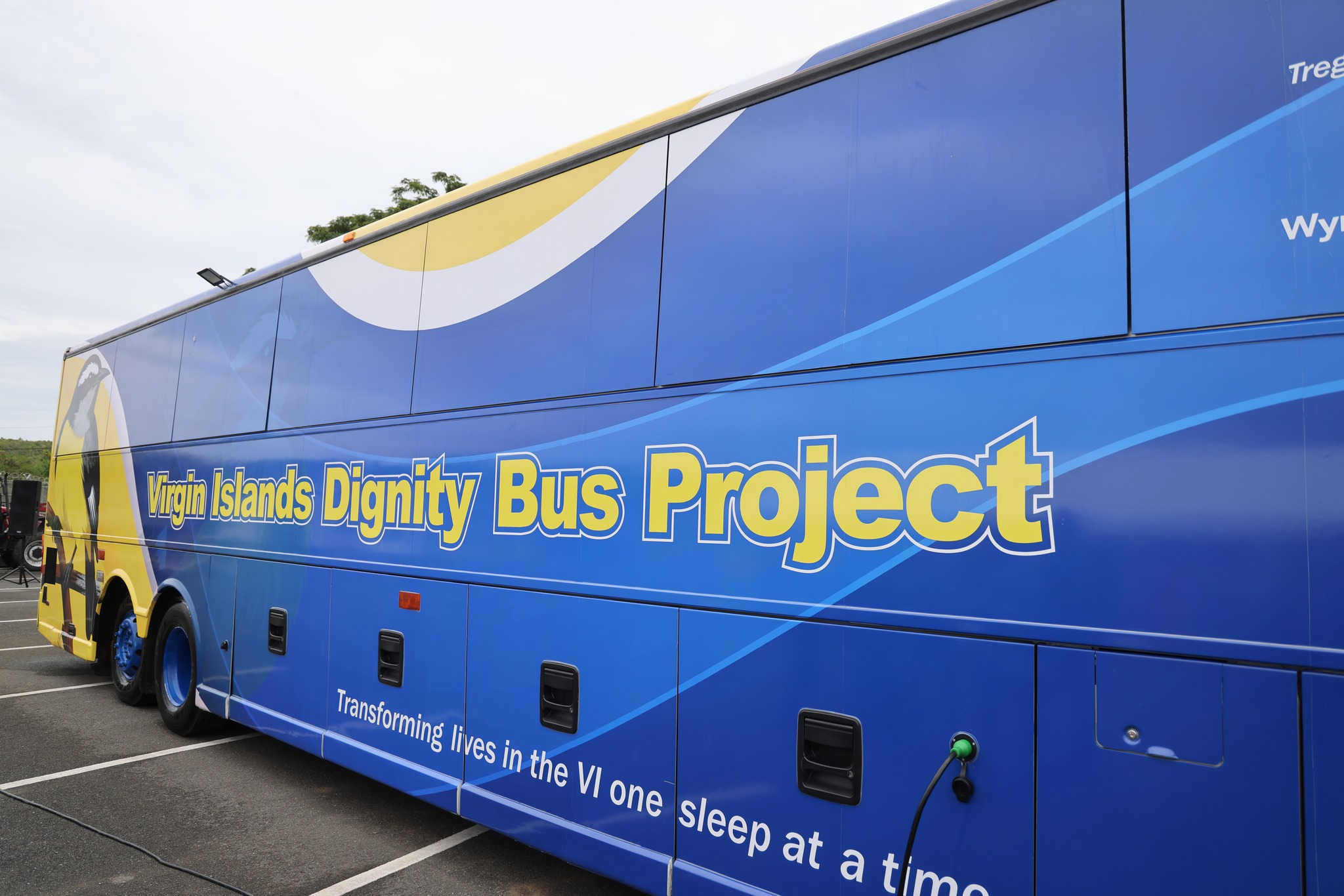
The Bureau of Corrections has introduced its first “Dignity Bus” on St. Croix, a mobile support unit designed to provide temporary assistance to individuals navigating homelessness, re-entry from incarceration, or personal crisis.

Unveiled Thursday, the bus was described by BOC Director Winnie Testamark as “hope on wheels.”
Addressing those gathered for the rollout, Ms. Testamark said the bus represents more than transportation. It is a “refuge for those in need,” she explained. “It is dignity restored for individuals who may be navigating homelessness, transition, or crisis.”
The Dignity Bus is equipped with a shower, laundry facilities, a kitchen, and sleeping accommodations. Individuals who access the bus will also be connected to meals and supportive services.


BOC inmates in orange uniforms stand alongside corrections officers in black, with BOC Director Winnie Testamark pictured at center during the launch of the Virgin Islands Dignity Bus Project. (Image Credit: Government House)
According to Ms. Testamark, the initiative is aimed particularly at individuals transitioning from incarceration as well as members of the territory’s unhoused population. She emphasized that successful reintegration requires creative approaches. “We recognize that successful re-entry and community wellness requires innovation,” she said.
With limited social support services and low-income housing options currently available, the bus is intended to serve as a bridge for vulnerable individuals awaiting more permanent housing solutions.
“To those who will one day step onto this bus seeking shelter, I want them to know you are not forgotten. You are seen, you are valued, and this territory is committed to walking alongside you and your journey,” Testamark said.
Governor Albert Bryan Jr., who attended the event, used his remarks to reflect on compassion and community responsibility. He shared a personal story about growing up in a neighborhood where a man addicted to crack cocaine lived nearby.
“He came by one day and asked to cut the yard,” the governor recounted. His mother agreed, and “over the course of 40 years this person became like part of the family.” The man, known as “Trini,” was cared for by the governor’s father, who provided food, clothing, and even a bicycle one Christmas.
The governor said he once asked his father why he extended such care to Trini. His father replied, “but for the grace of God, there go I.”
Governor Bryan said the story underscores the importance of compassion toward those facing hardship. “Each one of us can remember a time in our lives…where life could have gone horribly wrong,” he said, adding that a healthy community takes care of its most vulnerable members.
“Any one of us could fall into a bad time and may have to use that bus one day in this community,” he noted.
The governor described the Dignity Bus as reflecting the values he hopes to uphold in his administration.

With pride, he said the bus is “a symbol of what I hoped my administration would be: compassionate enough to take care of the people who can’t take care of themselves, and [with] enough bravery to make sure that we do it despite formidable odds.”