


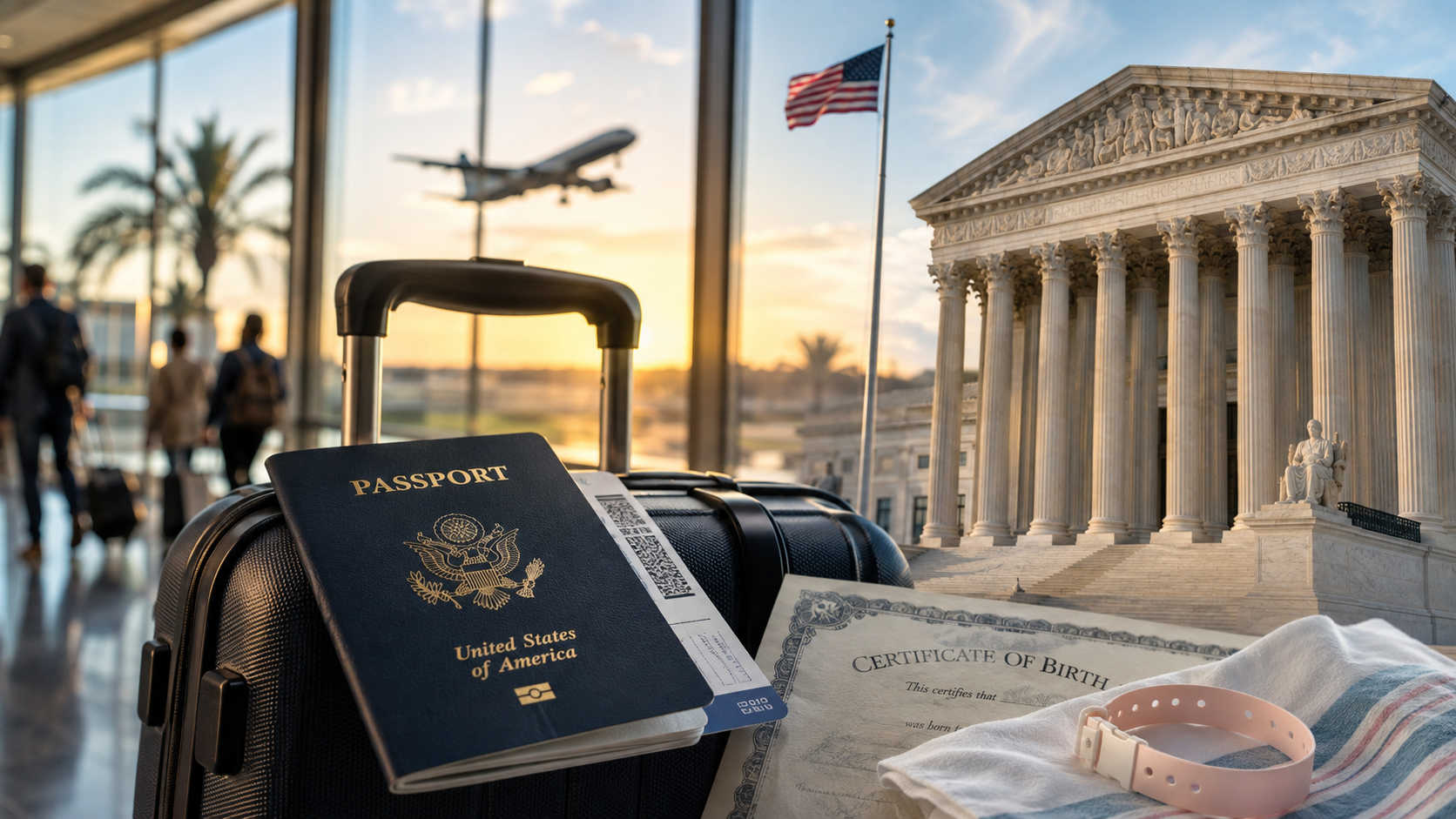
President Donald Trump on Thursday signed two executive orders renewing his effort to restrict access to birthright citizenship, this time directing federal agencies to withhold citizenship recognition in specified cases involving foreign terrorists, foreign government employees and paid arrangements to give birth in the United States, while separately giving immigration officials broader authority to combat what the administration calls “birth tourism.”

The orders represent a new approach following Trump’s defeat at the Supreme Court on June 30, when the justices rejected his January 2025 effort to deny citizenship to children born in the United States to parents who were in the country illegally or temporarily. In Trump v. Barbara, the court ruled 6-3 against that policy, with five justices concluding that the Fourteenth Amendment protects citizenship for those children and Justice Brett Kavanaugh reaching the same result under federal law.
The first new order, titled “Continuing to Protect the Meaning and Value of American Citizenship,” does not attempt to revive the earlier policy in the same form. Instead, it states that no executive department or agency should issue documents recognizing U.S. citizenship — or accept citizenship documents issued by state, local or other authorities — when neither parent of the person is a U.S. citizen and at least one of four specified circumstances applies.
The first category involves a parent whom the administration considers an “alien enemy.” The order defines that term to include any member of an organization designated by the United States as a Foreign Terrorist Organization or a person designated as a Specially Designated Global Terrorist under federal authorities governing terrorism-related sanctions.
A second category applies when either parent is a foreign government employee. The order says that includes ambassadors; nationals of foreign countries employed by their country’s embassy or consulate; people employed by foreign governments in an official capacity; and employees of international organizations who possess international-organization immunity.
The third category targets arrangements in which a parent is deemed to have engaged in a commercial transaction to purchase or obtain access to birthright citizenship, or engaged in fraudulent activity to obtain citizenship. The order specifically includes commercial transactions designed to ensure that a child’s mother is present in the United States or a U.S. territory to give birth, as well as transactions with a surrogate who is present in the United States or a territory to give birth.
The fourth category covers a person born in a U.S. territory or U.S. territorial waters where citizenship is not conferred by federal statute.
Under the order, the secretaries of State and Homeland Security, the attorney general and the commissioner of Social Security are directed to take appropriate steps to align their departments’ regulations and policies with the new directive. All executive departments and agencies are also ordered to issue public guidance within 30 days explaining how they will implement it.
The White House described the categories as a non-exhaustive identification of children it contends fall outside birthright-citizenship protection under exceptions recognized in the Supreme Court’s June decision.
The court’s ruling, however, broadly reaffirmed citizenship for children born on U.S. soil to parents who are unlawfully or temporarily present. The Citizenship Clause of the Fourteenth Amendment covers people born or naturalized in the United States and “subject to the jurisdiction thereof.” The court held that children of undocumented immigrants and temporary visitors meet that jurisdictional requirement and are citizens at birth.
Chief Justice John Roberts’ majority opinion traced the constitutional rule to the common-law principle of jus soli, or citizenship based on place of birth. The court described the historical exceptions as narrow, including children of foreign ministers and people born where the sovereign did not exercise control. Its discussion of United States v. Wong Kim Ark, the landmark 1898 citizenship decision, also addressed the historical exception for children born to alien enemies during a hostile occupation.
Trump’s new order uses a broader definition of “alien enemy” than that historic hostile-occupation example, expressly including parents linked to designated terrorist organizations or designated as global terrorists. It also creates the separate category involving commercial arrangements intended to obtain citizenship through a U.S. birth.
Second Order Targets "Birth Tourism"
Trump’s second order, titled “Ending Birth Tourism,” focuses not on citizenship documentation itself but on foreign nationals entering the United States to give birth and on individuals or businesses that facilitate such travel.
The order defines birth tourism as the entry of a foreign national into the United States through a nonimmigrant visa for the purpose of giving birth on U.S. soil. It also includes efforts by one foreign national to facilitate another foreign national’s entry through a nonimmigrant visa for that purpose.
Trump delegated authority under Section 215(a) of the Immigration and Nationality Act to the secretaries of State and Homeland Security to implement the policy. Those officials are authorized to issue or revise rules, policies and operational guidance.
The enforcement options laid out in the order are extensive but discretionary. State and Homeland Security may take action to prevent a person from entering the United States or being granted a visa or other travel authorization when the person is entering or attempting to enter for birth tourism.
The order also authorizes the agencies, within their existing authority, to revoke a visa or travel authorization and permanently bar entry for a foreign national who enters or attempts to enter for birth tourism. It permits denial of entry or removal of someone who previously participated in birth tourism or plans to do so.
Enforcement may also extend beyond the traveler. The order authorizes appropriate action against entities, organizations or individuals, whether inside or outside the United States, that facilitate or enable birth tourism. Other federal agencies are directed to provide State and Homeland Security with records and information needed to carry out the policy, subject to applicable law.
The secretaries of State and Homeland Security retain authority to make exceptions on humanitarian grounds or when they determine that a foreign national’s entry is in the national interest.
Birth Tourism Was Already Restricted Under Visitor-Visa-Rules
Travel to the United States primarily to give birth for the purpose of obtaining U.S. citizenship for a child was already prohibited as a permissible basis for receiving a B visitor visa.
The State Department changed its B-visa regulations in January 2020 to require consular officers to deny applications when they have reason to believe the applicant’s primary purpose for traveling is to give birth in the United States to obtain citizenship for the child. Current State Department guidance continues to state that birth tourism is not a permissible purpose for a visitor visa.
Current consular guidance provides a rebuttable presumption when an officer has a specific reason to believe an applicant will give birth during the proposed U.S. stay. An applicant can overcome that presumption by establishing another legitimate primary purpose, such as obtaining specialized medical treatment unavailable near her home. The guidance also states that officers should not routinely ask female applicants whether they are pregnant or require proof that they are not pregnant.
Thursday’s executive order goes further by explicitly identifying additional potential consequences, including visa revocation, removal, possible permanent exclusion from the country and enforcement against people or organizations that facilitate birth-tourism arrangements.
How Trump's First Birthright Citizenship Order Was Different
Trump’s original executive order, signed on January 20, 2025, sought a much broader change.
That directive ordered federal agencies not to recognize U.S. citizenship for a child when the mother was unlawfully present in the United States at the time of birth and the father was neither a U.S. citizen nor a lawful permanent resident. It imposed the same restriction when the mother was lawfully in the country but only temporarily and the father was neither a citizen nor permanent resident. The restrictions were to apply to children born more than 30 days after the order was signed.
Courts blocked the policy before it could take effect, and the Supreme Court ultimately rejected it on the merits in June.
Five justices — Roberts, Amy Coney Barrett and the court’s three liberal members — concluded that the Constitution itself protects citizenship for children born in the United States to parents who are illegally or temporarily present. Kavanaugh agreed that Trump’s order could not stand but concluded that federal immigration law, rather than the Constitution, was the controlling obstacle. Justices Clarence Thomas, Samuel Alito and Neil Gorsuch dissented.
The Supreme Court’s ruling relied heavily on Wong Kim Ark, which established in 1898 that a U.S.-born child of Chinese nationals was an American citizen. The court said that temporary presence by a child’s parents did not remove them or their child from U.S. jurisdiction for purposes of birthright citizenship.
Trump subsequently said he would ask the Supreme Court to rehear the case, but the 25-day deadline for seeking rehearing expired in late July without the administration filing such a request.
What the Orders Mean for the U.S. Virgin Islands
The new directives carry direct relevance for the U.S. Virgin Islands because federal immigration law expressly includes the territory within the geographic definition of the United States.
The Immigration and Nationality Act defines the “United States,” when used geographically, to include the continental United States, Alaska, Hawaii, Puerto Rico, Guam, the Virgin Islands of the United States and the Northern Mariana Islands.
Federal law separately provides specific citizenship protection for people born in the Virgin Islands. Under 8 U.S.C. §1406(b), people born in the Virgin Islands on or after February 25, 1927, and subject to the jurisdiction of the United States are U.S. citizens at birth.
That statute is significant to one provision of Trump’s new citizenship order. The order includes people born in a U.S. territory or territorial waters “where citizenship is not conferred by Federal statute.” Because federal law expressly confers citizenship at birth in the Virgin Islands, that particular territorial category does not on its face describe the USVI.
Other provisions are more directly applicable to the territory. The citizenship order expressly includes commercial arrangements to have a mother or surrogate present in the United States or a U.S. territory to give birth. And the Immigration and Nationality Act invoked by the separate birth-tourism order includes the Virgin Islands within its geographic definition of the United States.
The two orders therefore mark a substantially narrower citizenship strategy than Trump’s first attempt: rather than again declaring that children of undocumented immigrants and temporary visitors generally are outside the Fourteenth Amendment, the administration is identifying specific categories it says remain excluded after the Supreme Court’s ruling while separately using immigration and visa authorities to discourage foreign nationals from traveling to U.S. soil for the purpose of giving birth.



Advertisements