




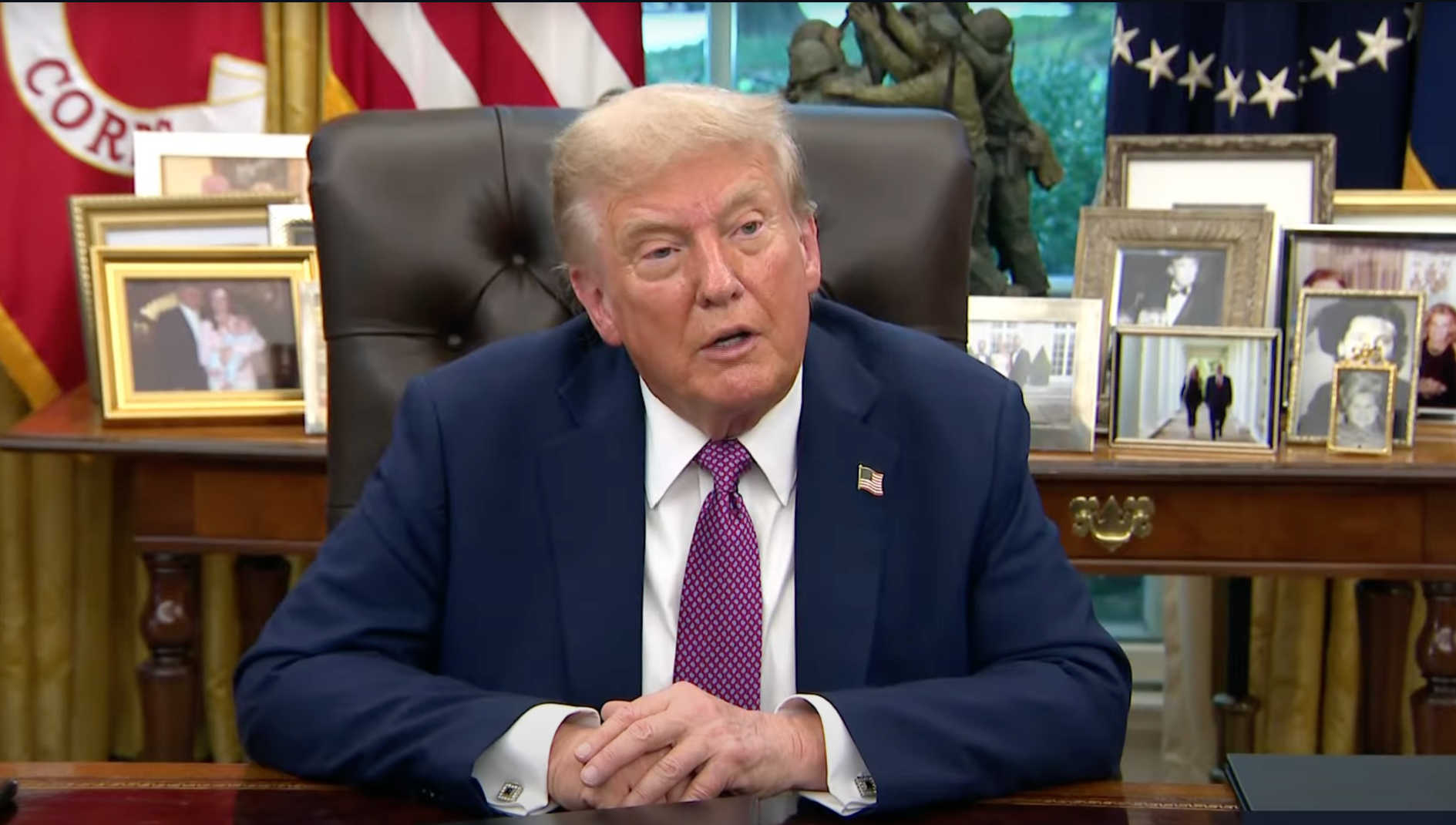
President Donald Trump at the Oval Office on Sept. 5, 2025 signing executive orders and addressing the press. Photo Credit: SCREENSHOT/V.I. CONSORTIUM.
On September 5 President Donald Trump signed an executive order authorizing the use of "Department of War" and "Secretary of War" as secondary titles for the U.S. Department of Defense and its leadership. The move, which does not formally rename the department, reflects a symbolic shift aimed at emphasizing a more assertive military posture.

The directive, issued from the Oval Office, instructs Defense Secretary Pete Hegseth to use these titles in official correspondence, public communications, and ceremonial contexts, while also directing him to propose legislative and executive actions to make the renaming permanent. The Department of Defense, established in 1949 under the National Security Act, retains its official name, as only Congress can enact a formal change.
The executive order has sparked a range of reactions across political and military circles. Supporters, including some Republican lawmakers, argue that the secondary title harkens back to the department’s historical roots as the Department of War, which existed from 1789 to 1947. They contend it better reflects the military’s mission of projecting strength.
“The U.S. military is the most lethal fighting force on the planet, & restoring the Department of War name reflects our true capabilities to win wars, not just respond to them,” said Sen. Rick Scott (R-Fla.), who, along with Sen. Mike Lee (R-Utah) and Rep. Greg Steube (R-Fla.), has introduced legislation to codify the change. However, critics, including some Democrats, view the move as a distraction from more pressing national security priorities. Sen. Jeanne Shaheen (D-N.H.) called it an “effort to distract from other issues that are going on in the country” during an MSNBC interview.
The Department of War was the original name of the agency overseeing U.S. military affairs, established under President George Washington in 1789 with Henry Knox as its first secretary. It managed military operations through major conflicts, including the War of 1812, World War I, and World War II, until the National Security Act of 1947 reorganized it into the National Military Establishment.
This entity was renamed the Department of Defense in 1949 to reflect a broader mission encompassing national security and deterrence in the post-World War II era. The executive order’s reference to the historical name taps into a narrative of past military victories, with President Trump stating, “We won WWI, and we won WWII, not with the Department of Defense, but with a War Department, with the Department of War,” during a recent interview on Fox & Friends.
Implementation of the executive order has already begun, with the Pentagon’s website, defense.gov, redirecting to war.gov, which now displays “U.S. Department of War” as its header. The order also mandates that all executive departments and agencies accommodate the secondary titles in their communications, provided they do not conflict with legal or statutory obligations.
However, the rebranding effort has raised concerns about its cost, with estimates suggesting a full overhaul of signage, emblems, and digital assets could reach billions of dollars. When asked about the expense, President Trump downplayed the issue, stating, “We know how to rebrand without having to go crazy.” The White House has not provided specific figures, and the order specifies that costs for its publication will be borne by the Department of Defense.
Within the Pentagon, reactions have been mixed, with some officials expressing frustration over the logistical challenges of implementing even a partial rebrand. Others see the move as symbolic.
“We’re going to go on offense, not just on defense. Maximum lethality, not tepid legality. Violent effect, not politically correct,” said Defense Secretary Hegseth at the signing, emphasizing a cultural shift toward a “warrior ethos.” Critics like Rep. Darren Soto (D-Fla.) have pointed to the irony of such aggressive rhetoric from an administration that has also expressed interest in pursuing a Nobel Peace Prize.
The long-term fate of the rebranding effort remains uncertain, as a permanent name change requires congressional approval. While Republican lawmakers have introduced bills to formalize the shift, opposition from Democrats and some Republicans, including Sen. Mitch McConnell (R-Ky.), who criticized the administration’s Pentagon budget priorities, suggests a challenging path forward.

The executive order represents the 200th signed by President Trump since taking office, aligning with his broader agenda of reshaping federal institutions.


Advertisements