



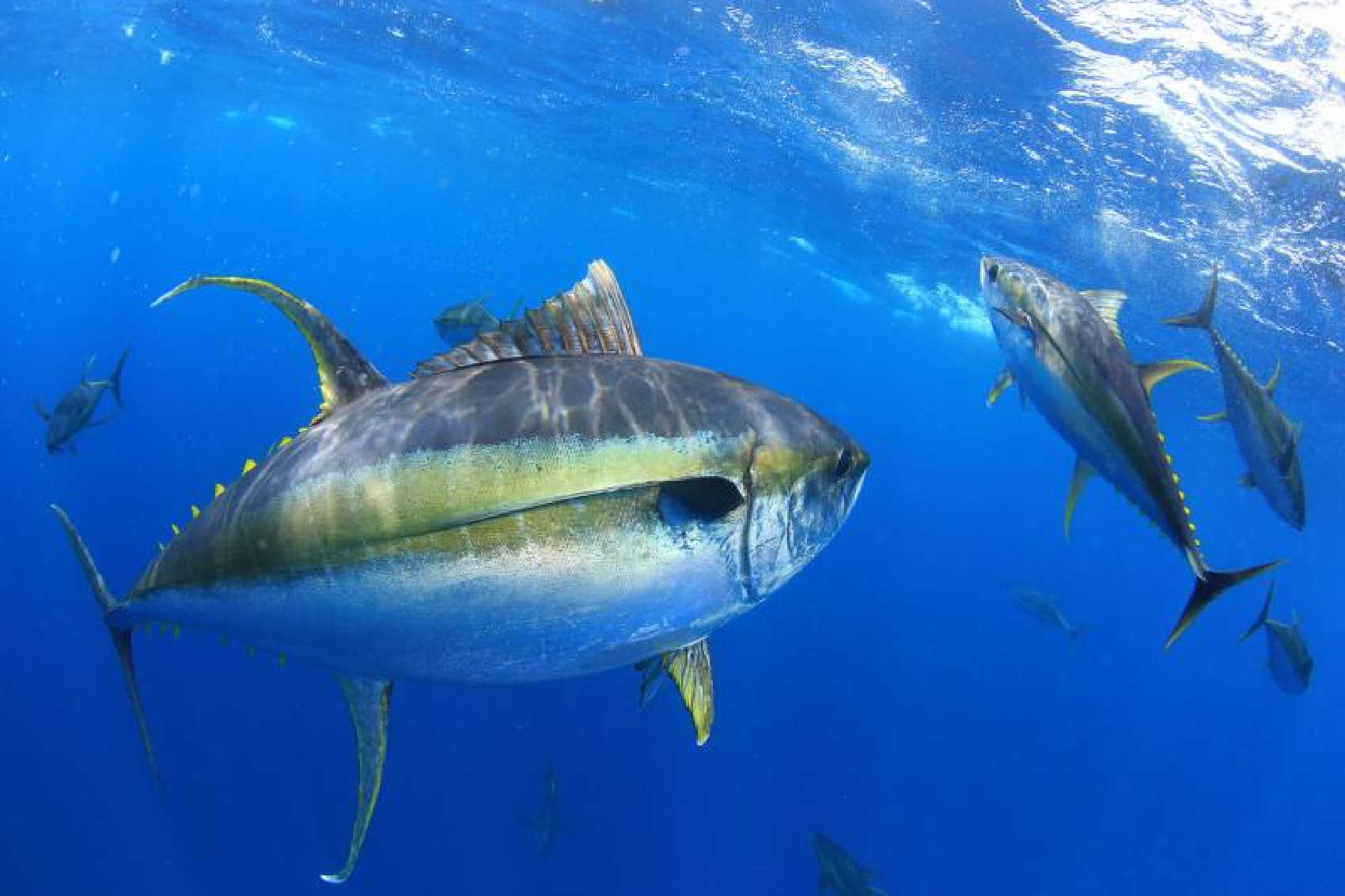
A school of yellowfin tuna swims through clear blue ocean water, illustrating NOAA’s proposed changes that would allow qualifying USVI commercial fishermen to spearfish and sell four tuna species. Photo Credit: NOAA.
The National Oceanic and Atmospheric Administration is proposing a significant expansion of fishing options available to qualifying commercial fishermen in the U.S. Virgin Islands, including allowing them to use spearguns to harvest and sell four species of tuna, retain certain sharks caught on buoy gear, and use powered equipment to deploy and retrieve that gear.

NOAA Fisheries is holding its first public hearing on the proposed regulations today, August 31, from 1 p.m. to 3 p.m. Virgin Islands time. A second hearing is scheduled for October 1, while written comments will be accepted through October 13.
At the center of the proposed changes for the territory is NOAA's Highly Migratory Species Commercial Caribbean Small Boat permit, a federal permit specifically designed for fishing in Puerto Rico and the U.S. Virgin Islands. Holders of the permit are already authorized to commercially fish for and sell bigeye, albacore, yellowfin and skipjack tuna — collectively referred to by federal regulators as BAYS tunas — as well as swordfish and allowable shark species.
Under NOAA's preferred proposal, those fishermen would also be permitted to use spearguns to harvest and commercially sell the four BAYS tuna species, subject to existing size and retention limits.
The proposal does not extend speargun use to swordfish, sharks or bluefin tuna.
NOAA's proposed regulations would also place specific restrictions on how tuna may be taken with a speargun. The fisherman would have to be physically in the water when the weapon is fired and could freedive, use scuba equipment or use another underwater breathing device. Only free-swimming tuna could be taken, meaning fishermen could not first restrain a fish on a fishing line and then shoot it.
Powerheads and other explosive devices would remain prohibited.
The proposed change represents an expansion from current federal rules governing commercial tuna harvest. NOAA says spearguns are already authorized in certain recreational Atlantic tuna fisheries, but the agency is now proposing their use for commercial harvest under several federal permits, including the Commercial Caribbean Small Boat permit available in the U.S. Caribbean.
Another change could expand what Virgin Islands fishermen are permitted to keep when using buoy gear.
Under NOAA's preferred proposal, Commercial Caribbean Small Boat permit holders would be allowed to retain allowable shark species caught on buoy gear. Existing restrictions governing which shark species may be taken, along with current retention limits and commercial quotas, would remain unchanged.
Federal regulators said the affected shark quotas are currently underutilized and projected that the change could provide fishermen with expanded harvesting opportunities and potentially increase revenue from shark landings and sales.
NOAA is also proposing to modernize the way buoy gear may be handled.
Commercial Caribbean Small Boat permit holders are already authorized to use buoy gear and may generally deploy up to 35 individual buoy gears. Current federal requirements have required the gear to be deployed and retrieved by hand.
The new rule would allow fishermen to use power assistance, including electric or hydraulic winches, to release and retrieve the gear. NOAA said interest in powered retrieval has grown as fishermen increasingly use deeper buoy-gear sets, particularly when targeting swordfish during daylight hours.
According to the agency's economic analysis, an electric reel could cost approximately $8,000 while a hydraulic setup could cost roughly $2,000. NOAA said powered equipment could make fishing less physically demanding and improve efficiency by allowing fishermen to retrieve hooked fish and redeploy gear more quickly.
The existing 35-buoy limit applicable to Commercial Caribbean Small Boat permit holders would remain in place.
A separate part of the proposed rule would clarify that fishermen operating highly migratory species vessels may carry and use small cast nets, dipnets and similar equipment to collect bait, provided the equipment is too small or too weak to catch highly migratory species. Such gear is not explicitly authorized under existing rules, creating a technical prohibition even though it is commonly used simply to collect bait.
NOAA said the broader proposal is intended to remove unnecessary inefficiencies and give fishermen greater flexibility while maintaining federal conservation and fisheries-management requirements. The agency said changes in fishing techniques, species distribution, market conditions and gear technology over the past two decades prompted it to revisit some longstanding restrictions.

The rules remain proposals and would not take effect unless NOAA completes the federal rulemaking process and adopts them in final form.


Advertisements