

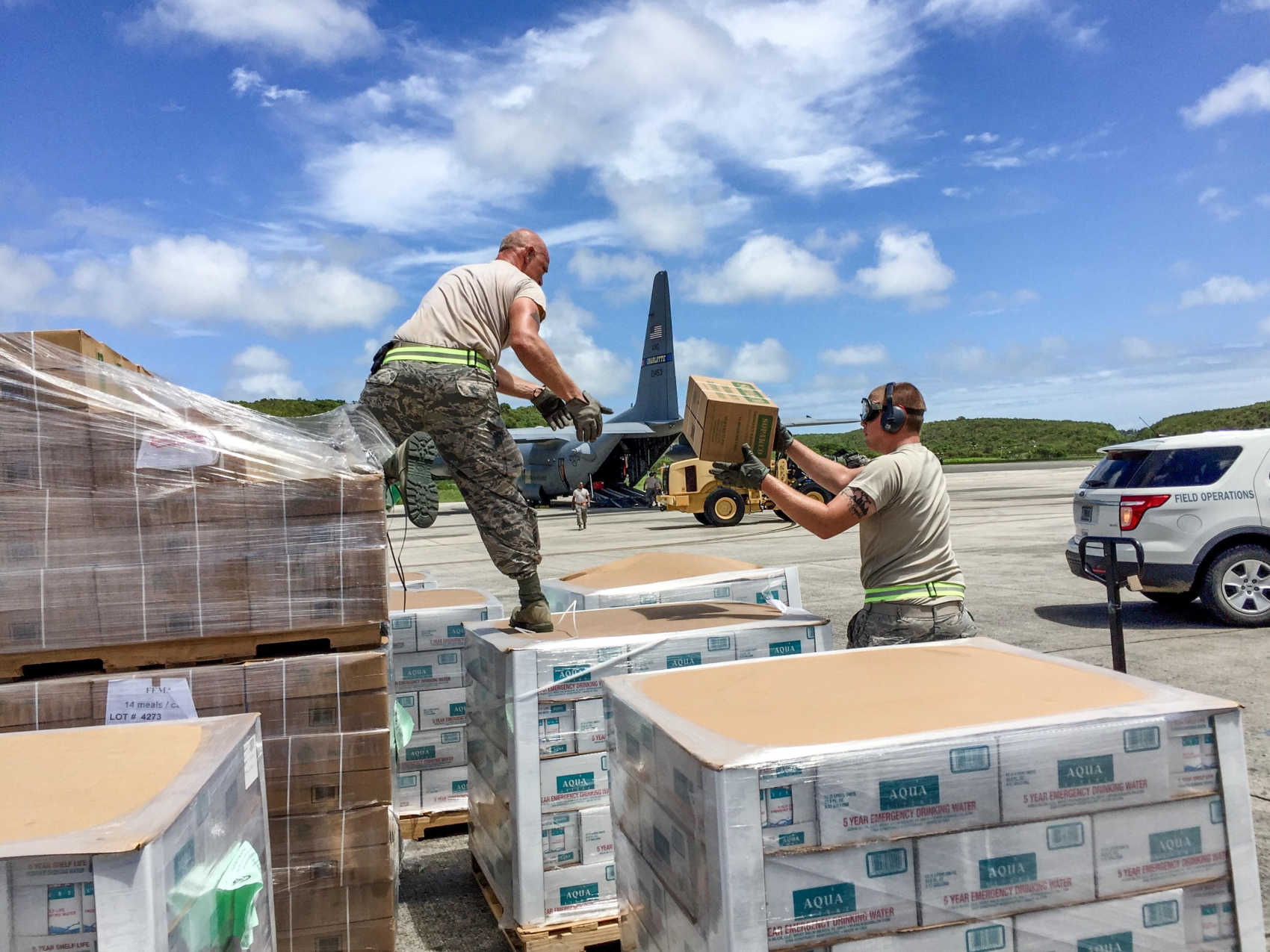
FEMA personnel unload pallets of emergency supplies from a military transport aircraft on St. Croix following Hurricanes Irma and Maria, illustrating the rapid disaster logistics network FEMA now seeks to establish for the USVI and Puerto Rico. Photo Credit: FEMA.
FEMA is seeking multiple contractors to move disaster supplies from the mainland to the USVI and Puerto Rico, with capacity for roughly 4,000 containers over three months and full round-the-clock operations required within 48 hours of each task order.

The Federal Emergency Management Agency is moving to establish a large-scale disaster transportation network capable of rapidly moving emergency supplies from the U.S. mainland to the Virgin Islands and Puerto Rico, with contractors required to begin operations within 24 hours of being activated and reach full, round-the-clock capability within 48 hours.
The procurement, formally titled Disaster Overseas Transportation Support – U.S. Virgin Islands/Puerto Rico, would create multiple federal contracts covering ocean, air and ground transportation, port operations, cross-docking, staging, warehousing and delivery of emergency resources throughout the islands. FEMA's current solicitation envisions a one-year base period beginning October 1, 2026, followed by four one-year options that could keep the transportation network in place through September 30, 2031.
At the center of the operation would be the movement of FEMA's Initial Response Resources — the supplies needed in the earliest stages after a hurricane or other major disaster. The agency identifies water, meals, generators and medical supplies among the cargo the system must be prepared to move from the continental United States into Puerto Rico and the U.S. Virgin Islands. Contractors would also transport equipment and resources belonging to other federal agencies supporting a disaster response.
The scale FEMA is requiring is substantial. Under the current Performance Work Statement, the contractor network must be capable of handling approximately 4,000 containers or trailers during a three-month period. That capacity covers the combined Puerto Rico and Virgin Islands mission and should not be interpreted as 4,000 containers destined for the USVI alone.
FEMA is also imposing aggressive activation requirements. Contractors must establish initial operational capability within 24 hours of a task order and be fully functional within 48 hours, after which operations must be available 24 hours a day, seven days a week. The requirement is designed so that FEMA does not have to assemble a shipping and logistics system from scratch after a major storm has already struck.
The envisioned network extends well beyond putting containers aboard ships. FEMA is seeking contractors that can provide the personnel, shipping containers, trucks, trailers, chassis, handling equipment and facilities necessary to move commodities through the entire supply chain. Required services include ocean freight, expedited air cargo, ground transportation, drayage, line-haul trucking, cross-docking and staging operations, as well as movement of cargo from ports to FEMA-designated points of need within the islands.
The contracting framework also contemplates secured "catch yards" used to stage trucks and containers near ports, along with container storage, refrigerated equipment and warehouse capacity. FEMA's pricing documents include services for refrigerated containers, chassis and ISO tanks, as well as large-scale warehousing and commodity pre-positioning — allowing equipment and supplies to be positioned ahead of or during an emergency instead of relying solely on shipments initiated after impact.
Air transportation forms another part of the network. The solicitation includes expedited movement of palletized cargo from mainland regions to the USVI and Puerto Rico, providing FEMA with an alternative when supplies are too urgent to await ocean transportation or when maritime operations are constrained.
The system is also designed to work in reverse once an emergency operation begins winding down. FEMA requires what it calls retrograde operations, allowing containers, equipment and other federal resources to be moved from disaster locations back through ports and ultimately returned to staging areas or other destinations.
FEMA is pursuing the arrangement through a multiple-award, firm-fixed-price, indefinite-delivery/indefinite-quantity contracting structure. In practice, that would allow the agency to select multiple companies and then issue individual task orders for transportation and logistics services as disasters or other operational needs arise, rather than negotiating an entirely new transportation contract for every emergency.
The agency opened the solicitation in July and later extended the deadline for final Phase II proposals by one week, from August 21 to August 28. That deadline has now passed. FEMA's procurement record does not currently show that the contracts have been awarded, and the solicitation expressly reserves the government's right to cancel the procurement without making an award.
That distinction is important. FEMA is not announcing that a new five-year transportation contract is already in force. Rather, the agency has completed the proposal stage of a procurement intended to create the network, with contract performance scheduled to begin October 1 if awards proceed as contemplated.
The solicitation comes as the Virgin Islands remains particularly dependent on functioning maritime and air links during disasters. When hurricanes disrupt normal commercial supply chains, FEMA and other federal agencies must be able to move large quantities of food, drinking water, generators, medical supplies and other emergency commodities across hundreds or thousands of miles and then distribute them after arrival.
The new contracting structure seeks to have that capability established in advance, including the ships, aircraft, trucks, containers, staging areas, warehouses, equipment and personnel necessary to rapidly scale operations when the federal government activates its response.

FEMA has not published a final contract award value in the current solicitation record reviewed by the Consortium. Earlier procurement-market estimates have circulated concerning the potential value of the program, but they are not sufficiently supported by the final FEMA solicitation to be reported as the value of the forthcoming contracts.


Advertisements