




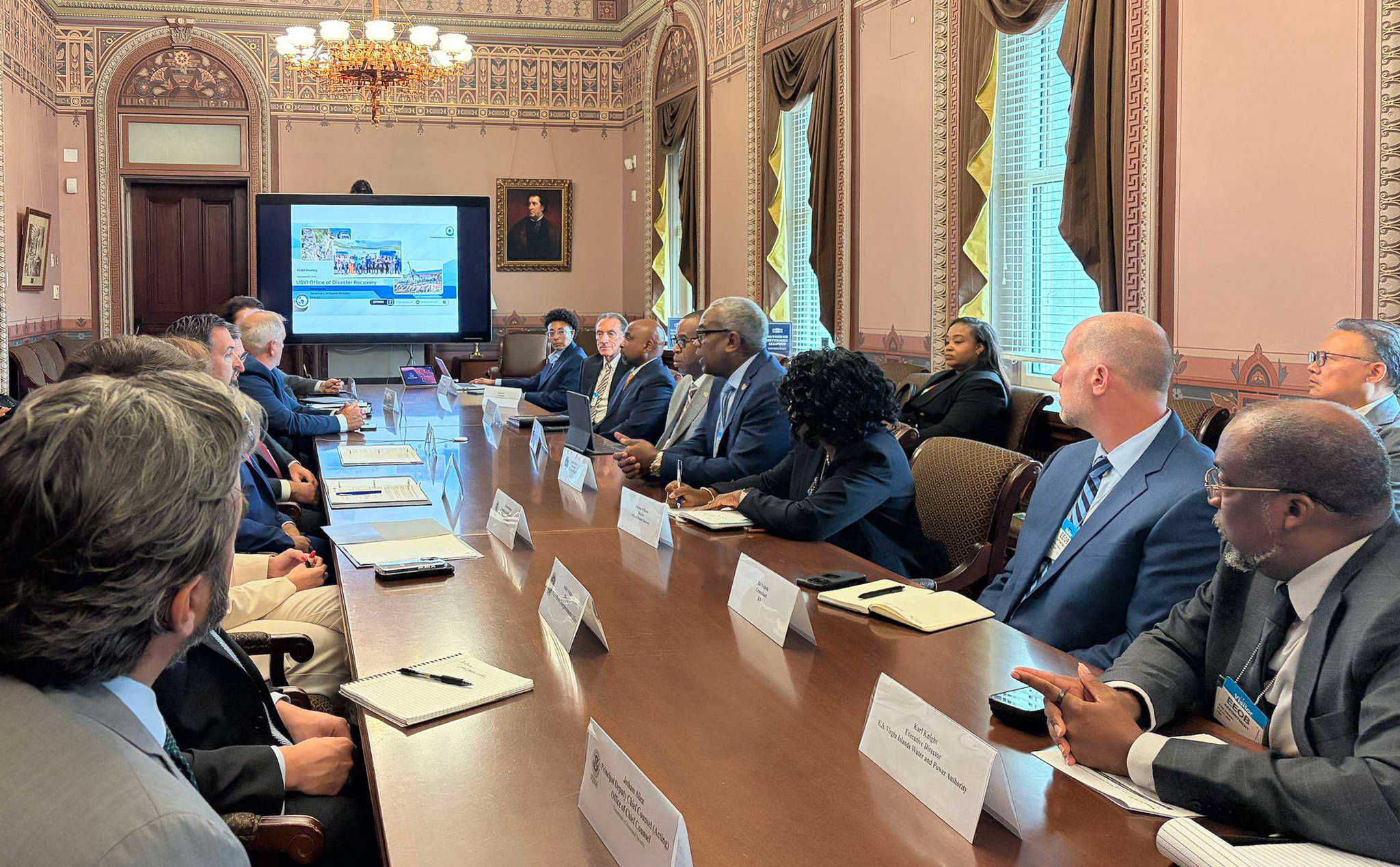
An August 24 letter from FEMA initiating an enhanced compliance review of the Virgin Islands’ disaster recovery program led to a Washington meeting Monday between Gov. Albert Bryan Jr., senior territorial recovery officials, FEMA and White House budget officials, with the governor saying afterward that no specific projects were flagged, no new funding conditions were imposed and reimbursements have not been delayed.

The letter, obtained by the Consortium, was sent by FEMA Region 2 Administrator Christopher Hartnett to Office of Disaster Recovery Director Adrienne Williams-Octalien. FEMA said it was reviewing the “status, pace, documentation, and financial oversight” of recovery work throughout the territory, including project execution, funding accountability, management-cost spending, time-extension requests and compliance with federal requirements.
FEMA explicitly tied the heightened scrutiny to HUD’s recent suspension action involving the Virgin Islands Housing Finance Authority, saying issues identified by HUD could also affect FEMA-funded projects. The agency pointed to possible duplication of benefits, project delays, financial controls, procurement oversight, documentation and contractor performance, and said its enhanced review could encompass projects involving VIHFA, ODR, the V.I. Water and Power Authority and other territorial entities.
The review was not limited to a general request for updates. FEMA said it would apply heightened scrutiny to supporting documentation, manual reimbursement validation, management costs, time-extension requests, payments to professionals and contractors relative to project completion, and possible overlap with HUD-funded work. The agency warned that additional oversight or enforcement measures could follow if performance, documentation or accountability concerns were not adequately addressed.

FEMA also required senior representatives from the GVI, VIHFA, ODR and WAPA, along with relevant contractors or consultants, to attend a Washington meeting on project execution, recovery timelines, federal-funding accountability, documentation, possible duplication of benefits and any corrective actions needed to keep the recovery moving. It separately requested a project-by-project status report by September 24.
That meeting took place Monday. Mr. Bryan was joined by Ms. Williams-Octalien, Acting Territorial Public Assistance Officer Tamisha Lambert, WAPA Chief Executive Officer Karl Knight, VIHFA Executive Director Derek Gabriel and other members of the recovery team, according to Government House.
Mr. Bryan characterized the discussion differently from FEMA’s formal description of the broader process.
“I wouldn’t call it a compliance review but more as an update on the status of our projects,” he told the Consortium.
According to the governor, federal officials did not identify any individual project, agency or contractor as problematic. He said their principal concern was whether the territory could move obligated money into actual construction and expenditures quickly enough to meet its planned recovery timeline through 2031.
“Their main concerns were around spending rates,” Mr. Bryan said. He said federal officials appeared satisfied with controls already in place but wanted assurance that the territory could realistically execute its spending plan.
Government House said FEMA and White House Office of Management and Budget officials emphasized the need for continued measurable progress. The administration, in turn, pointed to the timing and scale of the federal obligations: FEMA Public Assistance funding for the territory grew from approximately $2.3 billion in September 2020 to about $21.6 billion by September 2025, with major school and healthcare obligations beginning in early 2022 and additional hospital, wastewater, education, road, water and power projects approved through January 2025.
Mr. Bryan said the two most significant obstacles identified during Monday’s discussion were environmental review and workforce housing. Government House listed other constraints, including shortages of skilled labor, contractor availability, limited construction capacity, debris disposal, inflation and market conditions. Federal officials expressed a willingness to work with the territory on workforce housing and environmental-review processes.
Approximately $12 billion in recovery projects are currently moving through environmental-compliance processes, according to the administration, making the pace of federal environmental reviews a significant factor in construction schedules.
The administration also used Monday’s meeting to highlight the amount of work already under contract. Through Rebuild USVI, the government says it has released 11 procurement bundles along with additional individual solicitations and executed 12 contracts covering 39 projects supported by approximately $13.7 billion in obligated funding.
Government House projects 19 major projects in active construction during 2026, rising to 42 in 2027 and 46 simultaneously in 2028, with significant construction continuing through 2030 and beyond. The portfolio includes schools, hospitals and healthcare facilities, power generation, water and wastewater systems, roads and public buildings across St. Croix, St. Thomas and St. John.
Among the major investments cited by the administration are approximately $2.4 billion in education projects on St. Thomas and $769 million on St. Croix; $4.1 billion in infrastructure work in northcentral St. Croix and $4.4 billion in eastern St. Thomas; $1.2 billion in St. Thomas healthcare projects; and approximately $885 million in power-generation projects on St. Croix and St. Thomas.
FEMA’s August letter requires the territory to provide by September 24 a status report covering every FEMA-funded recovery project, including completed work, projects under construction, delayed or unobligated projects, unobligated balances, pending time extensions, management-cost expenditures, contractor-performance summaries and any scopes that could overlap with HUD-funded activities. For delayed projects, FEMA wants the cause of the delay, responsible party, revised completion schedule and next milestone.
Asked whether the government would meet that deadline, Mr. Bryan said the administration has already provided FEMA with the information requested and will continue supplying additional material on individual projects.
Government House said the U.S. OMB made a separate request Monday for additional project-level information, which the territory expects to provide by the end of September.
Despite the breadth of FEMA’s review, Mr. Bryan said it has not slowed reimbursements or project approvals and that FEMA has imposed no additional funding conditions since the August 24 letter.
He also said the HUD concerns that FEMA cited in initiating the review did not become a subject of Monday’s discussions. HUD was not present, he said, and federal officials did not ask the administration to revalidate its financial-control systems.
Asked whether the administration has concerns about WAPA, VIHFA or ODR — all entities specifically identified in FEMA’s letter as potentially falling within the review — Mr. Bryan responded: “We don’t have any concerns.”
The meeting also addressed the territory’s required local match. Government House said federal cost shares stand at 95 percent for standard recovery projects and 98 percent for projects funded under Section 428, leaving the territory responsible for 5 percent and 2 percent respectively. Mr. Bryan told federal officials that the enhanced federal shares have been critical to moving major projects forward.
The administration stressed that its push for faster execution would continue alongside financial oversight. ODR and VITEMA use financial and compliance reviews, documentation requirements and physical site inspections as part of the recovery-payment process, Government House said. Its presentation noted that FEMA monitored approximately $1.4 billion, or 42 percent, of the territory’s $3.28 billion in drawdowns between 2017 and 2024.
“We have three responsibilities: get the funds, spend the funds and spend the funds correctly,” Mr. Bryan said. “Speed matters, but so do accountability and compliance. Our goal is to move this recovery as quickly as possible while ensuring that every federal dollar is properly accounted for and ultimately delivers a lasting benefit to the people of the Virgin Islands.”
FEMA’s August letter reserves the agency’s authority to take additional action under applicable law, regulation, policy or award terms and says it may coordinate with HUD, OMB, DHS leadership and White House staff as appropriate. Mr. Bryan said no corrective action was discussed or contemplated during Monday’s meeting and expressed skepticism that imposing additional controls would make recovery projects move faster.

The governor also said the administration is willing to make its September 24 submission to FEMA public, noting that much of the underlying project information is already available through government recovery reporting.