

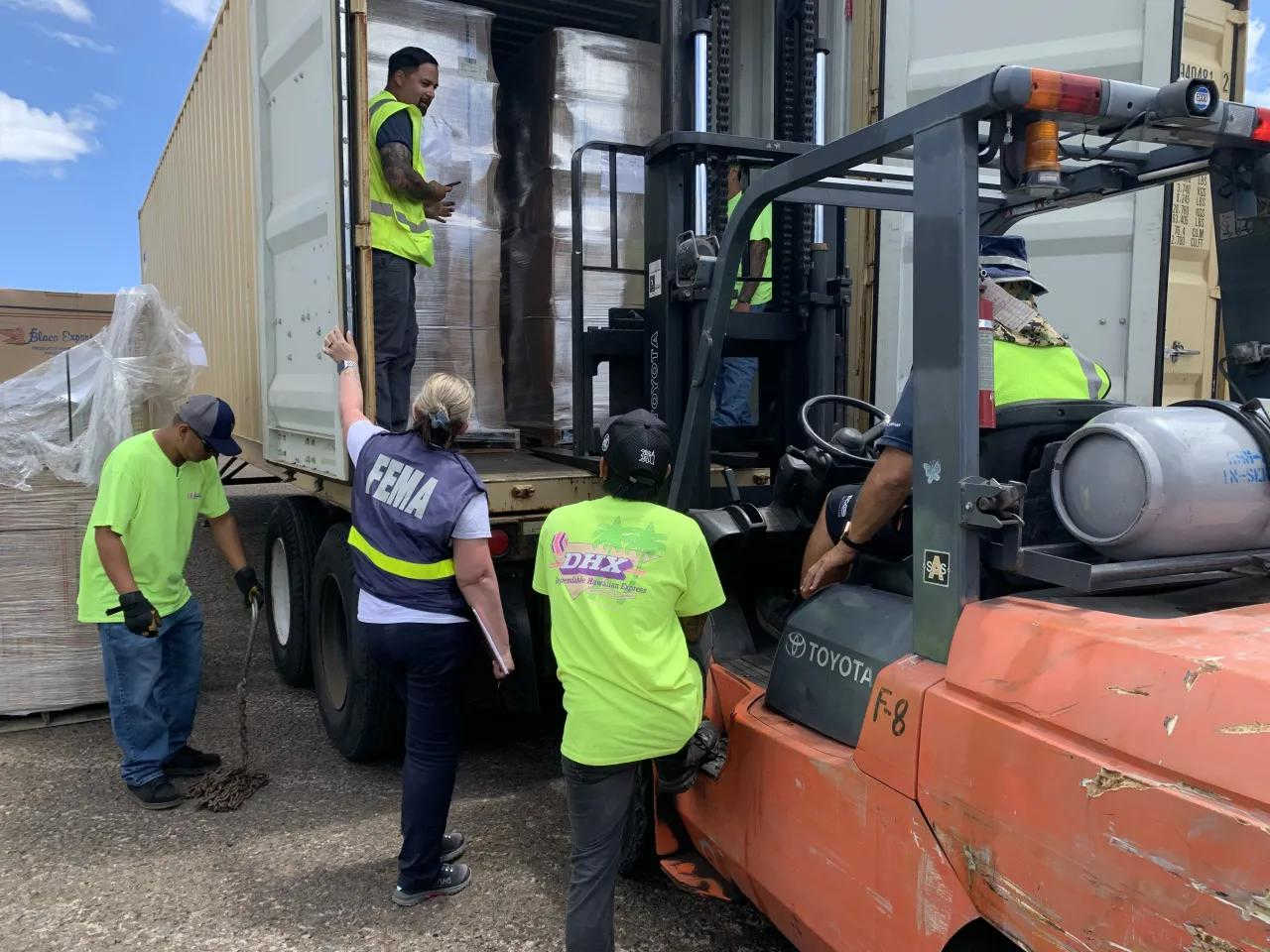
The Federal Emergency Management Agency is moving to pave and repair roadways at its Mosquito Point complex on St. Thomas after two recorded forklift accidents occurred on a dirt-and-gravel access road leading to one of the facility’s communications bunkers, including an accident in which the driver was ejected.
The disclosure appears in a federal solicitation issued by FEMA Region 2 for roadway improvements at the agency’s St. Thomas Initial Operating Facility, also known as the Mosquito Point Complex.
FEMA describes the access road leading to Communications Bunker #3 as “mission critical” and says the roadway has been the site of two recorded forklift accidents. The agency specifically notes that one of those accidents involved a driver being ejected. FEMA did not state when the accidents occurred, identify the driver or say whether the person suffered injuries.
The new project calls for resurfacing existing asphalt roadways and paving the dirt-and-gravel road leading to Bunker #3. An alternate portion of the solicitation would also allow FEMA to pave the access road to Bunker #2.

According to the procurement documents, the work is intended to improve safety, support heavy-vehicle and forklift traffic, improve operational access and reduce roadway hazards at the federal site.
The Mosquito Point complex sits on approximately 20 acres of steep, multi-level rocky terrain and contains roughly one mile of roadways and approaches. FEMA says the site includes about 0.45 miles of concrete roadway, 0.39 miles of asphalt and 0.14 miles of dirt or gravel road.
The procurement also indicates that portions of the site's asphalt roads were recently cut open to install underground electrical power and fiber-optic conduit. Those areas now require subgrade preparation, compaction, proof rolling and resurfacing as part of the planned work.
FEMA published the updated solicitation on September 28, with offers due September 29 at 3 p.m. Eastern time. The federal notice became inactive September 30. As of the latest publicly available record reviewed by V.I. Consortium, FEMA had not posted an award for the work.
Federal records show that Mosquito Point has served as an important FEMA operational facility since the aftermath of the 2017 hurricanes.
In 2018, FEMA awarded an approximately $84,779 contract for restoration work at its St. Thomas bunker as part of the federal response to Hurricane Maria.
A year later, FEMA paid $7,000 for repairs and inspections of a forklift located at the Mosquito Point bunker. That July 2019 contract was associated with federal disaster declaration DR-4340 for the U.S. Virgin Islands. The record does not indicate whether that forklift was involved in either of the accidents referenced in the new paving solicitation.
The earlier forklift work nevertheless provides additional context for the type of heavy equipment FEMA has operated at Mosquito Point over the years as the facility supported the territory’s disaster-recovery effort.
The latest procurement does not disclose the dates of the two forklift accidents, whether either resulted in serious injury, whether the incidents triggered an occupational-safety investigation or whether concerns about the Bunker #3 roadway had previously been raised.
It also does not say how long the road has remained unpaved despite FEMA now characterizing it as mission critical.
The agency’s own description, however, directly links the planned paving work to safety concerns and continued use of the route by forklifts and other heavy vehicles.

FEMA’s St. Thomas operations remain part of the agency’s broader disaster-response infrastructure in the U.S. Virgin Islands. Federal planning documents published this year separately acknowledge limitations in FEMA’s permanent warehousing capacity and staffing in the Virgin Islands and Puerto Rico, underscoring the importance of maintaining operational sites capable of receiving and moving emergency resources.