


Gov. Albert Bryan Jr. is calling for an urgent Inter-Virgin Islands Council meeting in Washington, D.C., after representatives from several federal agencies raised questions about the British Virgin Islands’ Commercial Recreational Vessel License framework and its impact on U.S. Virgin Islands maritime businesses.
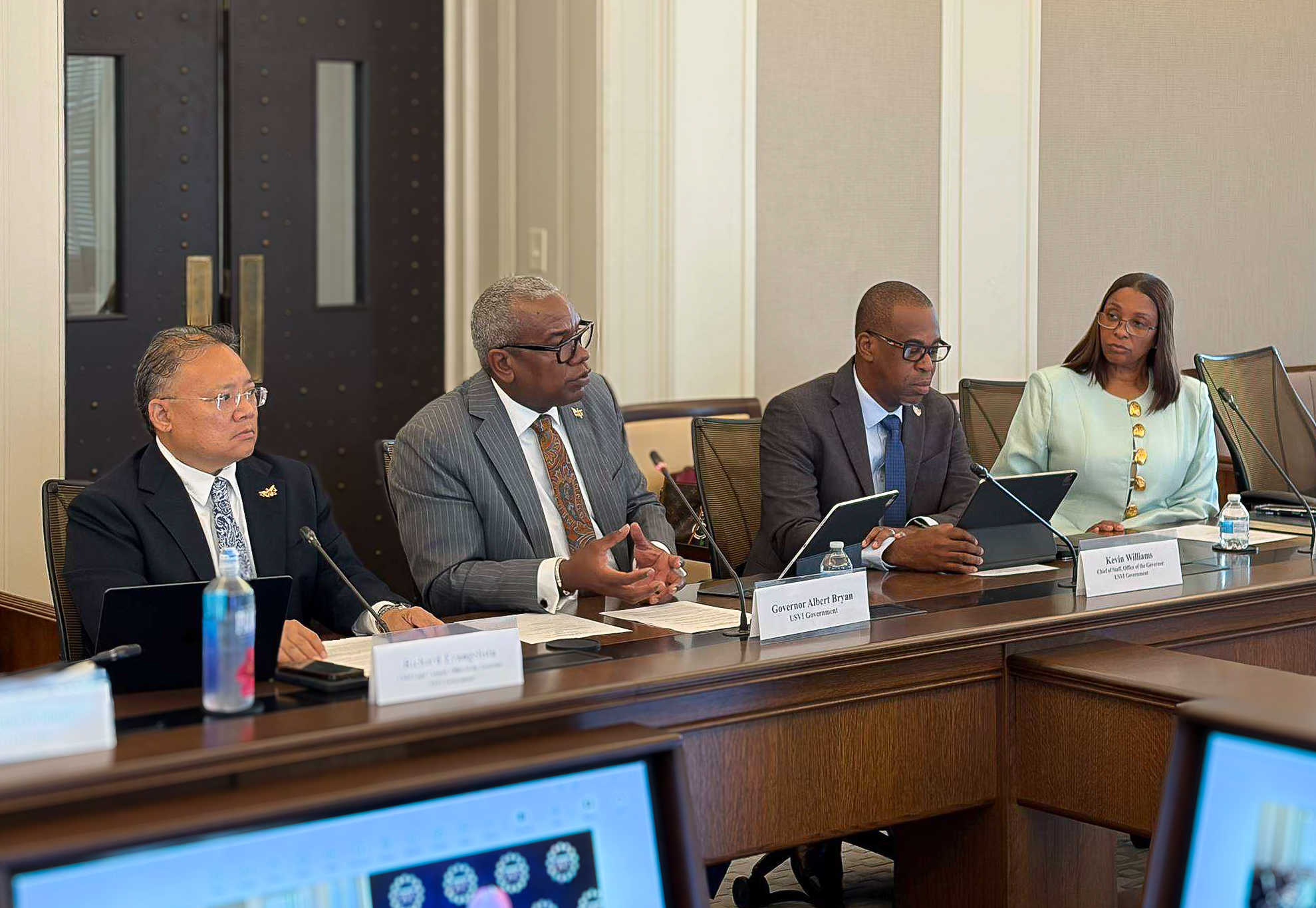
According to Government House, the issue surfaced during a September 17 meeting between Mr. Bryan and federal officials at the U.S. Department of the Interior in Washington. Representatives from Interior, the State Department, Department of Homeland Security, Department of Commerce, Office of the United States Trade Representative and Small Business Administration asked about the status of the BVI matter and its effects on USVI-based commercial operators, passenger movement and regional commerce.
The discussion brought the long-running disagreement over BVI licensing requirements into a broader federal context because the regulations affect U.S.-flagged vessels, American businesses and passengers moving between the neighboring territories.
Following Thursday’s meeting, Mr. Bryan formally proposed convening the USVI and BVI governments under the Inter-Virgin Islands Council in Washington during the week of October 12, with relevant federal agencies participating. He has requested written confirmation of the BVI Government’s participation by September 25.

“The U.S. Virgin Islands has approached this issue in good faith and with respect for the BVI’s authority to regulate commercial activity in its waters,” Mr. Bryan said. “But these regulations have consequences for U.S. businesses, U.S. vessels and U.S. passengers, and the interest expressed by our federal partners makes clear that this matter extends beyond the waters separating our two territories.”
Government House said federal representatives expressed willingness to participate in a coordinated discussion between the two territories, and that federal meeting space has been offered for the proposed October session, subject to scheduling.
Fees and Entry Limits Remain at Center of Dispute
The dispute centers on the BVI’s Commercial Recreational Vessel License framework for foreign-based operators. The revised structure presented by BVI Premier Natalio Wheatley in April maintained an annual fee of $7,500 for foreign-based term-charter vessels with up to seven entries, with each additional entry costing $2,100. Operators can instead purchase unlimited annual entries for $24,000. The annual day-trip charge was reduced from an earlier proposal of $12,500 to $8,500, while water-taxi licenses remained $2,500.
BVI rules have long required foreign commercial recreational vessels to obtain authorization and provide supporting documentation. Official BVI materials list requirements including company information, operational plans, vessel registration and insurance documents, crew information and relevant licensing and certification records.
The Bryan administration says its concerns extend beyond the headline license fees to the cumulative impact of entry restrictions, preauthorization rules, vessel documentation requirements, crew-clearance procedures and other conditions on USVI charter companies, water taxis, dive operators and related businesses.
“Our businesses cannot be expected to operate indefinitely under escalating costs, uncertain procedures and requirements that affect their ability to compete and earn a living,” Mr. Bryan said. “We are neighbors, and our preference is to resolve this cooperatively. But we also have a responsibility to protect the economic interests of the people and businesses of the U.S. Virgin Islands.”
The two governments have been negotiating the treatment of commercial vessels for years. In 2022, the Bryan administration announced what it described as an agreement with the BVI for reciprocal management of the charter industry, including work toward reciprocal arrangements for charter boats and water taxis picking up and dropping off passengers in each territory.
Those discussions continued as the BVI developed its newer licensing framework. At an April 2025 meeting, Mr. Bryan and Mr. Wheatley reviewed the revised fees and discussed entry and exit procedures, including efforts to develop a more automated clearance system.
USVI Wants Work Plan and Interim Protections
Government House said the proposed Washington meeting would address implementation of the CRVL framework, licensing fees and entry limits, customs and immigration procedures, vessel and crew requirements, and standards intended to make cross-border maritime activity predictable for commercial operators.
The USVI is also seeking a written work plan establishing responsibilities and deadlines, along with interim protections for affected businesses while the two governments attempt to resolve the dispute.
“We have offered a clear path forward,” Mr. Bryan said. “The appropriate next step is for the BVI Government to come to the table with the USVI and our federal partners so we can address these concerns constructively and establish a stable path forward for the maritime economy we share.”
According to the administration, if the matter remains unresolved, federal agencies could separately examine issues falling within their respective jurisdictions, including maritime safety, customs, immigration, border security, transportation and trade.
The BVI Government has not yet publicly confirmed its participation in the proposed October meeting. Its commercial recreational vessel rules remain part of a broader regulatory framework governing foreign-based charter activity in BVI waters.

The Bryan administration said it will continue coordinating with USVI maritime businesses and federal agencies while awaiting the BVI Government’s response.