




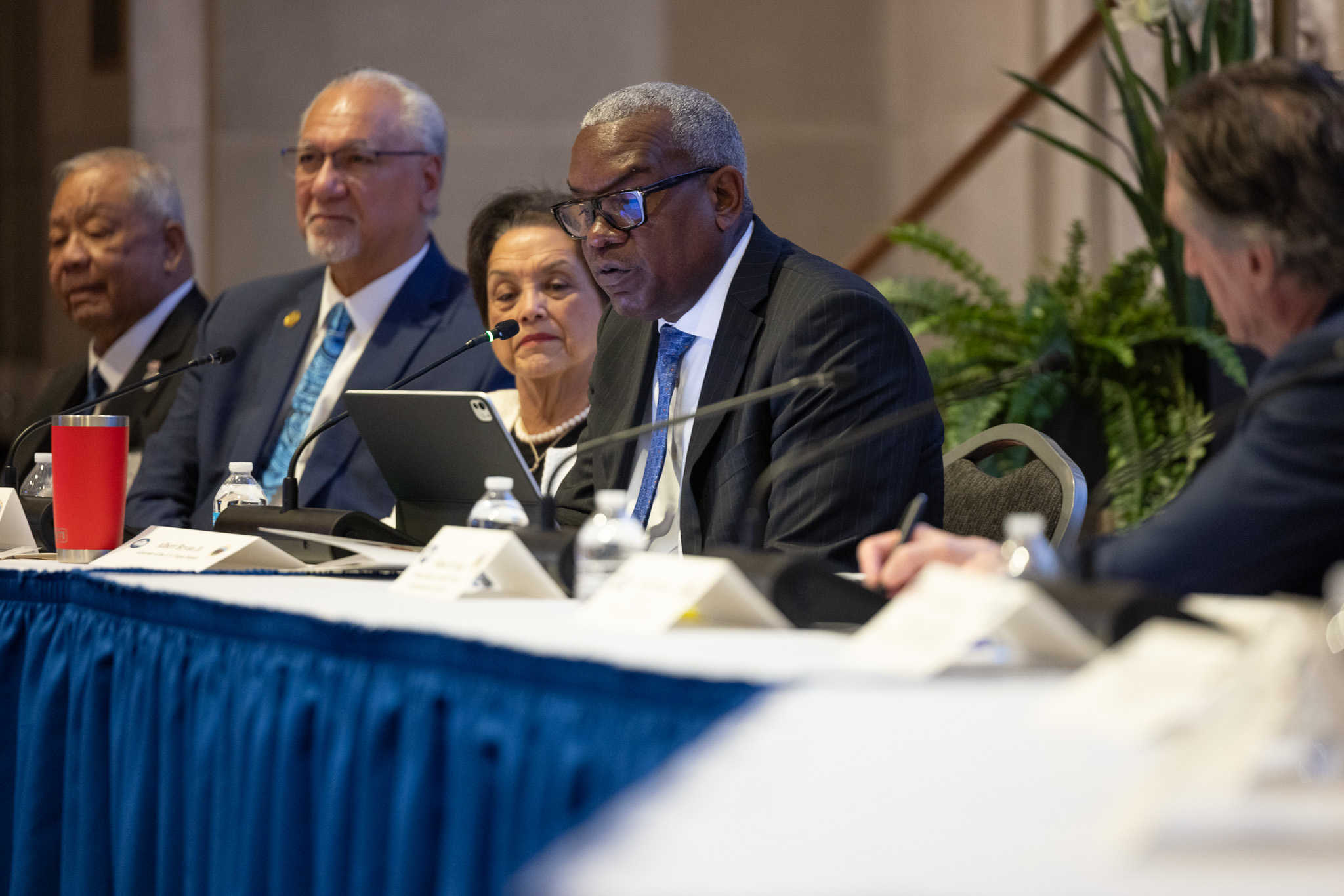
Governor Albert Bryan Jr. at the 2026 Interagency Group on Insular Areas meeting at the U.S. Department of the Interior. Photo Credit: GOV'T HOUSE.
Governor Albert Bryan Jr. used a major federal forum in Washington, D.C., this week to press the White House and federal agencies for policy changes he said are critical to the cost of living in the U.S. Virgin Islands, the pace of hurricane recovery, and access to essential services at home.

According to Government House, the governor delivered his remarks Wednesday during the 2026 Interagency Group on Insular Areas meeting at the U.S. Department of the Interior, speaking before Secretary Doug Burgum, Interior Department leadership, fellow territorial governors, and federal partners. In his address, Bryan emphasized that the U.S. Virgin Islands is part of the United States and should not be treated like a foreign destination when federal policies are drafted.
A central point of his message focused on shipping and customs rules that affect what residents pay for goods. Bryan urged the Administration to restore the de minimis exemption for shipments to the Territories, arguing the change would directly affect consumer costs for items that are often unavailable locally or more expensive because of shipping. The de minimis exemption, Government House explained, is a federal rule allowing low-value shipments to enter without added duties and certain processing fees, which helps many Virgin Islands residents keep costs down when ordering everyday necessities.
“When that exemption is restricted or removed for the Territories, the impact is not theoretical,” Governor Bryan said. “It shows up in the price of school supplies, household items, clothing, small tools, and other essentials that Virgin Islands families often have to order from the mainland.”
He also warned that efforts intended to curb abuse by foreign shippers should not be written in a way that sweeps in the U.S. Virgin Islands, describing Virgin Islands residents as American consumers buying from American companies and relying on steady access to mainland goods.
On labor needs tied to recovery, Bryan called for changes that would allow the Virgin Islands to use H-2B visas for skilled construction workers. He described workforce shortages as a major barrier to rebuilding faster and noted that the territory’s H-2B program is currently limited to entertainers and athletes.
“We don’t need entertainers and athletes, we need able hands to help rebuild as soon as possible,” Governor Bryan said.
He contrasted the territory’s workforce constraints with mainland states that can draw workers from nearby areas, saying the Virgin Islands must compete for limited labor and needs more trained workers to rebuild homes, schools, hospitals, and public infrastructure at the pace residents deserve.
The governor also noted the importance of preserving the federal disaster recovery cost share waiver, which reduces how much the Virgin Islands must pay as a local match for FEMA-supported projects. With limited local revenue and major needs across housing, education, and infrastructure, he said the waiver helps keep projects moving and prevents costs the territory cannot absorb.
“That waiver makes rebuilding possible,” Governor Bryan said. “Without it, schools stall. Hospitals stall. Power infrastructure stalls.”
On health care, Bryan renewed his call for equitable Medicaid treatment and sustained federal support to modernize and expand the territory’s health care system. He said the focus is improving access to care at home, expanding services available in the Virgin Islands, and reducing the need for families to travel off-island for routine specialty care.
“A stronger health care system is about more than facilities,” Governor Bryan said. “It is about expanding what we can offer, strengthening staffing, and making sure people can get timely, quality care without leaving their community.”
Bryan also thanked federal partners for outcomes Government House said were delivered through collaboration over the last year, including the permanent setting of the rum cover-over at $13.25 per proof gallon. He said the change provides long-term revenue certainty and supports essential government services.
“That permanency eliminates the annual legislative cliff that has destabilized our fiscal planning for decades,” Governor Bryan said, noting that the revenue supports schools, public safety, health care, and other core services.
In closing, the governor expressed appreciation for federal engagement that protected the mainland-to-territory trade lane and for continued support of hurricane recovery through the disaster cost share waiver.

“We are proud Americans. We are proud of our partnership with this Administration,” Governor Bryan said. “Thank you for your partnership, and thank you for recognizing that the strength of the United States includes the strength of its Territories.”


Advertisements