

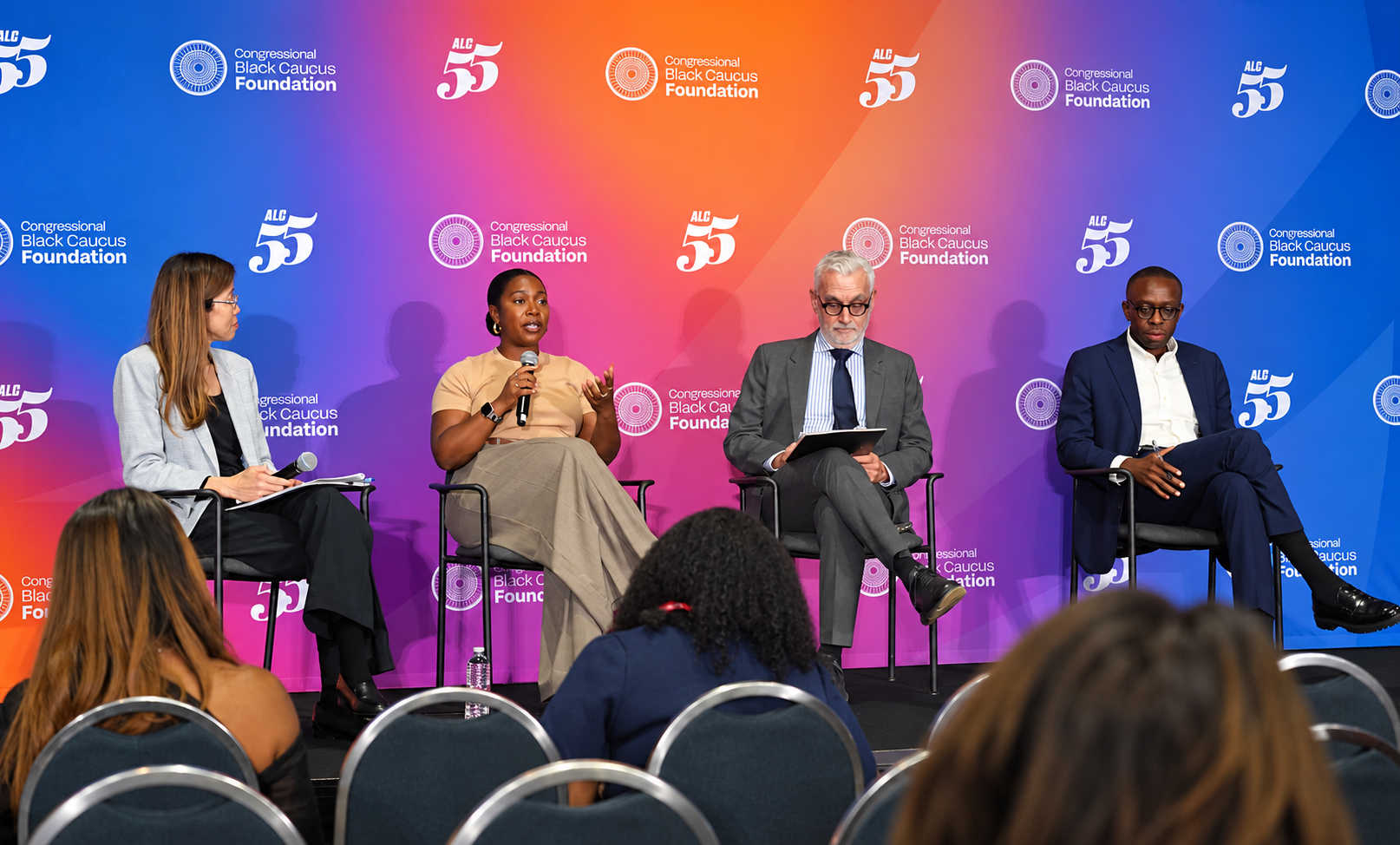
WALTER E. WASHINGTON CONVENTION CENTER, WASHINGTON, D.C. — Congresswoman Stacey E. Plaskett used the opening day of the Congressional Black Caucus Foundation’s 55th Annual Legislative Conference on Wednesday to convene a discussion about how digital commerce could strengthen economic links among Africa, the Caribbean and the United States, with speakers moving from payments and e-commerce to access to capital, cryptocurrency, artificial intelligence, cybersecurity and regulation. At the center of the conversation was a practical question: whether new digital systems can remove longstanding barriers that make it harder for small businesses and diaspora communities to reach customers, receive payments and secure financing.

The two-hour member session, “Bridging Continents: The Future of Digital Commerce Across Africa, the Caribbean, and the United States,” was held from 1 to 3 p.m. at the Walter E. Washington Convention Center. The conference runs Sept. 16-20 in Washington. Kyeh Kim, chief operating officer of Fulcrum Ventures, moderated the discussion, which included Stuart “Stu” Alderoty, president of the National Cryptocurrency Association and chief legal officer of Ripple; Kelly Ifill, founder and CEO of Guava; and Jumia co-founder Tunde Kehinde. Flutterwave founder and CEO Olugbenga “GB” Agboola was listed for the session but did not participate, while Barbados Prime Minister Mia Mottley delivered recorded opening remarks. The Consortium attended the event.
Plaskett opened on a personal note, telling the audience, “This is my last CBC as a member of Congress,” before framing digital commerce as a way for people across the African diaspora to build economic relationships that work more directly to their benefit. “You know that triangle was used for centuries for other people's benefit, and how do we internalize and make that triangle work for us?” she said. Plaskett pointed to entrepreneurs in places such as St. Croix, Bridgetown and Accra, arguing that payment systems, logistics, digital identity, regulation and access to capital will help determine whether smaller businesses can reach customers thousands of miles away.
Plaskett is serving the closing months of her congressional tenure after she and Senate President Milton Potter won the Democratic nomination for governor and lieutenant governor in the August primary.
Mottley, speaking by recorded video, placed much of her emphasis on ensuring that Caribbean and other smaller economies help shape the rules governing the emerging digital marketplace instead of simply operating under standards designed elsewhere. “The question is, in terms of the rules that will govern that level of digital commerce, are we at the table?” she asked. She also reduced one of the central challenges facing entrepreneurs to a straightforward principle: “when you trade, you get paid. It's as simple as that.” Mottley said digital payment records could help informal and unbanked entrepreneurs establish a transaction history that financial institutions could use when assessing creditworthiness, while warning that cybersecurity threats and the Caribbean’s comparatively high telecommunications costs remain significant obstacles.

Mottley pointed to Barbados’s new BiMPay system as an example of that transition. The Central Bank of Barbados launched BiMPay in June as a national instant-payment system allowing transactions among participating financial institutions around the clock, while also providing a digital-wallet route for people without conventional bank accounts.
The panel repeatedly returned to trust. Kehinde recalled Jumia’s early experience with “pay on delivery,” when customers who were reluctant to put payment information online could inspect merchandise before deciding whether to buy it — a system that helped address skepticism but also left the company absorbing the cost when products were rejected at the doorstep. Alderoty focused on cross-border payments, arguing that individuals sending money internationally often face fees and delays that are far less transparent than the nearly instantaneous movement of information online. Ifill approached the issue from access to credit, describing a small-business owner who was denied financing by the same institution that had held her mortgage for years despite an operating business and plans to expand.
That discussion led into alternative methods of judging creditworthiness. Ifill said real-time transaction information from platforms such as Shopify, payment processors and accounting software can provide lenders with a more current picture of a small business than traditional credit models alone. Alderoty said cryptocurrency should be viewed as a complement to traditional finance rather than a replacement and argued that sound regulation should protect consumers and market integrity without eliminating room for innovation. Kehinde, meanwhile, urged entrepreneurs to build resilient businesses capable of surviving market shocks and described artificial intelligence as a potentially significant economic opportunity, arguing that businesses should examine how they can participate in rapidly growing AI-related value chains rather than focusing exclusively on the technology’s risks.
When Plaskett shifted the conversation specifically toward Africa and asked how the diaspora could participate in the continent’s growth, Kehinde pointed to remote work, the minerals needed for data centers and other infrastructure, financing, logistics and remittances. He argued that Africa’s young workforce and physical resources could be paired with capital, technical expertise and commercial relationships from diaspora communities abroad.

Questions from the audience extended the discussion into regulatory sandboxes, cross-border remittances, alternative financial data, the intersection of AI agents and cryptocurrency, and whether emerging technologies could broaden or further concentrate wealth. Plaskett closed by describing the session as the beginning of a broader conversation around digital commerce, crypto, artificial intelligence, small business and economic opportunity, while the panelists ended by emphasizing education, access to assets and finding practical ways for entrepreneurs and communities to participate in new technology-driven markets.