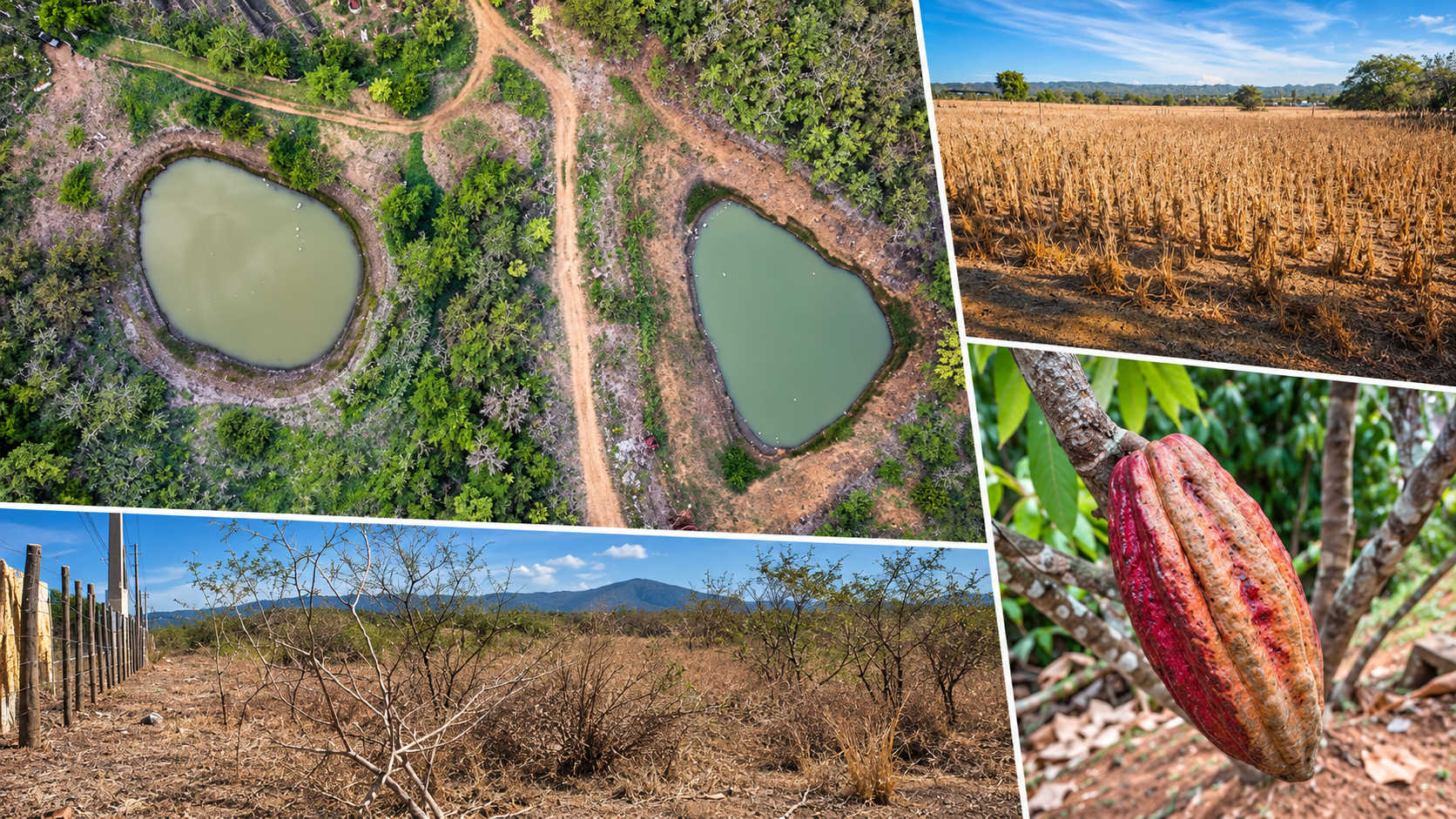
Drought conditions have deteriorated to the most severe federal classification on St. Thomas, while St. Croix and St. John remain under extreme drought as farmers across the territory report dying livestock, damaged crops, depleted ponds and rising costs to obtain water and animal feed.

The worsening conditions are detailed in an October 8 update from the National Oceanic and Atmospheric Administration's National Integrated Drought Information System and its regional partners. The assessment places St. Thomas under Exceptional Drought, or D4, the highest category on the U.S. Drought Monitor's five-level scale, while St. Croix and St. John remain at D3, classified as Extreme Drought.
The latest assessment, based on information available through October 6, represents a deterioration from conditions reported by The Consortium in July, when all three islands were classified as D3. St. Thomas had already reached D4 by late September, and the new report shows that the territory has experienced little meaningful relief despite scattered rainfall.
The designation carries serious consequences for the agricultural sector, where producers are struggling to maintain livestock, keep crops alive and obtain sufficient water for their operations. Federal officials report that groundwater levels remain low, while rainfall received on St. Croix and St. John has been insufficient to replenish depleted soil moisture or underground water supplies.

According to the October 8 assessment, farmers across the territory are paying approximately $450 for deliveries of 5,000 gallons of water, while hay is being sold for $30 to $35 per bale. The Virgin Islands Department of Agriculture is also unable to provide baling services in the St. Thomas-St. John District because of machinery shortages, further complicating efforts to obtain affordable animal feed.
The combination of depleted ponds, limited natural forage and expensive supplies is placing additional financial pressure on agricultural producers already reporting livestock deaths and crop losses.
On St. Thomas, farmers describe particularly severe conditions. Agricultural ponds have little or no water remaining, and soil moisture has been depleted to levels that make cultivation increasingly difficult.
Livestock producers are conserving available water, reducing their herds through culling and separating male and female animals to limit reproduction while feed and water remain scarce.
Poultry farmers are reporting early molting, which they believe is linked to excessive heat, while orchard farmers say trees are dying and fruit production is being affected. Avocados are reportedly smaller than usual, and some coconut and banana trees have died.
Not all crops have stopped producing. Farmers report that mango and dragon fruit trees continue flowering and bearing fruit despite the drought, although the broader outlook remains unfavorable.
The severity of St. Thomas's rainfall deficit is reflected in measurements from Bordeaux, where only 1.89 inches of rain fell during the summer season. That was less than 20 percent of the area's normal rainfall for the period.
The lack of meaningful precipitation has also left ponds across the island at exceptionally low levels, creating greater dependence on purchased water for agricultural operations.
On St. John, farmers are confronting similar problems. Hot, dry weather has damaged fruit trees, row crops and specialty crops, while numerous ponds have dried up completely.
Some producers report that the ground has begun cracking because of the lack of moisture. Banana trees and other plants have fallen over, and farmers are postponing new planting activities because they cannot depend on sufficient water to sustain the crops.
Rather than expanding production, some growers are concentrating on longer-term survival measures, including improved irrigation, water conservation and land-management practices. Livestock and poultry losses are also continuing on the island.
St. Croix has received intermittent rainfall, including beneficial showers associated with the remnants of Tropical Storm Dolly in late August. However, the precipitation has not been sufficient to reverse the prolonged drought.
Farmers on the island report losses among sheep, goats and cattle, while dry pastures and limited forage continue affecting livestock health.
The situation has also disrupted poultry operations. Some farmers report that their birds began molting as early as June rather than August, a change they associate with the unusually hot and dry conditions.
The latest assessment describes severe deterioration of agricultural soils, with some St. Croix farmers reporting cracks reaching as deep as 24 inches. Producers growing specialty crops and traditional row crops say moisture in the soil is nearly nonexistent.
Wildlife is also being affected. Across the territory, deer and birds are reportedly moving closer to residential areas in search of food and water, while observers report declining numbers of wild poultry.
Federal officials warn that persistently dry vegetation, combined with gusty conditions, is also increasing the risk of wildfires.
The agricultural difficulties are part of a broader water-supply concern facing the Virgin Islands. The federal update warns that groundwater levels remain depressed and cannot recover without sufficient rainfall.
It also reports that water consumption and production through desalination are approximately equal, leaving little room between the amount being produced and the amount being used.
That concern was already evident in August, when the Virgin Islands Territorial Emergency Management Agency warned that the territory's reverse-osmosis water production was barely keeping pace with consumption.
As The Consortium reported at the time, VITEMA Director Daryl Jaschen said each district was producing approximately 3.1 million gallons of water daily while consuming approximately 3 million gallons, leaving a narrow operating margin.
Officials were also warning about low stored-water levels and urging conservation as the drought continued.
The crisis prompted Gov. Albert Bryan Jr. to request federal disaster assistance for the territory's agricultural community in August.
Following that request, the U.S. Department of Agriculture approved a Secretarial Drought Disaster Declaration on August 20, designating St. Croix, St. Thomas and St. John as primary natural disaster areas.
The designation allows eligible farmers and agricultural producers to apply for emergency loans through the USDA Farm Service Agency.
The assistance is intended to help qualified producers recover from drought-related losses, including by replacing essential equipment or livestock, reorganizing farming operations or refinancing certain debts. Applicants have eight months from the declaration date to seek assistance, and each application is assessed individually.
The declaration does not automatically provide grants or guarantee that every affected farmer will receive financial assistance.
While the Virgin Islands continues to face worsening drought conditions, neighboring Puerto Rico experienced some improvement after a tropical wave brought substantial rainfall in late September.
The rainfall helped replenish some reservoirs serving the San Juan metropolitan area and eased short-term drought conditions across much of Puerto Rico. Extreme Drought nevertheless persists in the island's southern plains, where farmers continue confronting significant agricultural losses.
No comparable recovery has occurred across the U.S. Virgin Islands.
Looking ahead, federal forecasters see little immediate relief.
Seasonal climate models indicate a 50 to 60 percent probability of below-normal rainfall through the early winter months, alongside a greater than 70 percent probability of above-normal temperatures.
Forecasters also expect El Niño conditions to strengthen through the end of 2026. The latest assessment places the likelihood of a very strong El Niño event during the Northern Hemisphere fall and winter of 2026-2027 at approximately 90 percent.
Strong El Niño events are often associated with below-normal rainfall in the northeastern Caribbean, although officials caution that individual events can vary and other weather patterns also influence local conditions.
The National Oceanic and Atmospheric Administration's latest Seasonal Drought Outlook projects that drought will persist across the U.S. Virgin Islands through December, while eastern and southern Puerto Rico are also expected to remain affected.

Conditions could move closer to normal during late winter and early spring 2027, but that outlook provides little immediate relief for farmers attempting to sustain their operations through the coming months.