




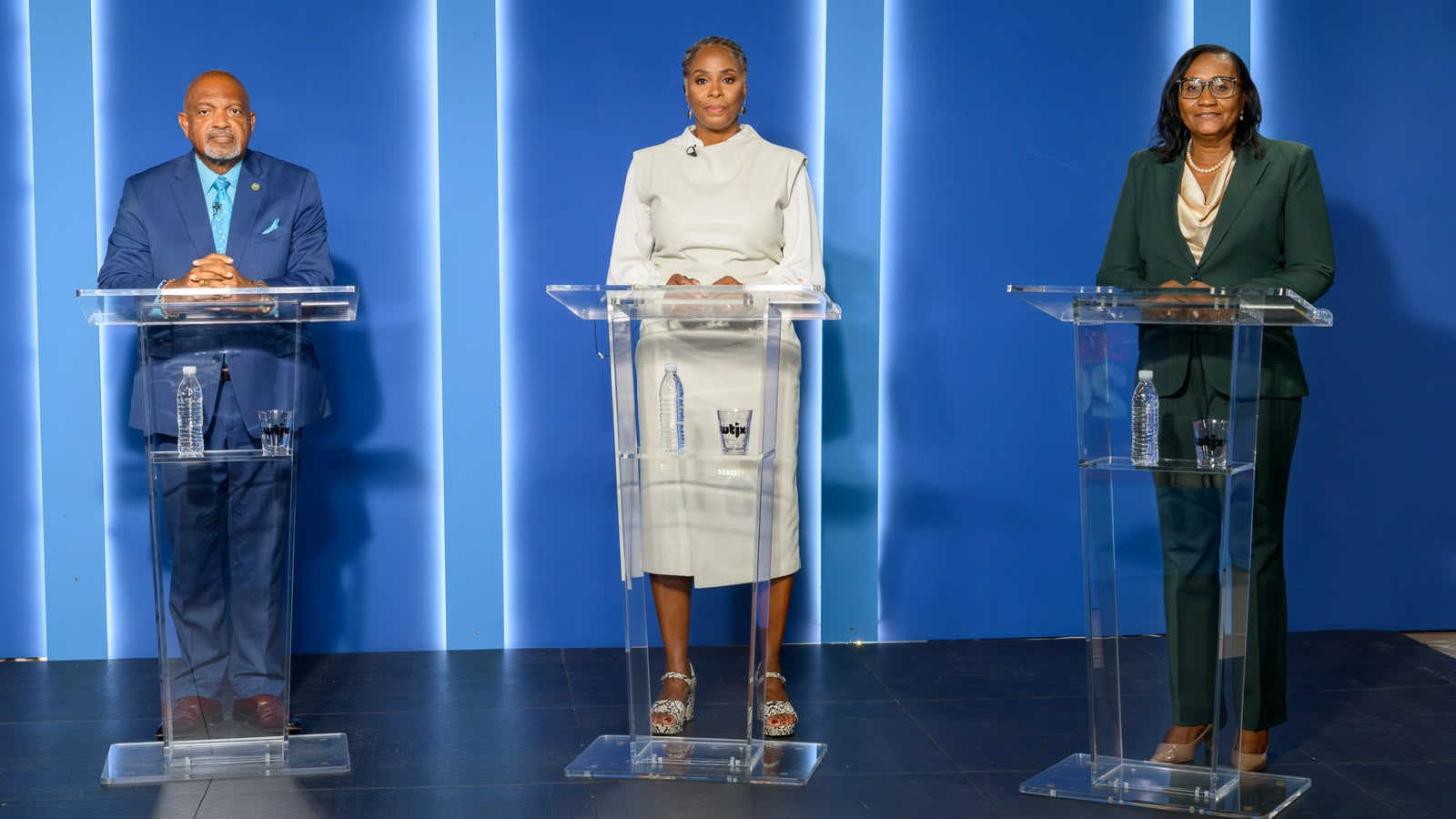
Democratic gubernatorial candidates Tregenza Roach, Stacey Plaskett and Donna Frett-Gregory proposed new ethics and energy measures during Monday night’s V.I. Consortium and WTJX debate after being pressed over their silence on the convictions of three former high-level members of the Bryan administration.

The second of three Consortium-WTJX debates opened with moderators Ernice Gilbert and Marcellina Ventura-Douglas asking each candidate: “Why have you been silent on the convictions of…three high-level members of the administration?”
The question referenced the trials and convictions of former V.I. Police Commissioner Ray Martinez and former cabinet members Jenifer O’Neal and Calvert White.
Mr. Roach, the sitting lieutenant governor, said it would have been imprudent for him to comment while the trials were underway and that there was no longer a need to do so.

“All three have been convicted and are now serving their terms. I believe the solution is looking forward,” he said.
Mr. Roach proposed increasing staffing within the Office of the Inspector General and conducting regular ethics and conflict-of-interest training throughout the public sector.
“There is no commentary necessary on a criminal investigation and on a conviction,” he said.
Ms. Plaskett, the territory’s delegate to Congress, said her office “felt at the time that it wasn’t necessary to respond on that and to let the court have its course.”
She proposed establishing stronger ethics laws governing members of future administrations.
“One of the first things we discussed was to bring down ethics rules so that members of an administration know the confines of the law and are allowed to be held accountable for them.”
Ms. Frett-Gregory maintained that she has been “vocal about those convictions and about what has happened with corruption,” and promised to establish “a forward-facing corruption hotline for the people of the Virgin Islands.”
She also committed to fully funding the Inspector General’s Office, noting that the current budget before the Legislature contains no additional funding for the new employees Mr. Roach said should be hired.
“It’s the same funding that came down previously,” Ms. Frett-Gregory said.
Candidates Present Different First-100-Day WAPA Plans
Asked what they would do during their first 100 days to address the V.I. Water and Power Authority’s continuing problems, Mr. Roach called for an immediate forensic audit.
“We believe that it is essential to look at where the finances are in terms of the rank and file, or whether administrative positions that are carrying these heavy titles are overrepresented in the department.”
Ms. Plaskett said she would follow a recommendation from the U.S. assistant secretary of energy and “look into a state of emergency.” She also proposed using the Energy Crisis Assistance Program to help keep electricity affordable for lower-income households.
Ms. Frett-Gregory argued that officials already have the authority to declare a state of emergency and noted that a comprehensive assessment of WAPA had already been completed.
Instead, she said her administration would push WAPA during its first 100 days to solicit “a public relationship with a private partner on the revenue generation side.”
All three candidates agreed that WAPA should be required to pass half of the savings produced through increased renewable-energy use to customers through lower electric bills. They also agreed to explore using the power-generation capacity of St. Croix’s refinery to reduce pressure on the utility.
Cost of Living, Taxes and Healthcare
On the territory’s high cost of living, Ms. Frett-Gregory proposed concentrating on job creation and reducing food and energy costs. Ms. Plaskett called for increasing tax revenues so the government could better serve residents, while also pursuing more affordable housing.
Mr. Roach discussed possible energy subsidies, support for land and homeownership and a reevaluation of the gross receipts tax, including raising the earnings threshold for small businesses.
Ms. Frett-Gregory responded by pointing to previously approved legislation establishing a tax study commission and the administration’s failure to submit nominees.
“To date, not one person has been sent down to the legislature for consideration for the tax study commission. That’s irresponsible,” she said. “There’s too much legislative work that has been done that has not been implemented in the territory.”
The debate then turned to the hospitals and their difficulty collecting revenue.
Ms. Plaskett broadened the issue beyond healthcare, arguing that “we have cash management issues…throughout the government.”
“We are operating at a budget deficit in many places, and we need to get a handle on that,” she said.
Ms. Plaskett said the territory must complete the rebuilding of its hospitals before the federal government undertakes system-level reimbursement reform.
“These are basic things that will allow additional support to come in.”
She said healthcare spending should become an immediate priority for the next administration.
“Rather than using money for other things such as documentaries on oneself, we need to put the money for the people,” she said.
Ms. Plaskett added that she would halt the workforce reduction rumored to be planned at Juan F. Luis Hospital if she had the authority to do so.
Mr. Roach defended the current administration’s record, citing “a great improvement in cash management throughout the Bryan-Roach administration.”
He acknowledged, however, that “the hospitals operating independently, there’s work to be done in that regard.”
Ms. Frett-Gregory called for the hospitals’ billing functions to be outsourced immediately. She also advocated better training for medical personnel on billing and coding, arguing that “we are leaving lots of money on the table.”
Like Ms. Plaskett, she proposed realigning the territorial budget to make healthcare spending a greater priority.
Candidates Defend Their Records
During the individual questioning, Ms. Plaskett addressed her reversal from a 2020 declaration that she had “no interest in running for governor.”
She said her experience as delegate during the intervening six years showed her that “so many resources, so much funding, so much opportunity sent down to the Virgin Islands that has not been utilized.”
“I cannot see another four years or eight years in the same trajectory that we are,” she said.
Ms. Frett-Gregory was questioned about her endorsement of Heritage Wireless to the V.I. Department of Education. The company was led by Corey Alston, who was later imprisoned for a large Medicare fraud scheme.
Ms. Frett-Gregory insisted that she had vetted Heritage Wireless, describing it as “a company that was hired by the Federal Communication Commission. That was the vetting we did.”
She said the mechanism intended to provide free devices to Virgin Islanders “was a $15 billion project that never came to this territory because our delegate and our governor did not ensure that our children got that opportunity.”
Ms. Frett-Gregory also emphasized that “not one single dime of these Virgin Islands’ money was spent for those iPads,” and minimized Mr. Alston’s role by saying “he was not the person that was responsible for the entire organization.”
Online media reports have identified Mr. Alston as the company’s president.
Mr. Roach was also pressed about what moderators characterized as his willingness to claim the administration’s successes while distancing himself from its failures.
Although he acknowledged that “there is still work to be done,” he did not identify specific failures. He also rejected Ms. Frett-Gregory’s characterization of WAPA’s continuing problems as a failure of the administration.
“There is a different success in the district of St. Croix, which nobody reflects on when they’re analyzing the WAPA story,” he said, referring to the relative stability of electrical service on St. Croix.
Ms. Plaskett, meanwhile, faced questions about her relationship with the late convicted sex offender Jeffrey Epstein and the changing descriptions she has given of that association.
“Asking an individual to give you resources or…money to your campaign, and calling them a friend, does not mean that you have a friendship,” she said.
Ms. Plaskett noted that a recent congressional effort to censure her prompted bipartisan support in her defense, which she said “had not been done before in any of the censure votes.”
She attributed the censure effort to the “partisan environment that we face right now in Washington.” Its failure, she said, “speaks to the bipartisan friendships that I have.”
Both of her opponents said they found her description of the relationship troubling. Ms. Plaskett maintained that referring to Epstein as a “monster”, a “constituent” and, in passing, a “friend” was not contradictory. The questioning referenced a message in which she hoped she was “not presumptuous to consider” Epstein a “friend.”
Revenue, Development, Crime and Recovery
The candidates also addressed property-tax relief for senior citizens, with Ms. Frett-Gregory defending her policy on the issue. Mr. Roach defended previous comments about the dangers faced by witnesses to crimes.
Ms. Frett-Gregory defended the creation of the Bureau of School Construction and Maintenance despite its operational deficiencies. She argued that the problems occurred because “this administration did not follow the law” while implementing the bureau.
Ms. Plaskett again defended her outspoken opposition to President Donald Trump, while Mr. Roach discussed the failure of Optimum Global and the broader challenge of securing individual health insurance in the territory.
The candidates were also asked how they would generate new government revenue. Ms. Plaskett proposed making Earned Income Tax Credit reimbursements permanent and discussed legislation to create a Virgin Islands stablecoin.
Ms. Frett-Gregory called the blue economy a “sleeping giant” and proposed making St. Croix a Caribbean transshipment hub.
Mr. Roach said South Shore development work was already underway, called for completion of the territory’s cannabis industry framework and agreed with Ms. Frett-Gregory on the potential of the blue economy.
The debate also covered homelessness and hurricane recovery. The candidates’ answers on recovery were recorded before the recent disclosure that the V.I. Housing Finance Authority had been suspended from receiving future U.S. Department of Housing and Urban Development grants over allegations of financial mismanagement and ineffective use of federal funding.
The final question addressed the shortage of police officers and the territory’s high crime levels.
After approximately two hours of questioning, the candidates closed with the prospect of a historic general election in November. Ms. Plaskett or Ms. Frett-Gregory would become the first woman elected governor of the Virgin Islands, while Mr. Roach would become the first naturalized citizen to lead the executive branch.

All three said their focus was not on the historical significance of their candidacies but on what they hoped to accomplish for Virgin Islanders.