

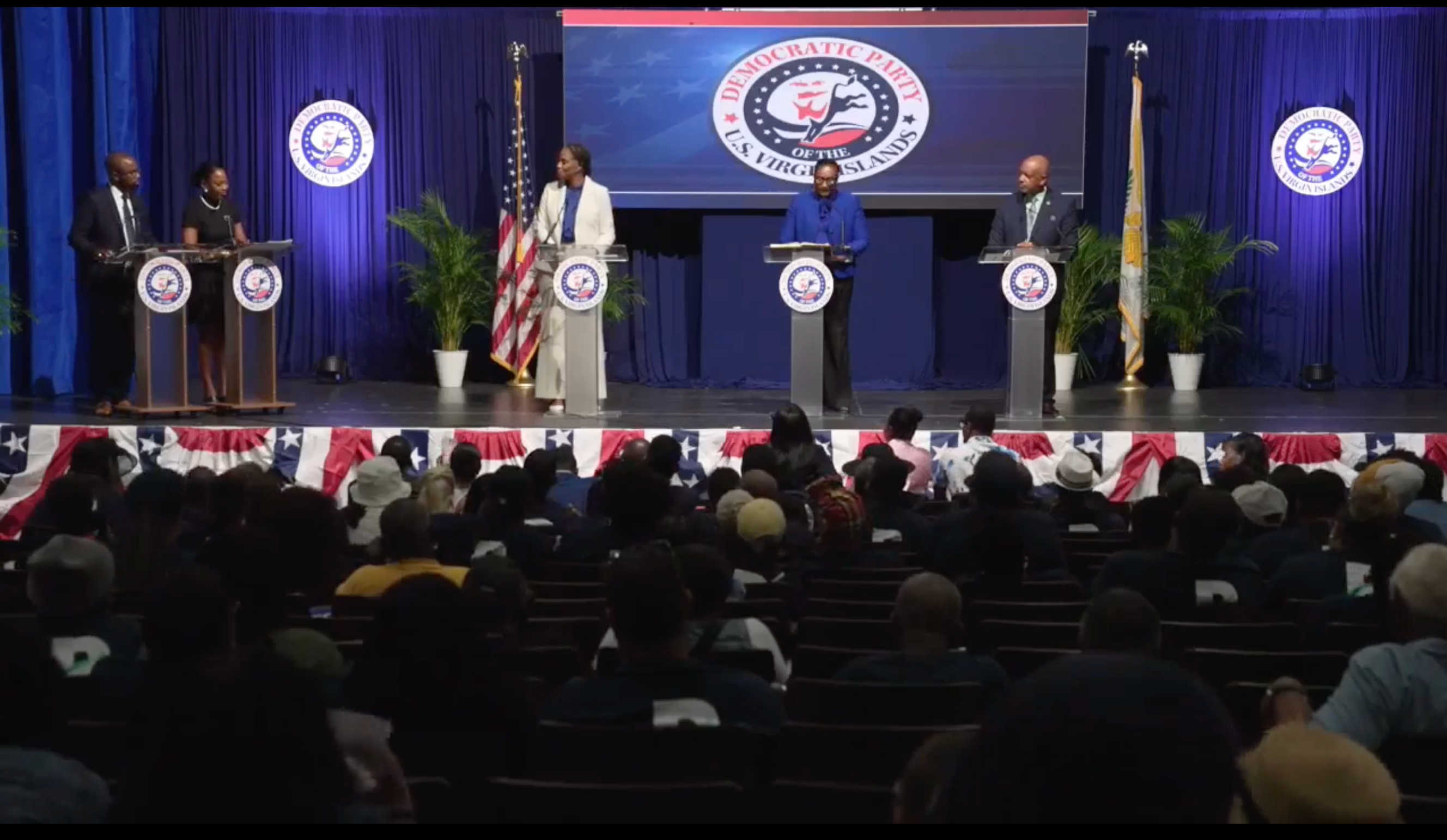
ST. CROIX — The Democratic gubernatorial debate became a sustained argument Friday night over who must answer for the territory’s unresolved problems and which candidate is best equipped to convert government resources, plans and promises into measurable results.

Lt. Gov. Tregenza Roach defended the Bryan-Roach administration’s record and called for voters to judge him by the offices and initiatives under his direct control. Delegate Stacey Plaskett argued that unprecedented federal resources have not produced adequate improvements in the territory’s hospitals, schools, utility system and disaster recovery. Former senator Donna Frett-Gregory presented herself as the candidate with the local government, financial and management experience needed to replace announcements with execution.
Their disagreement over responsibility shaped exchanges on WAPA, healthcare, education, insurance, housing, workforce development, crime, tourism, federal funding and the territory’s declining population.
The debate was held at the St. Croix Educational Complex auditorium and moderated by Rick Grant and SSheniqua Robinson.

Plaskett opened by emphasizing her 11 years representing the Virgin Islands in Washington. She said she and running mate Milton Potter entered the race because they refused to accept current conditions, citing unfinished disaster-recovery work, inadequate healthcare access and families still struggling to obtain essential government services.
She argued throughout the debate that federal funding and opportunities secured for the territory had not been managed effectively by the local government.
Frett-Gregory cited more than 35 years of public service and her background in business, finance, education and government administration. She said the territory needed leaders who understood how local agencies, appropriations and public finances operate and who would accept responsibility during both successful and difficult periods.
Roach highlighted more than 60 years of combined public service between himself and running mate Novelle Francis Jr. He pointed to free tuition at the University of the Virgin Islands, development plans for the South Shore of St. Croix and the modernization of the Office of the Lieutenant Governor.
Roach said residents can now conduct more business with the office online and credited its employees with developing the territory’s Street Addressing Initiative (SAI). He argued that school and hospital projects were already moving forward and said the next administration should continue that work while strengthening services for senior citizens and families.
The candidates’ competing interpretations of leadership surfaced immediately.
Plaskett described herself as a servant leader who arrives early, works late and expects government employees to respect both their colleagues and the residents they serve. She proposed requiring cabinet members and other senior officials to adopt schools so young people could see government leaders participating directly in their communities.
Roach responded by questioning Plaskett’s work on federal responsibilities affecting Virgin Islanders, including postal service, customs, airport processing and the future of Caneel Bay.
Frett-Gregory questioned whether Plaskett would improve communication with territorial officials, alleging that calls she made while serving as chair of the Legislature’s congressional committee went unanswered. Plaskett rejected that account, saying she had returned Frett-Gregory’s calls and messages and met with her on several occasions.
Plaskett then argued that although she does not control the U.S. Postal Service, the lieutenant governor regulates banking and insurance, two areas in which residents continue to face limited and expensive options.
WAPA and Government Accountability
WAPA emerged as one of the most consequential areas of disagreement.
Frett-Gregory said that within her first 100 days, her administration would require the authority to issue a request for qualifications for a public-private partnership involving its revenue-generation operations.
She also proposed a public-facing government dashboard and a 411 reporting system to address corruption, along with immediate attention to roads, streetlights, healthcare and other basic services.
Plaskett said the first requirement for addressing WAPA was transparency. She argued that the territory had access to more than $4 billion for utility reconstruction but residents still lacked a clear understanding of the overall plan.
She proposed installing batteries at substations as an immediate and intermediate reliability measure, followed by microgrids, renewable energy and the movement of power generation from the Richmond plant to the South Shore.
Roach accused Plaskett of making WAPA a major issue only after entering the gubernatorial race. He pointed to composite pole replacements, underground utility work in Christiansted, Frederiksted and Charlotte Amalie, and renewable-energy projects as evidence that a foundation was already being established.
Plaskett responded that she lives on Hill Street in Christiansted and experiences outages like other residents. She said she had contacted the administration seeking action as early as 2019 and argued that federal energy officials offered technical assistance because the local government had been unable to maintain reliable service.
During the lightning round, Frett-Gregory made WAPA her principal commitment to voters.
“I will not stand down until the Virgin Islands Water and Power Authority is fixed for the people of the Virgin Islands,” she said.
Roach proposed giving the Office of Management and Budget a greater role in maintaining fiscal discipline, including centralizing grants management, coordinating government fiscal officers and requiring agencies to report regularly on public projects.
He also called for more investigators and staff within the Office of the Inspector General.
Frett-Gregory questioned why the proposed fiscal year 2027 budget did not include an additional inspector general position despite the territory’s corruption problems.
Roach responded that the governor and lieutenant governor are campaign partners but do not exercise identical authority after taking office. He said the lieutenant governor’s statutory responsibilities are clearly defined and that the governor must approve certain personnel actions within the office.
Asked how she would reverse the territory’s population decline and diversify the economy, Plaskett said the Virgin Islands could not continue depending on a single company or industry to provide long-term prosperity.
She proposed expanding the marine sector on St. Thomas and developing the South Shore of St. Croix for transshipment, storage and digital infrastructure. Plaskett said the territory could position itself as a link among Africa, South America, the Caribbean and the United States.
She also proposed using rebuilt hospitals as regional healthcare centers serving patients from other Caribbean jurisdictions.
Roach said the hospital project had already been awarded and accused Plaskett of promoting the South Shore concept without adequately crediting Francis for legislation supporting it.
Frett-Gregory said Plaskett had not clearly explained how the proposals would bring Virgin Islanders home or create space for young people to build careers in the territory.
Frett-Gregory said industries connected to rebuilding the Virgin Islands should receive priority, but local residents must be trained to participate. She referred to $9 million set aside for workforce development and questioned why the government continued discussing the importation of workers.
She proposed expanded training in construction, artificial intelligence, medicine and nursing, along with scholarships for students who agree to return home.
Roach cited the free-tuition program at UVI and said applications from public high schools increased by 67 percent during its first year. He also pointed to vocational certifications, apprenticeship programs, the Labor Investing for Tomorrow program and the Governor’s Financial Fellows Program.
Plaskett said the administration had eight years to develop a local workforce but was now considering bringing thousands of outside workers into the territory for positions Virgin Islanders could have been trained to fill.
On small businesses, Roach proposed reviewing Economic Development Authority programs, expanding business incubation, involving UVI and its Research and Technology Park, and increasing the gross receipts tax exemption threshold for smaller companies.
Plaskett said the lieutenant governor’s banking authority should have been used to attract more financial institutions and improve access to loans and bonding.
Frett-Gregory said money appropriated by the 35th Legislature for the Catalyst Fund had not been released and referred to a tax study commission that had been authorized years earlier.
Healthcare and Education
Frett-Gregory proposed expanding telehealth, reviewing medical licensing boards and removing barriers that prevent healthcare professionals from practicing in the territory.
She also called for subsidized primary-care clinics, saying too many residents use hospital emergency rooms for routine care, and proposed temporary partnerships with national hospitals while local facilities are rebuilt.
Roach said the territory’s exclusion from the Affordable Care Act contributed to insurers leaving the market. He proposed examining a universal healthcare system in which the government subsidizes coverage for residents who are not insured through public employment.
Plaskett said rebuilding the hospitals was central to expanding services and achieving changes in federal reimbursement rates.
Frett-Gregory accused Roach of failing to attract affordable health insurance during his tenure, leaving small businesses and their employees with few options. Roach said the decline of the individual insurance market began before the current administration and was tied to the territory’s exclusion from the Affordable Care Act.
On education, Roach proposed greater involvement by UVI in the public school system and cited previous programs that brought younger students to the university for academic enrichment.
He also discussed a teacher academy and said funding for maintenance must be built into the construction of new schools.
Frett-Gregory called for concentrating federal education resources on early childhood and career and technical education.
Plaskett said intervention should focus particularly on kindergarten through third grade. She cited the number of children performing below grade level in reading and mathematics and said the territory should not be satisfied with current outcomes.
Responding to an audience question, Frett-Gregory proposed higher salaries, incentives, classroom resources and homeownership assistance to recruit and retain qualified teachers.
Housing, Crime and Tourism
Plaskett proposed creating a housing acceleration task force to identify government-owned land that could be developed with private partners.
She said the territory should again build middle-class communities that allow families to create equity and proposed using housing assistance to recruit teachers, police officers, firefighters and nurses.
Roach cited the limited housing supply and high prices across all three main islands. He then accused Plaskett’s campaign contributors of purchasing properties in historic towns and contributing to rising costs.
Frett-Gregory called for greater investment in the towns, action on abandoned properties and additional probate judges to help resolve cases that leave land and buildings unusable for years.
Plaskett responded by acknowledging her campaign donations but accusing opponents of pressuring government vendors and campaign supporters. The competing accusations were not independently examined during the debate.
On public safety, Frett-Gregory said the government must address the root causes of crime by expanding jobs and opportunities for young people. She also proposed additional police recruitment classes and strengthening the cadet program.
Plaskett agreed that prevention required investment in young people and said police officers needed better support and compensation.
Roach disputed claims that the government had failed to provide opportunities, citing labor, apprenticeship and financial training programs.
Frett-Gregory responded by asking why young Virgin Islanders continue leaving in large numbers if the available opportunities are sufficient.
Roach said tourism should be expanded through regional travel, greater use of locally made products aboard cruise ships and stronger cooperation with the British Virgin Islands in the marine industry.
Plaskett emphasized the unique identity of each island and highlighted St. Croix’s National Heritage Area designation.
Frett-Gregory called for individual tourism strategies for each island, improvements to the visitor product and modernization of the airports.
Candidates Directly Question One Another
The debate’s most direct exchange began when Plaskett asked Roach to grade the Bryan-Roach administration after seven years. Roach gave it a B.
He cited the stabilization of the Government Employees’ Retirement System, repayment of the 8 percent salary reduction, the St. Thomas waterfront expansion and roadwork on St. Croix.
Roach also accused Plaskett of claiming individual credit for federal funding that resulted from collaboration among multiple officials and administrations.
Plaskett said she participated in changing federal law to make the resources available. She argued that Roach appeared willing to accept credit for the administration’s accomplishments and should therefore accept responsibility for its failures.
Frett-Gregory asked Plaskett how she would protect the territory’s interests under President Donald Trump, citing her adversarial relationship with the president and congressional Republicans.
Plaskett said she continues to work with members of both parties and cited federal actions benefiting Caribbean vessels and St. Croix farmers.
Roach returned to the issue by questioning how Plaskett would approach Trump after serving as an impeachment manager.
Plaskett defended her participation in the impeachment and said she does not retreat when challenged but can work with political opponents when necessary.
“Stop making a boogeyman because you are the boogeyman that the people are experiencing every day here in this territory,” Plaskett told Roach.
Roach responded by citing the congressional vote to censure Plaskett and questioning whether her political relationships would adequately protect a territory represented by a single nonvoting delegate.
Candidates Make Their Final Cases
Plaskett closed by citing federal resources she said she helped secure, including disaster funding, loan forgiveness, changes to the territory’s Medicaid contribution and pandemic assistance for the government and public schools.
She argued that the central problem was not the availability of money but the local government’s failure to use it effectively, pointing to delayed hospital reconstruction, unreliable electricity and education money that was returned while schools remained in poor condition.
Frett-Gregory emphasized her experience within the Departments of Justice and Education, the Legislature and nonprofit organizations.
She said her financial background and knowledge of local appropriations and government administration distinguished her from candidates focused primarily on federal resources or the current administration’s record.
Roach said it was easy for challengers to describe an administration as a failure and promise to do better. He asked voters to judge him by the modernization of the offices under his control and again disputed Plaskett’s claims of individual responsibility for federal funding.

The debate left Democratic voters with three competing arguments: Roach’s case for continuing work already underway, Plaskett’s demand that federal resources produce visible local results, and Frett-Gregory’s call for a government-management reset centered on accountability and execution.