




A proposal by Senator Franklin Johnson to allow voters to request hand-counted paper ballots was held in committee for a second time Wednesday, after elections officials maintained their opposition and lawmakers agreed that testifiers needed more time to review a late-delivered amendment.

Bill No. 36-0187 was considered by the Committee on Government Operations, Veterans Affairs, and Consumer Protection. When the measure was first heard in January, stakeholders including the Office of the Supervisor of Elections and the Board of Elections objected, prompting Senator Johnson to draft an amended version presented as a substitute to the original bill.
However, due to an administrative oversight, the amended version was not delivered to invited testifiers until late Wednesday.
Introducing the measure, Senator Johnson stressed that the bill “does not end machine voting” and does not eliminate use of the DS200 tabulation machine. “This revised amendment says the paper ballot option is an addition to any voting method already allowed by law,” he explained.

Under the proposal, a voter who chooses to use a paper ballot could request that it be counted by hand. Those ballots would be stored separately from ballots tabulated by the DS200 machine and would not be scanned. Senator Johnson said the amendment addresses concerns previously raised by Elections Supervisor Caroline Fawkes, including spoiled ballots, chain of custody, reconciliation and other issues.
“This should not be framed as paper versus technology,” Senator Johnson declared. Instead, he said the measure provides both options. “The central question today is simple: Does the voting system belong to the people, or do the people belong to the system?”
Ms. Fawkes was not persuaded. Although her written testimony addressed the original bill, she said she had reviewed the late amendment and that her position remained unchanged. She testified that the proposal would “undermine accuracy, consistency, security, and public confidence in our elections.”
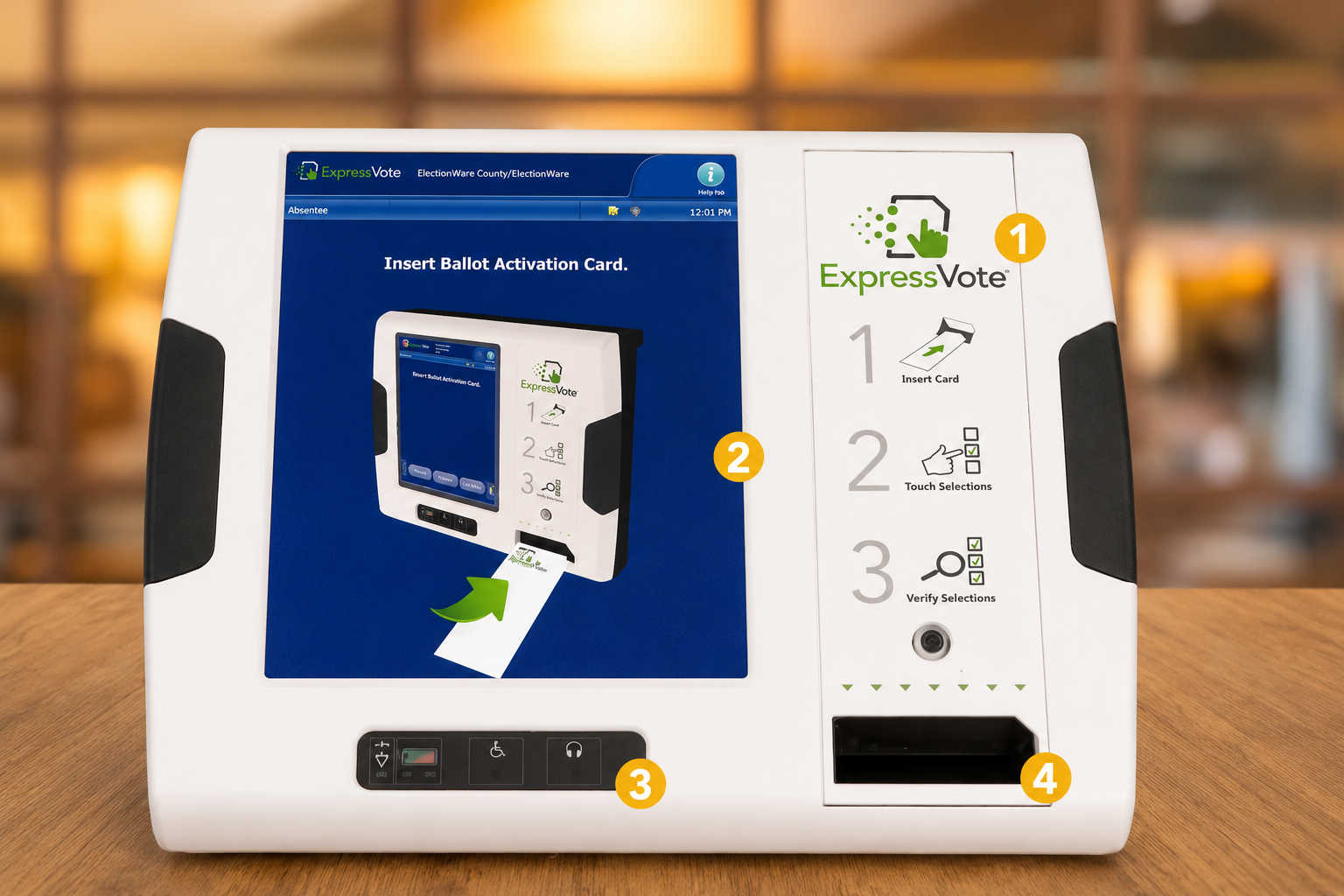
The Supervisor of Elections warned of potential “inconsistent results and increased human error” tied to hand-counting. She defended the current system, including use of the ExpressVote machine and DS200 tabulator, arguing that it promotes voter confidence and has been “carefully developed, tested, and proven to ensure elections that are lawful, reliable, and tested.”
Board of Elections Chairman Raymond Williams did not place an official position on the record, explaining that the board had not been able to meet since the amendment was shared Wednesday afternoon. The board had objected to the original version of the legislation.
Lawmakers agreed that both the Office of the Supervisor of Elections and the Board of Elections should be given time to review the substitute amendment before the bill is brought to a vote.
Still, discussion on the proposal continued and grew heated at times, with supporters and opponents remaining firm in their positions.
Ms. Fawkes told Senator Novelle Francis that operating both electronic tabulation and hand-counting at the same time would be “confusing.” She also told Senator Carla Joseph that hand-counting would be less efficient, more costly and require additional space.
According to Ms. Fawkes, approximately 30 percent of voters currently request paper ballots. Under the existing process, those physical ballots are fed into the DS200 machine for electronic tabulation. She said there is no available data showing how many voters would prefer to have their ballots counted by hand.
Senator Alma Francis Heyliger raised questions about the cost of facilitating hand-counts, asking whether the Office of the Supervisor of Elections had calculated what would be required.
Using elections as a baseline, Ms. Fawkes estimated the cost at “nearly $50,000.” She said previous recounts required five board members in each district. “Each clerk will be $250 to do that work a day, and it takes a number of days to do hand counting,” she explained. Ms. Fawkes also cited additional expenses, including feeding workers and “electricity.”
Senator Johnson rejected that estimate. In a pointed response to the opposition, he said “it's very irresponsible to make people believe they gonna cost you $50,000 to count maybe 20 ballots, 50 ballots.”
“We're making it sound today like as if hand ballots was the most corrupted thing in this territory,” he said, adding that several states conduct hand-counting.
Mr. Johnson argued that Virgin Islanders are losing confidence in the electoral process and pointed to what he described as a decline in the number of votes needed to be elected senator, saying the benchmark had dropped by 2,000. Mr. Williams attributed any potential decline in voter turnout to a shrinking population.
“Anything that we can do to bring more people to the poll, we should be willing to do,” Senator Johnson declared. “When you listen to them, they say, I ain't going back to the poll because I don't think my vote is being counted. I ain't going back to use that machine, because I don't trust that machine,” he told Ms. Fawkes.

The meeting ended without a resolution. Bill No. 36-0187 was held in committee, and testifiers were encouraged to review the substitute amendment and provide additional recommendations.