



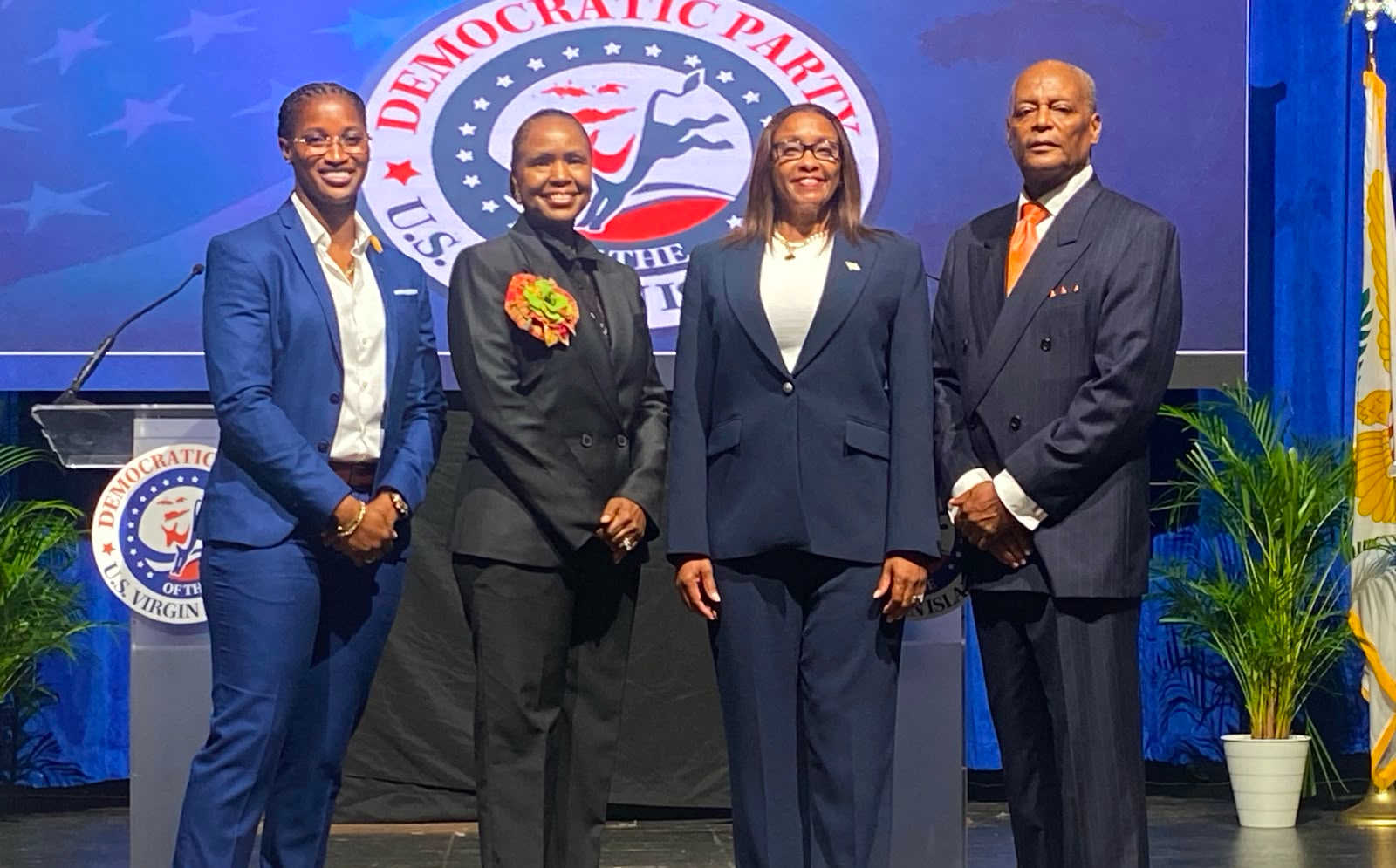
The four candidates seeking the Democratic Party’s nomination for Delegate to Congress offered competing approaches to healthcare funding, economic development, disaster recovery, federal oversight and the Water and Power Authority during the second of three primary debates.

Janelle Sarauw, Delia Smith, Terri Helenese and Emmett Hansen also discussed taxation, territorial-federal relations, education funding and how a non-voting delegate can increase the Virgin Islands’ influence in Washington.
Moderator Merlisa George maintained reasonable control over a boisterous audience while working to keep exchanges among the candidates cordial.
The debate began with a question to Ms. Sarauw about her 10-year vision for the Virgin Islands.

“We are at the crossroads between change and stagnation, crisis and opportunity," she responded.
Ms. Sarauw said she would seek a close relationship with the territorial executive and federal agencies to help ensure that federal funding is administered efficiently and effectively. She also called for the maximum use of St. Croix’s south shore as an economic engine for the island and the wider territory.
Ms. Smith agreed with that position. During his rebuttal, Mr. Hansen added that “we need to build the Virgin Islands from within,” while Ms. Helenese agreed that effective relationships with federal partners are necessary to ensure money flows efficiently into the territory.
Ms. Smith was asked how a congressional delegate could produce results for the Virgin Islands without voting power on the House floor. She defined success as building strong relationships and cited the bipartisan support she received for her appointment as U.S. Attorney for the Virgin Islands.
Ms. Sarauw noted that territorial delegates can vote in committees and therefore have opportunities to exercise influence. She said she would measure the success of a first term by whether she had built alliances with the other U.S. territories, as well as Alaska and Hawaii.
Mr. Hansen emphasized the importance of maintaining a close relationship with the territory’s next governor so that local and federal efforts could be coordinated. Ms. Helenese said her success during a first term would be measured by efforts to eliminate federal Medicaid caps.
Economic diversification was also a major topic.
Ms. Helenese advocated for the establishment of a feed mill on St. Croix as one way to support agriculture and diversify the economy.
“We bring in more food than we grow, so a feed mill produces and supports our farmers with minerals and nutrients,” she declared.
Ms. Sarauw emphasized the development of the St. Croix free trade zone as a strategy for economic growth and diversification.
Ms. Helenese agreed, noting that work toward that goal was already underway. She also proposed expanding eligibility for rum-cover-over returns to spirits other than rum to encourage increased production of those products.
Later in the debate, Mr. Hansen disclosed that he already had legislation prepared to make the suggested change.
The candidates offered different assessments of the territory’s healthcare challenges and the adequacy of federal funding.
Mr. Hansen acknowledged that Virgin Islanders face high healthcare costs while receiving limited returns.
“We don’t get what we deserve for Medicaid, Medicare, SSI,” he declared.
He said federal healthcare spending and the “double duty” issue should be addressed as priorities.
Ms. Helenese again focused on eliminating the cap on federal Medicaid spending in the Virgin Islands. Ms. Sarauw argued that hospital reimbursement rates urgently need to be updated and said the territory should benefit from prescription drug reforms from which it had previously been excluded.
Ms. Smith maintained that healthcare funding was available but that resources provided to the territory were being wasted.
Ms. Helenese rejected that assessment, arguing that healthcare funding is exhausted each year because it is insufficient to meet the territory’s needs.
“We need to rebase our hospitals. We need to strike 1108. That is the culprit here,” she declared.
The discussion then moved to federal education funding.
Ms. Sarauw said a significant amount of federal money provided for education is returned. She attributed the problem to “bottlenecks” and promised to conduct quarterly meetings with local commissioners to understand their frustrations and identify ways to reduce friction within the federal system.
Mr. Hansen said territorial authorities must improve their efficiency.
“It’s about time that we…get our act together and stop missing these deadlines,” he declared.
Ms. Smith suggested that more federal assistance was needed in the area of oversight. Ms. Sarauw disagreed, arguing that local agencies were already subject to extensive federal scrutiny.
“Education is under a third-party fiduciary. We have consent decrees left, right and center,” she rebutted, drawing raucous applause from the audience.
After bringing the crowd back under control, Ms. George asked Ms. Smith about disaster preparedness in the Virgin Islands.
Ms. Smith identified deficiencies in proactive planning and preparation as the territory’s primary challenge.
“We cannot and have not developed established records that show that the value of our losses are,” said Ms. Smith, arguing that the lack of documentation was driving FEMA delays.
Ms. Sarauw advocated for a disaster equity act that would ensure territories receive equal treatment in the distribution of disaster funding.
Ms. Smith responded that the Virgin Islands “received 100% reimbursement for the majority of the projects and the losses that we suffered” following the last two Category Five hurricanes.
“The issue is preparedness and being able to demonstrate where our losses are, so that we can in fact move the recovery,” she insisted.
The candidates also discussed their leadership styles and how they would increase the territory’s visibility and influence in Washington.
Ms. Sarauw proposed engaging the large Virgin Islands diaspora populations in Texas, Florida and other mainland jurisdictions. She said those residents could use their electoral power to influence the congressional representatives serving their districts.
Ms. Helenese cited her existing work as the governor’s representative in Washington, D.C., as evidence of her ability to work across party lines.
Mr. Hansen pointed to his previous experience as a Virgin Islands legislator, including his work with a representative from Hawaii to resolve an issue involving tenant councils in the territory.
The debate later turned to WAPA.
Ms. Helenese pledged to secure “as much money as possible” to strengthen the authority.
“Just call me the queen of pork,” she declared.
Other candidates focused instead on the need for stronger internal controls and more effective management.
“The problem with WAPA is not a lack of funding. It’s a lack of planning. It’s a lack of brains,” Mr. Hansen declared, pointing to what he described as a lack of accountability within the utility.
During the candidate-to-candidate questioning portion, every question was directed to Ms. Sarauw. Mr. Hansen did not participate in that segment.
Ms. Sarauw acknowledged the challenge during her closing remarks, addressing “discussion about me being being…unfit and confrontational.”
Referencing the recently observed Emancipation and Independence holidays, she defended confrontation as sometimes necessary to bring about political and social change.
“Emancipation would not happen without confrontation….Democracy requires…good trouble.”

The candidates largely did not avoid confrontation Thursday as they sought to persuade Democratic voters ahead of the August 1 primary election.