

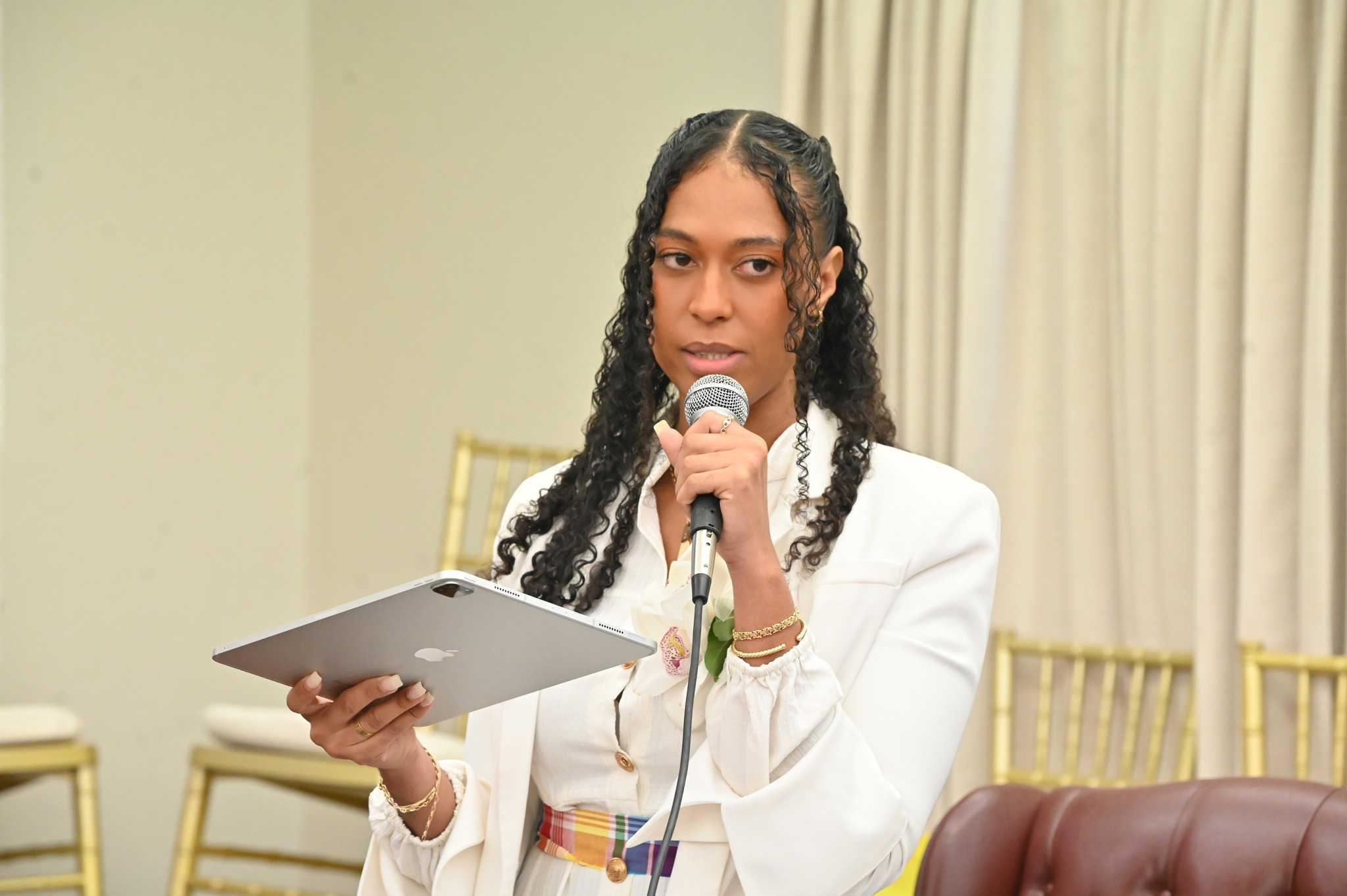
ST. THOMAS — Independent candidate Imani Daniel emerged as the leading vote-getter in Tuesday's St. Thomas–St. John senatorial election, heading a field of seven projected winners that includes three candidates associated with TheFuture political movement, four returning incumbents and three newcomers, according to combined unofficial results released by the Elections System of the Virgin Islands.

Daniel secured 4,516 votes, narrowly defeating incumbent Senator Alma Francis Heyliger, who finished second with 4,460. Senator Avery Lewis, the leading candidate in the August Democratic primary, placed third with 4,405 votes.
The results represent a significant breakthrough for TheFuture, a political action movement that organized candidates across party lines around a platform emphasizing government accountability, affordable housing, electricity reform and economic opportunity.
Alongside Daniel, two other candidates affiliated with the movement secured positions among the district's top seven: Democratic candidate Rudel A. Hodge Jr., who placed fifth with 3,794 votes, and independent Dr. Sennai Habtes, who finished sixth with 3,598.

Incumbent Senators Marvin Blyden and Carla Joseph also secured reelection, finishing fourth and seventh, respectively.
The outcome leaves the St. Thomas–St. John District with four returning senators and three first-time members entering the 37th Legislature in January.
It also represents an electoral setback for incumbent Senators Dwayne DeGraff and Ray "PuPa" Fonseca, both of whom finished outside the seven winning positions.
DeGraff placed ninth with 3,140 votes, while Fonseca finished eleventh with 2,519.
The seven projected winners comprise four Democrats and three independents. The results remain unofficial pending the Elections System's required canvass and certification.
Daniel moves from third in early voting to first overall
One of Tuesday's most notable developments was Daniel's performance on Election Day, which allowed her to overtake two incumbent senators who had finished ahead of her in early voting.
Lewis initially led the district with 2,851 early votes, followed by Francis Heyliger with 2,747 and Daniel with 2,732.
The rankings changed when the Elections System released the Election Day results.
Daniel collected another 1,784 votes, the highest Election Day total among the district's 20 senatorial candidates.
Francis Heyliger received 1,713 Election Day votes, while Lewis secured 1,554.
When both reports were combined, Daniel moved into first place with 4,516 votes, finishing just 56 ahead of Francis Heyliger and 111 ahead of Lewis.
The first-place finish is particularly significant for Daniel, who entered the race as an independent without previous service in the Legislature.
Her victory places a political newcomer at the top of a field that included several experienced incumbents, former public officials and candidates who had previously sought legislative office.
Daniel's professional background includes nonprofit leadership, disaster recovery work, community development and service as a delegate to the Sixth Constitutional Convention of the Virgin Islands.
According to her official campaign website, she centered her candidacy on modernizing government systems, strengthening community infrastructure, improving disaster preparedness, expanding workforce opportunities and pursuing constitutional reform.
Daniel also advocated for stronger accountability mechanisms within the territorial government, including changes to oversight institutions and the structure of public administration.
Her first-place finish gives her a prominent electoral mandate as she prepares to enter the Legislature, although committee assignments and legislative leadership positions will be determined after the incoming senators organize.
TheFuture emerges as an organized political force
Beyond Daniel's individual performance, Tuesday's results marked a substantial electoral breakthrough for TheFuture, whose candidates competed for seats in the Legislature and on the Board of Elections.
The movement, which describes itself as a community-rooted, ethics-focused political coalition, brought together candidates from different political affiliations under a shared reform agenda.
Its published platform calls for independent oversight of the Water and Power Authority, investments in renewable energy, expanded affordable housing, protection of local land ownership, improvements to education and healthcare, and greater opportunities for Virgin Islands businesses.
Unlike a traditional political party slate, TheFuture's candidates did not all appear under the same party designation.
Daniel and Habtes ran as independents, while Hodge entered the election as a Democrat.
Daniel and Hodge are identified as co-founders of the movement, while Habtes appeared among the candidates it supported.
During an October 26 League of Women Voters candidate forum broadcast by WTJX, Daniel publicly described the coalition and named its participating candidates.
"I'm also running with a group of candidates called The Future," she said.
"We are nonpartisan," Daniel added, explaining that the movement included Vernon Araujo, Habtes, Hodge, senator-at-large candidate Hadiya Sewer and Board of Elections candidate Raven Phillips.
"And we came together because we think a coalition that is values-based is what the Virgin Islands needs," she said.
Tuesday's unofficial results suggest the coalition achieved considerable electoral success.
In addition to Daniel, Hodge and Habtes securing positions among the projected St. Thomas–St. John Senate winners, Sewer defeated incumbent Senator Angel Bolques Jr. in the territory-wide senator-at-large contest.
Sewer received 9,809 votes compared with Bolques's 6,204.
Phillips also led the St. John Board of Elections contest, collecting 3,458 votes against 2,057 for Democratic candidate Preston Evans.
The movement's other St. Thomas–St. John senatorial candidate, Vernon Araujo, finished tenth with 2,575 votes.
Taken together, the unofficial returns place five candidates associated with TheFuture in winning positions across three elected bodies.
Those gains provide the movement with an opportunity to influence legislative discussions and public policy, although the candidates will still have to build working relationships with other officeholders to advance their proposals.
The election results demonstrate significant support for the movement's candidates but do not establish the motivations of individual voters.
Hodge and Habtes bring new professional backgrounds
Hodge's election adds an attorney and constitutional convention delegate to the St. Thomas–St. John legislative delegation.
A graduate of Charlotte Amalie High School, Hodge earned his undergraduate degree from Binghamton University and a law degree from Florida International University College of Law.
He is admitted to practice law in New York and the Virgin Islands and has served as a delegate to the territory's Sixth Constitutional Convention.
During his campaign, Hodge emphasized the importance of creating economic opportunities that would encourage Virgin Islanders to remain at home or return after completing their education.
His proposals included modernizing the territory's digital economy, strengthening financial services, improving government operations and supporting constitutional reform.
Hodge also proposed establishing a legislative committee focused on technology and the modernization of public systems.
He entered the general election after placing fourth in the Democratic primary with 1,690 votes, according to the Elections System's certified results.
His general-election performance significantly expanded that support, bringing his total to 3,794 votes and placing him fifth overall.
Habtes, meanwhile, brings a background in marine science, government administration and environmental resource management.
A St. Thomas native, Habtes earned advanced qualifications in oceanography and served as chief of fisheries within the Department of Planning and Natural Resources. His professional experience also includes teaching and research at the University of the Virgin Islands.
According to his campaign platform, Habtes advocated for evidence-based policymaking, reducing government bureaucracy, strengthening natural resource management and developing economic opportunities beyond the territory's traditional industries.
His proposals included expanding opportunities in agriculture, renewable energy, aquaculture, manufacturing and the broader blue economy.
Habtes also argued that territorial agencies require stronger administrative systems and appropriate authority to carry out their responsibilities effectively.
The independent candidate finished sixth with 3,598 votes, placing him among the three newcomers who will join the district's legislative delegation.
The election of Daniel, Hodge and Habtes introduces three candidates with experience in nonprofit management, law, constitutional reform, science and government administration.
Their electoral success also gives TheFuture a legislative presence that extends beyond a single candidate or political party.
Four incumbents retain seats
While the election introduced three newcomers, voters also returned four sitting senators to the Legislature.
Francis Heyliger led the returning incumbents with 4,460 votes, finishing second overall and narrowly missing first place.
The independent senator has served in the 34th, 35th and 36th Legislatures and will return for another term following a campaign emphasizing her legislative record and continued government oversight.
Before entering politics, Francis Heyliger developed a background in business and community organizations. She is also the owner of Radio One, AM 1000, and previously served as president of the Independent Citizens Movement.
Lewis, the current Senate secretary, finished third with 4,405 votes.
A former educator and labor leader, Lewis has been involved in public administration, workforce development and advocacy for government employees.
He led the district's Democratic primary with 2,897 certified votes, ahead of fellow incumbents Blyden and Joseph.
Although Daniel and Francis Heyliger surpassed him in the general election, Lewis comfortably retained his seat.
Blyden secured fourth place with 3,880 votes, continuing a legislative career that has included work on housing, government operations, infrastructure and social services.
During the campaign, Blyden emphasized his record of constituent services and legislative advocacy, arguing that elected representatives should be evaluated on their willingness to respond to residents' needs.
Joseph finished seventh with 3,431 votes, securing the final projected winning position.
The Democratic senator has served in the Legislature on matters involving government oversight, public administration and the territory's relationship with federal agencies.
Her reelection was less comfortable than those of the other incumbents, with the seventh-place position separated from the next candidate by fewer than 200 votes.
Together, Francis Heyliger, Lewis, Blyden and Joseph will provide the incoming delegation with substantial legislative experience, while the three newcomers introduce different professional perspectives.
DeGraff and Fonseca lose reelection bids
The most significant defeats among sitting senators were those of DeGraff and Fonseca, both of whom had served in the 36th Legislature.
DeGraff, an independent, entered the general election seeking another term after years of legislative service.
He received 2,072 votes during early voting, placing eighth at that stage of the count.
Another 1,068 votes on Election Day brought his total to 3,140, leaving him ninth overall.
Fonseca, a Democrat who currently serves as the Legislature's liaison to the United States Congress, also failed to retain his seat.
He received 1,539 early votes and another 980 on Election Day, finishing eleventh with 2,519.
Fonseca's defeat was particularly notable because he had successfully advanced through the Democratic primary, placing sixth among the party's seven nominees.
His general-election performance, however, was not enough to overcome the broader field of independent candidates and other Democratic contenders.
Two other Democrats who advanced through the August primary also finished outside the winning group.
Shenelle Fina Francis placed eighth with 3,245 votes, while Joel Browne Connors finished twelfth with 2,276.
Francis came closest to securing a seat among the unsuccessful candidates, trailing Joseph by 186 votes.
Her position was strengthened by 1,265 Election Day votes, allowing her to move ahead of DeGraff, but the additional support was insufficient to reach seventh place.
The margin remains subject to the counting and review of any outstanding eligible ballots. The reports released Tuesday do not establish how many absentee or provisional ballots remain to be included in the final certified results.
Potter's departure opens another seat
The composition of the incoming delegation also reflects Senate President Milton Potter's decision not to seek reelection to the Legislature.
Potter instead ran for lieutenant governor alongside Delegate to Congress Stacey Plaskett on the Democratic ticket.
The pair secured a commanding majority in Tuesday's gubernatorial election, positioning Potter to move from the Legislature to the executive branch in January.
His departure, combined with the defeats of DeGraff and Fonseca, accounts for the three changes in the district's Senate membership.
The incoming St. Thomas–St. John delegation will consist of Democrats Lewis, Blyden, Hodge and Joseph, and independents Daniel, Francis Heyliger and Habtes.
That distribution differs from the outgoing delegation, which included five Democrats and two independents.
It also demonstrates how an organized movement spanning party affiliations was able to place candidates among the winners without operating exclusively through one party.
New legislative term begins in January
The seven St. Thomas–St. John senators will serve alongside seven senators from St. Croix and the senator-at-large in the 37th Legislature of the Virgin Islands.
Under the Revised Organic Act, senators serve two-year terms beginning on the second Monday in January following their election.
The incoming Legislature is therefore scheduled to begin its term on January 11, 2027.
The Elections System has scheduled certification of the general-election results for November 13, following the required canvass and review of outstanding ballots.
The new senators will enter office as the Virgin Islands prepares for an administration headed by Governor-elect Stacey Plaskett and Lieutenant Governor-elect Milton Potter.
Among the most pressing issues awaiting lawmakers are the reliability and affordability of electricity, government finances, healthcare, housing, public safety, education and economic development.
For the district's returning senators, those issues represent continuing responsibilities from previous legislative terms.
For Daniel, Hodge and Habtes, they will provide an early test of the reform agenda promoted during their campaigns.
And for TheFuture, Tuesday's results represent a significant electoral achievement, placing three affiliated candidates in the district's top seven while delivering victories in other territorial contests.
Daniel's first-place finish, by just 56 votes over Francis Heyliger, adds another notable dimension to that success.

The final composition of the delegation remains subject to certification, but the unofficial results point to a changing political landscape in the St. Thomas–St. John District, where established legislative experience will meet a new group of candidates organized around promises of structural reform.