




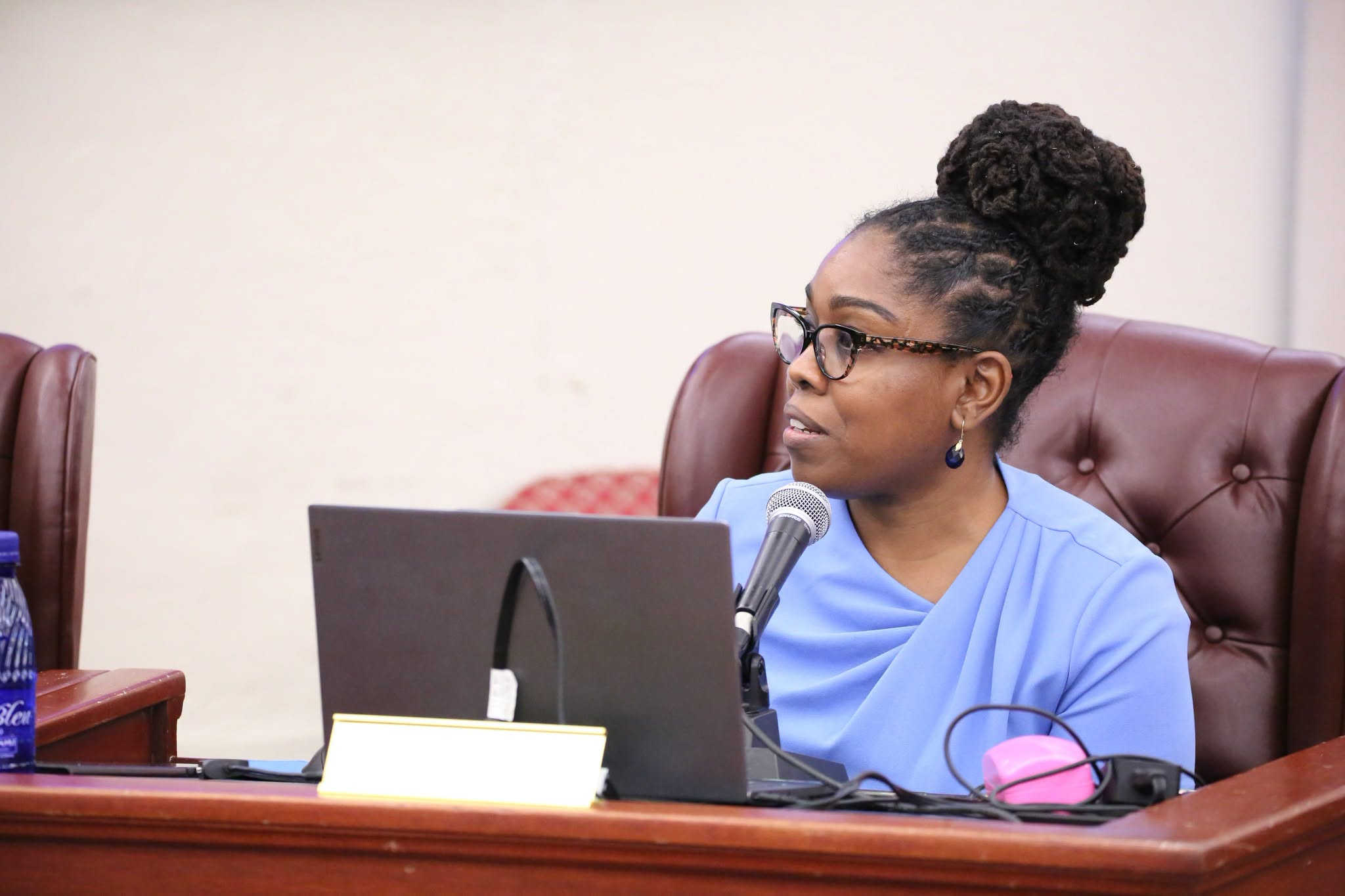
The Virgin Islands Board of Career and Technical Education is asking lawmakers for a major increase to its Fiscal Year 2027 budget, saying its recommended $689,681 allocation falls nearly $2 million short of what is needed to support career and technical education programs across the territory.
Appearing before the Committee on Budget, Appropriations, and Finance on Tuesday, Executive Director Genevieve Whitaker said the Board’s total programmatic needs amount to $2,654,168. The resulting funding gap, she said, is $1,964,000.
Ms. Whitaker said she is hopeful the Legislature will help close that gap.
The Board documented program needs through a series of surveys across the territory and attached costs to those needs. The listed items include $300,000 for textbooks, $100,538.97 for Information Technology/Engineering and National Center for Construction Education and Research tool packages, $176,596.36 for building and mechanical trades equipment and supplies, and $250,000 for Virtual Reality, or Transfr, expansion.

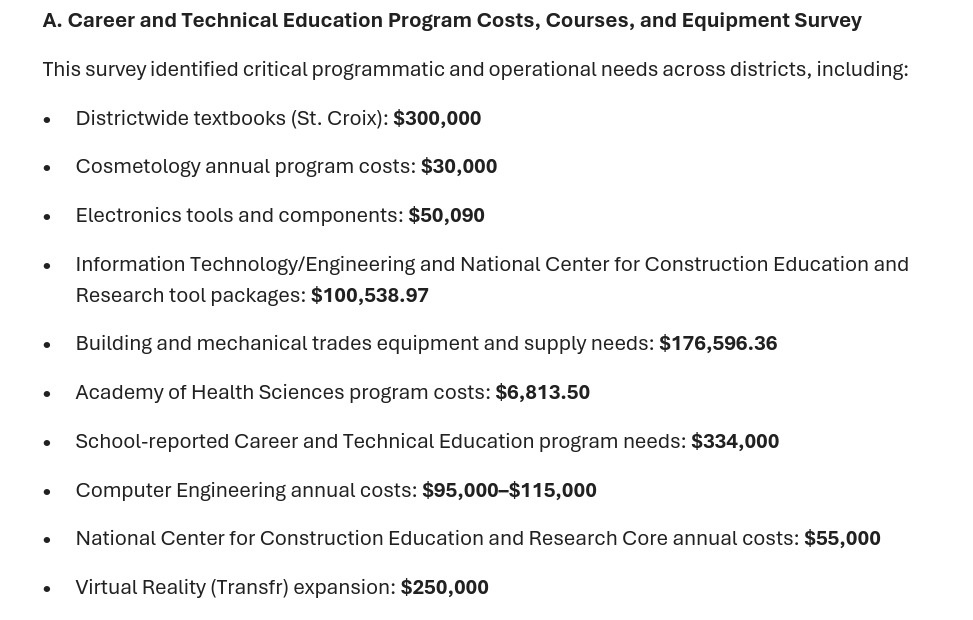
A survey conducted by the Board of Career and Technical Education identified programmatic needs and associated costs, as outlined in Ms. Whitaker’s testimony.
According to Ms. Whitaker, the documented needs identified through the survey findings “demonstrate that current funding is insufficient to sustain program delivery at the level required for students to succeed.”
She said additional funding would allow the Board to “strengthen program quality, expand student access, and build a more coordinated and effective Career and Technical Education system.”
Ms. Whitaker also told lawmakers that the Board has spent $451,258.78 in operational costs to date. With most spending "largely allocated to core operational and administrative functions,” she said the Board has limited resources to “fully support program expansion, student engagement activities, and the broader instructional and workforce development needs identified in survey findings.”
She told Senator Novelle Francis Jr., the committee’s chairperson, that the identified costs reflect “all the unmet needs for just some of our CTE programs.”
“If we were to really support even some of the programs, that number will really need to be increased,” Ms. Whitaker added.
Senator Kurt Vialet, however, said the Board had not “justified” the request for an additional $1.9 million. He noted that most of the Board’s programs are funded through the Department of Education and referenced specific items such as the Academy of Health Science Program.
Ms. Whitaker responded that “these are areas that are unfunded.”
The figures outlined by Ms. Whitaker during testimony do not add up to the $1.9 million funding gap she referenced. Instead, they total just over $1.4 million. She later told Senator Vialet that the request includes funding for existing programs and needs, as well as new programs.
“It’s a mixture,” she said.
Ms. Whitaker also said the $1.9 million request includes $600,000 for a special fund called the Lena Schulterbrandt Fund. “Between those costs and other costs…we’ll get up to that,” she told Senator Ray Fonseca.
Senator Vialet described the request as a “big ask.”
Ms. Whitaker said that if funding levels reflected the territory’s actual needs, students would be able to participate in competitions and practical exercises. She said the Board is at a “stalemate” because students cannot travel to conferences or competitions.
Using the construction sector as an example, Ms. Whitaker told Senator Hubert Frederick that “if we don’t properly fund CTE, we continue to have a basically lower and lower graduation rate of students being certified enough to be able to participate in our construction projects.”
“We're talking about a lot more money, but for right now, for our need to rebuild our territory, we will need to increase the funds in order to rebuild the territories,” she later stated.
Ms. Whitaker maintained that funding career and technical education is a “strategic investment.”

Senator Fonseca indicated that he was open to reviewing the request. “I personally would like to see what we can do to provide… I looked at it, and they're good items,” he said.