

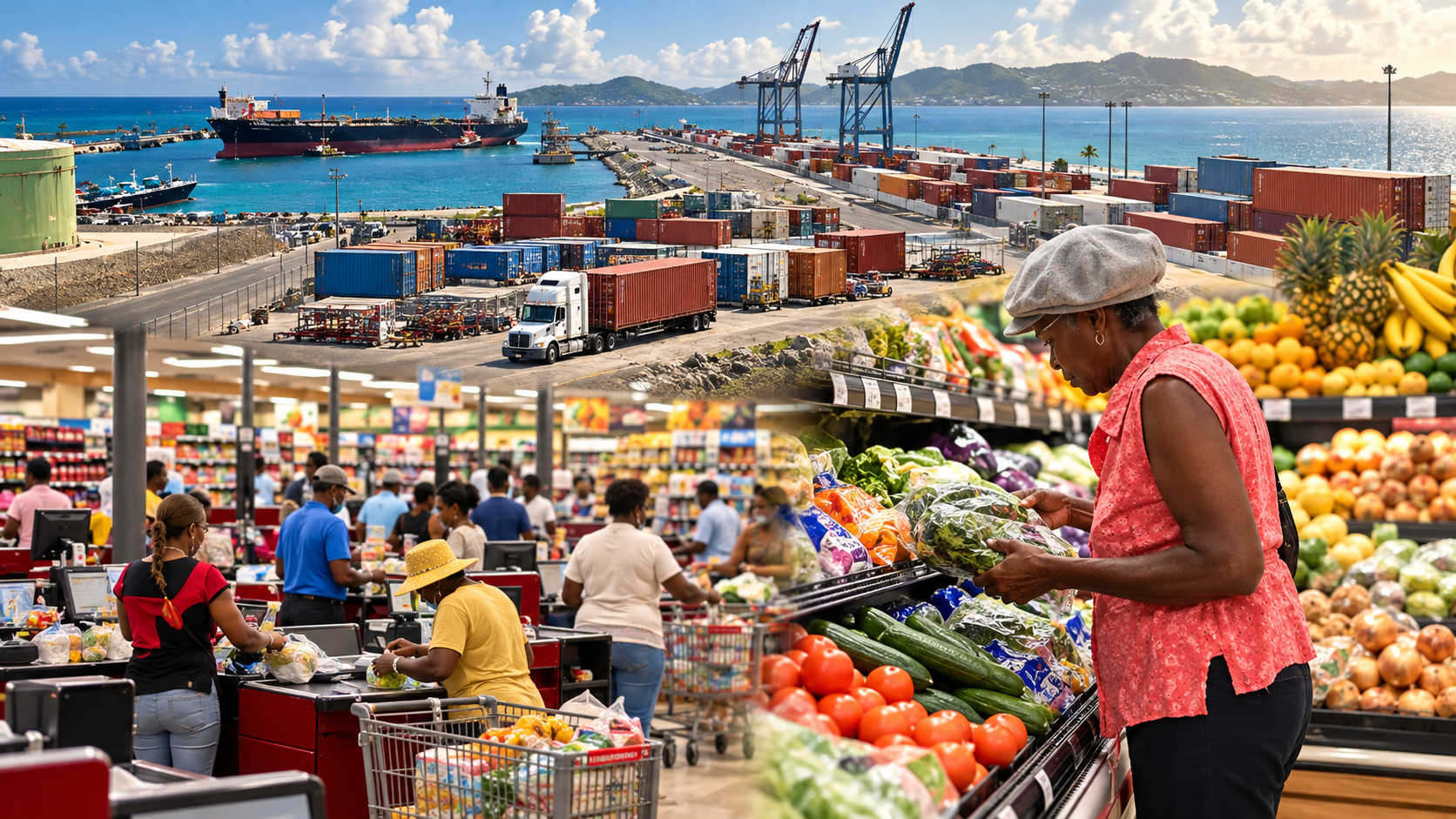
A hefty import bill, inflation, and an exorbitant cost of living are among the pressing challenges burdening both the average Virgin Islanders and the Territory’s economy. While recovery projects and other opportunities for revenue collection could prove beneficial, it’s a longer term measure that won’t result in immediate relief for everyday citizens.

On Tuesday, representatives of the Bureau of Economic Research appeared before the Committee on Economic Development and Agriculture to discuss the Territory’s economic outlook.
According to Senior Project Analyst Bernesha Liburd, while inflation in the USVI has slowed to “approximately 5.7% by July 2026”, it remained above the U.S inflation rate of 3.4%. Ms. Liburd drew the connection between those figures and the “unique affordability challenges faced by residents.”
She maintained that the trends “reinforce the importance of policies that promote housing affordability, workforce development, economic diversification, and long-term financial resilience.”

Meanwhile, the Territory’s 2025 import bill totaled $3.62 billion in both goods and services. Of that amount, food imports accounted for $168 million. Exports of goods and services, on the other hand, reached $2.6 billion in 2025.
BER believes that operationalizing the oil refinery will “significantly boost exports and improve the economic and financial position of the Territory,” per Ms. Liburd. The Bureau acknowledges that reopening the refinery is “somewhat controversial.”
The Territory’s high import bill troubled Senator Angel Bolques Jr., who suggested a surcharge on online purchases. “Even if it was a flat rate of $1 on $3.62 billion. You know what $3.26 billion can do for these Virgin Islands?” he asked. According to Senator Bolques, a revenue generation measure like a surcharge could ensure the Territory’s “survivability.”
Director Davies agreed that it would “improve our collections and our revenues significantly” and would “help to address our structural deficit.” He also ventured that an additional $3 billion would help pay “appropriate” salaries, attract workers, and create a massive multiplier effect.
The $3.62 billion figure represents the value of goods and services imported, not the number of online purchases that would be subject to a $1 fee. It therefore does not establish how much revenue the proposed surcharge would generate.
But for now, it’s a hypothetical, and long-term dream of both Senator Bolques and Dr. Davies.
The testimony provided by BER, however, offered a more realistic and medium-term approach.
Dr. Davies told the committee the outlook for 2027 is “cautiously optimistic.” He hopes projected gross receipts taxes of $31.2 million in 2026 and $36.7 million from disaster recovery spending in 2027 will “help provide a platform for a soft economic landing at the end of the cycle.”
Based on planned disaster recovery projects, Dr. Davies said the Territory is expected to see both increased revenue collection and increased circulation.
Still, he advised the Legislature that the economy stands to benefit from improved revenue collection through updated property taxes, local tax collection, and “improved GVI BUY processing.” These actions would better enable the government to make timely vendor payments, increase salaries, attract more talent to the public sector, and “further improve government effectiveness.”
Dr. Davies acknowledged the challenges with GVI BUY, but remained confident that “we foresee going forward that once all of the kinks have been worked out, that will create greater efficiency.”
Senator Marise James agreed that property taxes need to be revised, noting that they have not been evaluated in over a decade. Property owners, she said, “will only pay what we bill them. So it's not their fault; it's our fault, the Government of the VI.”
Dr. Davies also recommended that semiautonomous agencies take “calculated steps” to “strategically monetize their assets, collections, and fundraising to ease dependence on the general fund for operations.”
He said, as well, that the “proliferation of boards, commissions, bureaus, and other instrumentalities must be reviewed to provide for a more effective, efficient, and productive government.”
Senator Hubert Frederick, the committee’s chair, has indicated his intention to introduce legislation to address the “accountability with these instrumentalities that's been giving us so much problems.”

The Territory, said Dr. Davies, must expand its efforts to “again being the mecca of the region, by attracting and growing businesses, fostering private sector investment, investing in natural resources, expanding the blue economy, and implementing and amending policies, rules, and regulations that lead to sustained growth and prosperity…”